Get Full Government Meeting Transcripts, Videos, & Alerts Forever!
Get email alerts on the Child Welfare topic
No spam. Unsubscribe anytime.
Committee hears strong opposition to bill requiring drug tests before unsupervised parent–child visits
Summary
Law enforcement, child‑welfare directors and public‑defense counsel warned against a bill that would mandate drug testing before unsupervised visitation in cases where a controlled substance contributed to out‑of‑home placement, citing vagueness, cost, access and constitutional concerns.
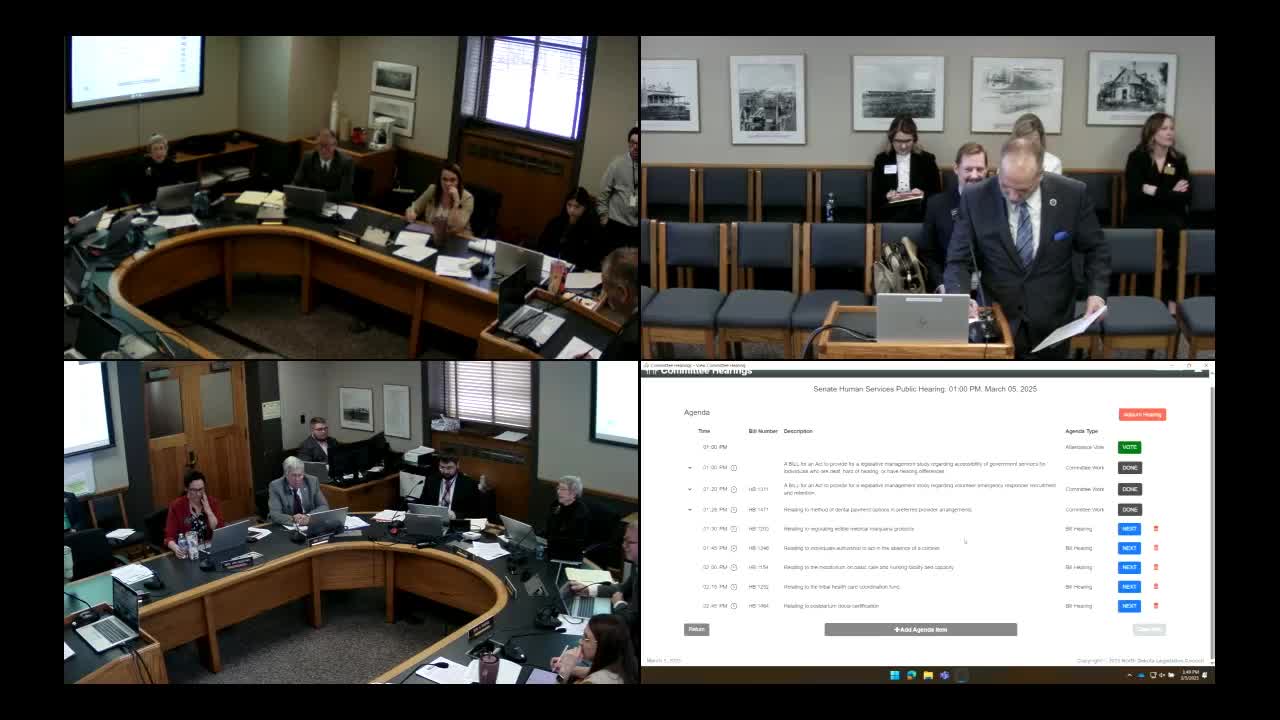
The Senate Human Services Committee heard extended opposition testimony to House Bill 12 68, a proposal that would require drug testing before unsupervised parent–child visits in child‑welfare cases where a controlled substance contributed to removal.
Travis Fink, executive director of the Commission on Legal Counsel for Indigents, told the committee the bill, as drafted, is vague about what chemical tests would be required and what test methods would satisfy the obligation. “This bill does not identify what that testing would be,” Fink said, warning that different tests (urine, blood, hair) measure different exposure windows and raise different legal and constitutional issues. Fink also expressed concern about equal‑access problems if an appropriation for testing is exhausted and indigent parents cannot pay for required screens.
Kim Jacobson, director of Agassiz Valley Human Service Zone and president of the North Dakota Human Service Zone Directors Association, told the committee she opposed the bill for operational and legal reasons. Jacobson argued that drug testing is a point‑in‑time tool and is not itself a safety plan; safety planning and reunification planning are distinct processes that require a range of measures and flexibility. She said one size‑fits‑all testing requirements could increase legal liability and might not be workable in rural areas where certified testing providers are far away.
Kelsey Bless, policy administrator for Children and Family Services, said the department has drafted a statewide policy for how drug testing is used in child‑welfare cases and will release it in April; she urged using consistent policy and training rather than a statutory mandate that could be inflexible and risk unintended legal consequences.
Concerns raised by witnesses included: - Vagueness: the bill’s phrasing — including references to “a chemical substance” — could be legally unclear; type of test (hair vs urine vs blood) affects interpretation and admissibility. - Access and equity: if state funds for testing are limited, wealthier parents could pay privately for tests while indigent parents could not, creating unequal access to reunification steps. - Legal and due‑process risk: witnesses warned that treating a positive test as an automatic barrier to unsupervised contact could trigger constitutional challenges or create civil‑liability risk for counties and zones.
Committee outcome: The committee took the testimony; no vote on the bill was recorded during this hearing. Several senators asked follow‑up questions and requested additional information about how other states handle similar requirements.
Ending: Committee staff and legislators signaled interest in further review; department and zone officials said they would continue working with lawmakers on consistent statewide policy guidance.