Get Full Government Meeting Transcripts, Videos, & Alerts Forever!
Get email alerts on the Education topic
No spam. Unsubscribe anytime.
Bill would require schools used as polling places to cancel classes or separate students on election days
Summary
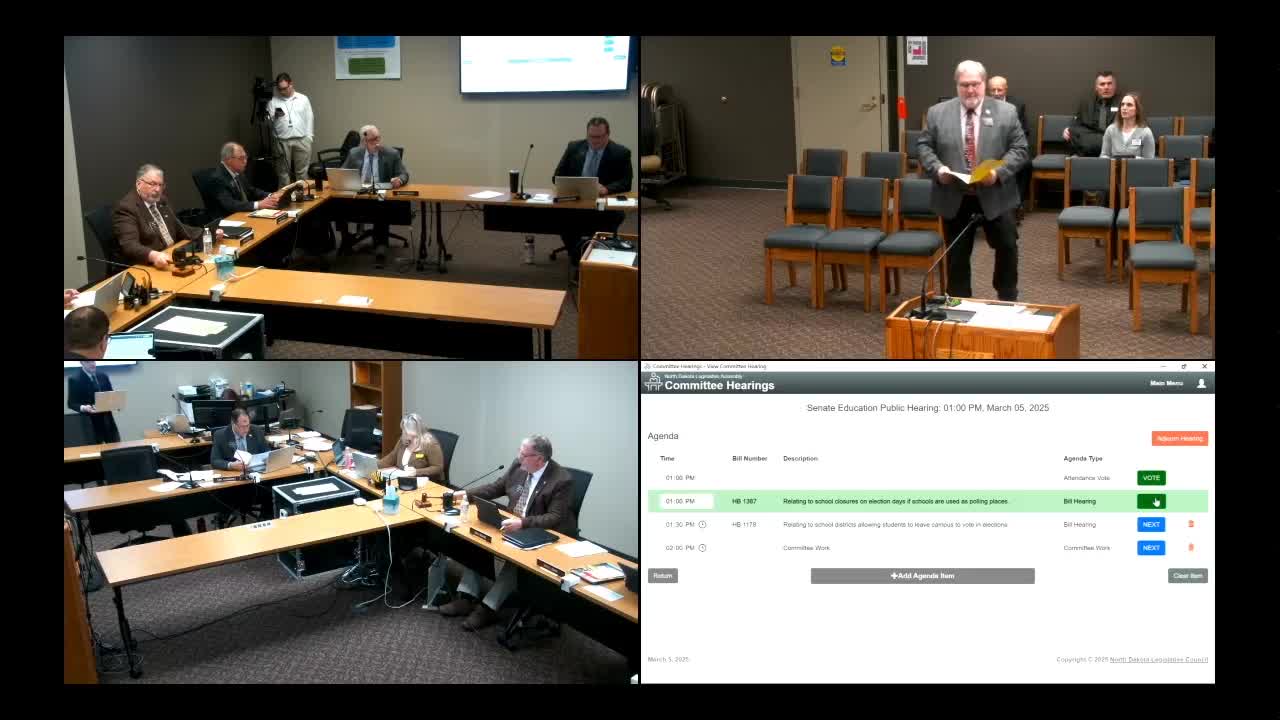
The Senate Education Committee heard testimony on House Bill 1387, which would require districts to cancel classes or ensure distinct separation between students and voters when a school building is used as a polling place.
Calling the Senate Education Committee back to order, the panel took testimony on House Bill 1387, a proposal that would require school districts to either cancel classes or ensure there is no opportunity for contact between students and voters when a school building is used as a polling place.
Representative Pat Heinert, District 32, told the committee the measure was intended to "protect our kids on election days." He described visiting a Bismarck elementary school on election day and seeing students and voters using adjacent spaces and said the bill language requires schools to "shall cancel classes or separate students to ensure there is no opportunity for student contact with a voter." He told committee members his concern grew after his daughter raised the issue and after he observed one school with about 482 students while roughly 1,800 people voted there during school hours.
Amy DeCook, executive director of the North Dakota School Boards Association, said the association supports the bill as amended by the House Education Committee because the amendment allows a school to either cancel classes or separate students from voting activities. "With that change in the bill, our members would be supportive of it," she said, and added that most school elections take place in summer but that special elections during the school year may require adjustments.
North Dakota Secretary of State Michael Howe testified from a neutral position and supplied data the committee asked for: in the November election there were 171 polling locations statewide and nine of those were in school buildings; eight of the nine were in Burleigh County. Howe said counties choose polling locations and the secretary of state's office provides guidance on accessibility and other factors but does not select local polling sites.
Committee members asked whether canceling classes would force districts to add makeup days or otherwise disrupt families; witnesses said districts must meet statutory instructional-hour requirements and would decide locally how to accommodate a canceled day or otherwise separate students. Witnesses noted rural districts and small schools may face greater difficulty in separating students from voting activity and might choose to relocate the polling place.
The committee did not take a recorded committee vote on House Bill 1387 during this hearing. Testimony and committee discussion emphasized local flexibility under the bill, the small number of school polling locations statewide in the most recent general election, and operational challenges in smaller districts.
The committee recessed after closing the hearing on House Bill 1387 and took no final action on the measure during this session.
Ending: The bill remains pending; committee members asked for follow-up details on how local districts and counties handle polling-location decisions and student separation in practice.