Get Full Government Meeting Transcripts, Videos, & Alerts Forever!
Get email alerts on the Education Programs topic
No spam. Unsubscribe anytime.
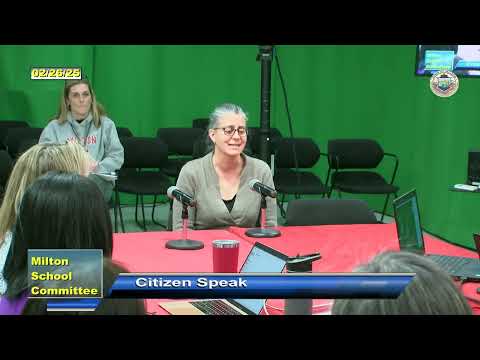
Milton School Committee approves revised Milton High Program of Studies, reduces community-service requirement
Summary
On Feb. 26 the Milton School Committee voted to adopt a revised Milton High School Program of Studies that cuts the graduation community-service requirement from 140 hours to 60 hours over four years, establishes a competency-determination pathway tied to coursework and existing MCAS results, and adds or renames several courses.
The Milton School Committee voted Feb. 26 to approve Milton High School’s revised Program of Studies, reducing the community-service graduation requirement to 15 hours per year (60 hours total over four years), adopting a competency-determination framework tied to coursework and existing MCAS results, and adding several new or revised courses.
The change to the community-service requirement was presented by Karen Cahill, principal of Milton High School, who told the committee, “We’re currently at 140 hours ... my recommendation is for it to go to 15 hours per year for our students, which makes it 60 hours over the course of their 4 years.” Cahill said the goal is to make the requirement “workable for our students” and to recognize a wider range of meaningful activities, including school-based service and certain family responsibilities that have grown more common since the 1990s.
Why it matters: Committee members and school staff framed the change as a response to shifts in student life, staffing and oversight since the requirement was written. Cahill said the district no longer has a full-time coordinator who vetted and tracked community-service opportunities and that enforcement of a 140-hour requirement led to inconsistent sign-offs. The committee approved the program to give students clearer, attainable expectations and to allow service done through clubs, athletics or other school activities to count.
Most important facts: The committee approved three main changes in the high school program packet: - Community service: the proposed requirement is 15 hours per year (60 hours total in four years), down from 140 hours; school-based activities and coach- or advisor-supervised service will be eligible. - Competency determination: the draft policy sets coursework-based pathways to satisfy graduation competencies and continues to accept MCAS results (including the November 2024 retest) where students have passed; the district will finalize a letter for families after committee approval. - Courses: Cahill described two bona fide new entries and several renamings — an unleveled social-studies course titled “America Today: How Did We Get Here,” a change to make a senior English semester course a full-year honors/CP offering (Sports and Society), the return of oceanography, and renaming automotive to “power mechanics” and a computer-technology course to “Intro to Cybersecurity.”
Committee process and vote: A School Committee member moved to approve the recommendations and another member seconded; the committee then voted in favor of the Program of Studies. The motion carried with an affirmative voice vote; the committee did not record a roll-call tally in the meeting transcript.
What the school said: Cahill stressed the administration wants students to “do it well” and not simply “check a box.” She said that without a dedicated, full-time community-service coordinator the district must make the requirement attainable and verifiable, and that the counseling office currently relies on an administrative assistant and counselors to track hours.
Context and next steps: Cahill said counselors will meet with middle-school students to explain new course options and the enrollment process. The administration will circulate the competency-determination letter to families after the committee’s approval, and staff plan further discussion in coming months about broader graduation requirements (including world-language options and the Seal of Biliteracy).
Ending: Committee members said they welcome additional, separate conversations about graduation requirements next spring and summer to allow time for community input and staffing analysis.