
Ohio veterans director outlines homes, workforce and mental-health priorities before House veterans committee
Get AI-powered insights, summaries, and transcripts
Sign Up Free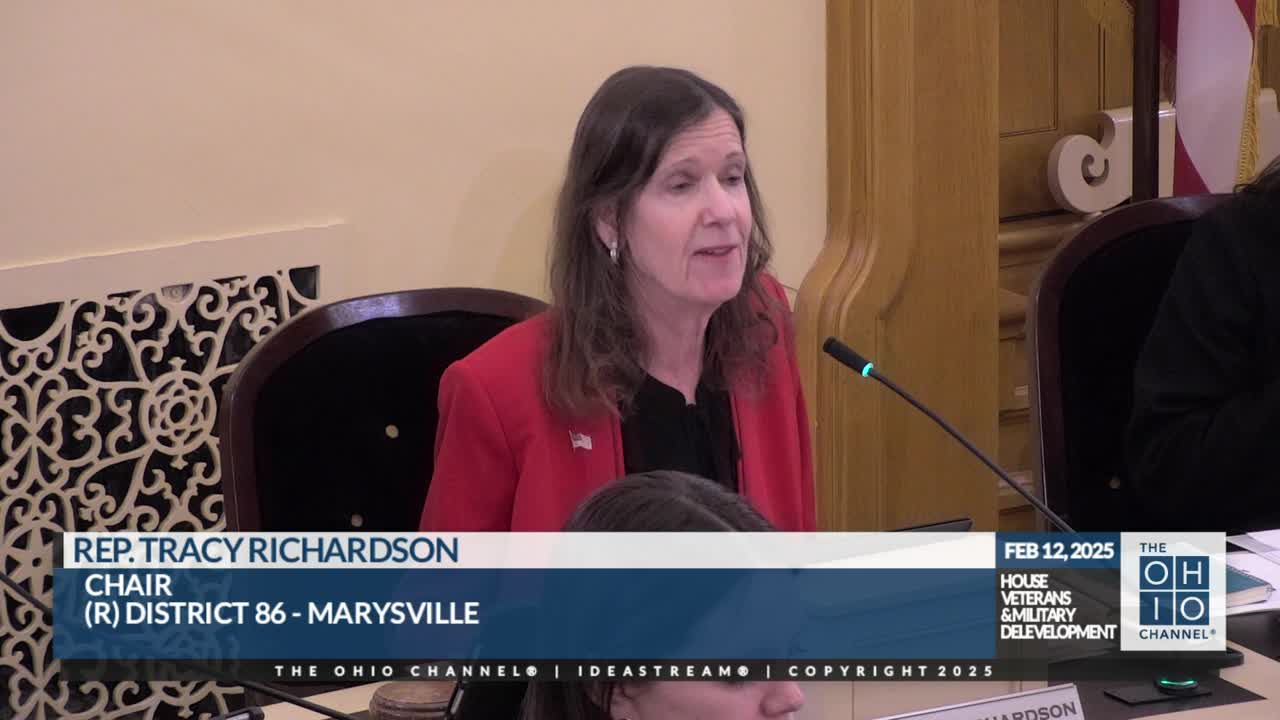
Summary
Director Ashenhurst of the Ohio Department of Veterans Services told the Ohio House Veterans and Military Development Committee that the department is working to expand and renovate veterans homes, boost veteran workforce pipelines and coordinate behavioral-health services across the state.
Director Ashenhurst of the Ohio Department of Veterans Services told the Ohio House Veterans and Military Development Committee that the department is working to expand and renovate veterans homes, boost veteran workforce pipelines and coordinate behavioral-health services across the state.
The presentation Wednesday by Director Ashenhurst — introduced to the panel as a retired general and the department director — laid out the agency's budget figures, renovation plans for the Sandusky and Georgetown veterans homes, and programs aimed at connecting transitioning service members and veterans with careers and culturally competent mental-health care.
Ashenhurst said the department received about $65,000,000 in the last biennium for construction and renovation work that will be matched by federal Department of Veterans Affairs funding when those federal resources arrive. “When those federal resources roll in, we're ready to break ground and go,” Ashenhurst said. She described the Sandusky facility as the largest veterans nursing home in Ohio, with about 600 beds, and Georgetown as a smaller facility with about 68 beds; the agency plans to add roughly 88 beds at Georgetown as part of renovations.
Why it matters: Ohio has an estimated 700,000 veterans based on VA projections, and committee members pressed the director on whether the state has enough long-term care capacity as the veteran population ages. Representatives said families are reluctant to place relatives more than an hour from home, and members urged the department to update its siting study and pursue state land and construction funding to complement federal matching.
On budgets and matching funds, Ashenhurst gave the committee a multi-year budget snapshot and described capital funding mechanics: the state typically pays about one-third of building costs for new veterans homes and the VA matches the remaining two-thirds when federal rules are followed. She said the agency's estimated budget for fiscal 2025 is “just shy of $170,000,000,” with subsequent years in the low hundreds of millions, and that the capital appropriation timing has not fully aligned with federal dollars yet.
Workforce efforts: Ashenhurst highlighted a workforce team — supported in part by JobsOhio resources — that conducts employer training (SHRM-qualified) on hiring veterans, visits active-duty installations to recruit separating service members and accepts resumes via QR codes at events. “We don't want them to come here for a job, we want them to come here for a career,” Ashenhurst said. Committee members asked about credential recognition (for example, military driver training and civilian commercial driver's licenses) and about scaling programs that connect spouses and transitioning service members to employment.
Behavioral health and 988: The director emphasized coordinated outreach and training to make mental-health care more accessible and culturally competent for veterans, including a role in the governor's statewide efforts and the VA's initiatives. Ashenhurst described STAR Behavioral Health as a program the department promotes to teach cultural sensitivity to providers and supported the state rollout of the 988 veterans option: “9-8-8 and push 1 — they get a culturally sensitive person answering the phone for veterans,” she said.
Members pressed for clarity on marketing and outreach. Representative Santucci asked whether the budget includes marketing funds to prevent veterans from paying for services they could obtain for free; Ashenhurst said there is no additional marketing money in the proposed budget and that the department relies on counties, veterans service organizations and social media to spread information. She urged counties' veteran service offices (CVSOs) and VSOs to amplify messaging and to help veterans avoid paying private actors for benefits assistance.
Hall of Fame and outreach: Ashenhurst encouraged nominations to the Ohio Veterans Hall of Fame, describing the process and deadline: nominations must be submitted by June 1 for that year, applicants can attach DD-214 evidence, and the panel recommends up to 20 nominees to the governor. She said the Hall of Fame highlights veterans’ post-service community contributions.
Concerns and next steps: Committee members asked for an updated siting study for future veterans homes, more precise estimates for capital and operating needs, and better county-level outreach so constituents know available services. Ashenhurst said the agency will provide a cost estimate to update the siting study and continue site-preparation work where feasible before federal funds arrive.
There were no formal committee votes or motions during Ashenhurst's presentation; members asked questions and the director responded. The committee adjourned after the exchange.
Ending: Committee members thanked Director Ashenhurst and said they remain committed to helping the agency pursue its goals of upgraded facilities, stronger workforce connections and improved behavioral-health access for veterans across Ohio.