Get Full Government Meeting Transcripts, Videos, & Alerts Forever!
Get email alerts on the Aviation Infrastructure topic
No spam. Unsubscribe anytime.
Ohio aviation group urges directing aviation fuel tax receipts into airport improvement trust under HB 54
Summary
The Ohio Aviation Association urged the House Transportation Committee to amend HB 54 to direct state aviation fuel tax receipts into an airport improvement trust so airports can provide required local matches and pull down more federal aviation dollars.
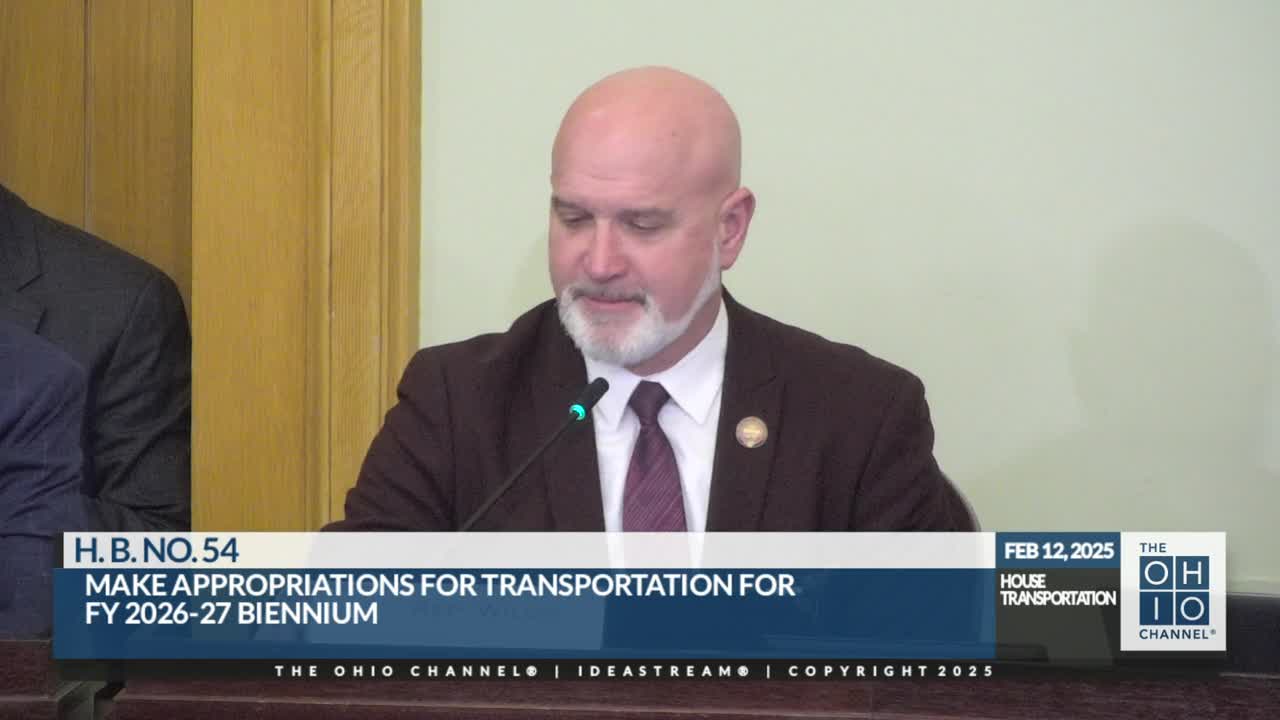
Tony Fiore, executive director of the Ohio Aviation Association, told the Ohio House Transportation Committee on Feb. 12 that Ohio airports lack a dedicated funding stream and urged an amendment to House Bill 54 to direct aviation fuel tax receipts into an airport improvement program.
Fiore said Ohio’s 104 publicly owned, public-use airports generate substantial economic activity — citing a 2014 statewide study at about $15 billion and a more recent Central Ohio regional study of about $13 billion — and estimating statewide impact “around $30,000,000,000.” He testified that Ohio’s airports employ more than 119,000 people and have roughly $1,180,000,000 in planned construction over the next four years, based on data airports file with the Federal Aviation Administration.
The proposed amendment Fiore described would have the Department of Taxation transfer aviation fuel tax and associated petroleum activity tax receipts into an ODOT airport improvement program, modeled on how motor-fuel receipts are dedicated to roads. Fiore said federal programs such as the FAA Airport Improvement Program require local/state matching funds and that the state’s share helps airports “pull down” federal funding. He estimated aviation fuel tax receipts could be about $20,000,000 annually and said Ohio currently allocated roughly $10,000,000 from the General Revenue Fund in the last biennium to aviation-related line items.
Fiore outlined specific priorities that could be funded through a dedicated trust: replacing underground aviation fuel tanks (he said about half of Ohio’s airports need this work), funding sustainable aviation fuel infrastructure (noting federal restrictions on funding traditional underground tanks), improving security and baggage claim at commercial service airports (a $10,000,000 request described in his testimony), and building hangars at general aviation airports to increase local revenue streams.
Chairman Willis and several committee members asked Fiore to clarify legal and revenue questions. Fiore cited a 1987 “grandfather” clause and said Ohio’s aviation fuel tax was 5% in 1987 and is now 5.75%, which he said gives the legislature authority to direct aviation-related receipts into a dedicated fund. He told the committee that some federal grants have matching ratios as high as 95/5 or 97.5/2.5 in certain programs and said lack of state matches has left many Ohio grant requests unmet.
Fiore asked the committee to adopt the amendment attached to his testimony and to consider retaining the existing $10,000,000 GRF allocation for other priorities (for example, replacing fuel tanks through a Commerce program). He said such a funding structure would better position Ohio to receive federal infrastructure dollars and to invest in advanced air mobility in later sessions.
The committee did not vote on the amendment during the hearing; members asked follow-up questions about revenue estimates, interstate comparisons, and legal authority.