Get Full Government Meeting Transcripts, Videos, & Alerts Forever!
Get email alerts on the Juvenile Justice Budget topic
No spam. Unsubscribe anytime.
Ohio Department of Youth Services urges support for budget as juvenile population and staffing pressures rise
Summary
The director of the Ohio Department of Youth Services told the House Public Safety Committee that DYS needs operating and capital funding to address a 35% population increase since 2020, persistent staff vacancies, and planned facility replacements and community corrections expansion.
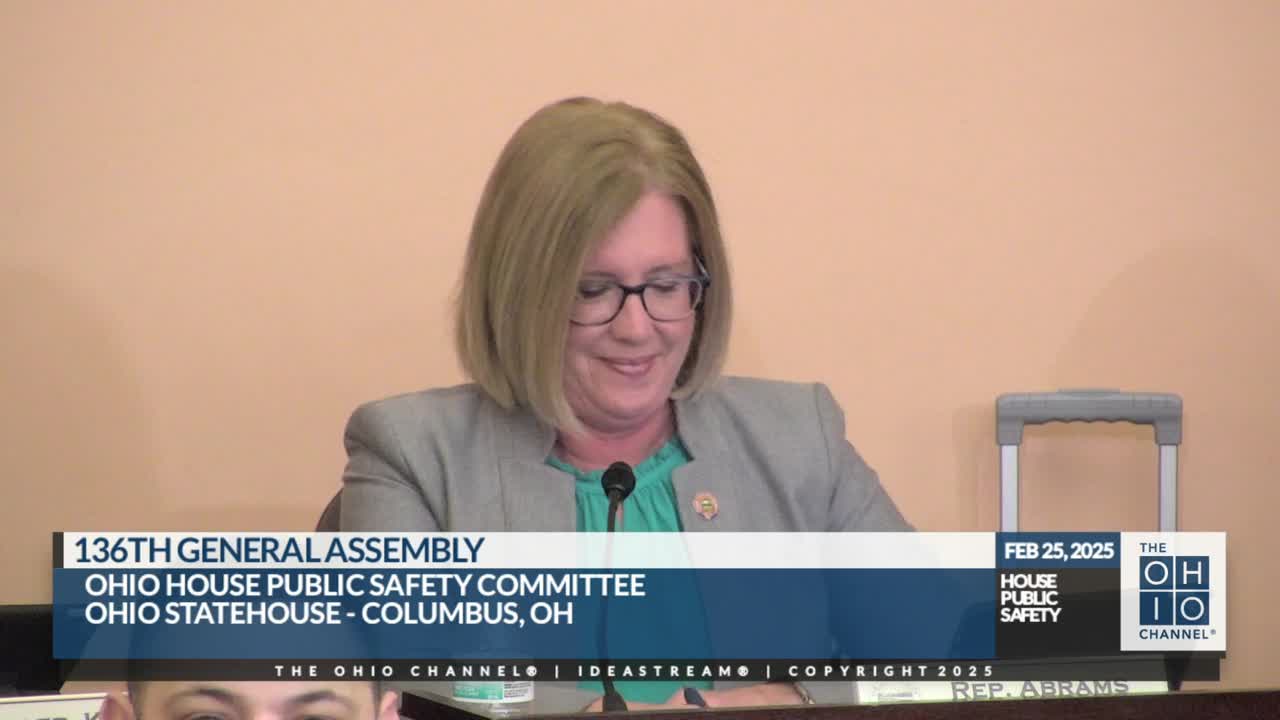
Director Amy [last name redacted], of the Ohio Department of Youth Services, told the House Public Safety Committee on the state's operating budget that the agency is requesting funding to address rising youth population, staffing shortfalls and facility shortcomings.
She said the agency's population in its three state facilities rose from 360 in December 2020 to 487 in January 2025 — a 35% increase — and that staffing and retention remain a primary concern. "Any assault on our staff is too many," Director Amy [last name redacted] said when asked about staff safety. She described measures DYS has taken, including expanded use of body-worn cameras, limited issuance of OC spray to designated staff, scenario-based training and increased incentive and supplemental pay for hard-to-fill positions.
The director told lawmakers staffing costs account for roughly 45% of the agency budget and described recent vacancy improvements: corrections officer vacancies fell from 24% in January 2024 to 15% in January 2025, educators' vacancies fell from 24% to 14%, while behavioral health staff vacancies remain about 35%. Total agency vacancies declined from approximately 18% a year ago to about 13% in January 2025. "These investments have helped reduce our vacancy rate," she said, asking for continued budget support so the state can compete in a tight labor market.
Why it matters: DYS houses youth committed by Ohio's 88 county juvenile courts and operates three correctional facilities (Circleville, Maslin and Highland Hills), plus funds 11 locally operated community correctional facilities (CCFs) and county subsidies for evidence-based community programs. The agency also runs a fully accredited school district inside its facilities; in the 2023–24 school year 53 youth earned a high school diploma and 35 earned a GED, the director said.
Programs and outcomes: The department highlighted Reclaim Ohio subsidy-funded programs as an early-intervention strategy. Director Amy [last name redacted] said there were more than 83,000 Reclaim-funded program admissions in fiscal year 2024 and that 81% of those youth did not recidivate in the subsequent 12 months. DYS also jointly funds the Behavioral Health Juvenile Justice Initiative and administers a youth services grant to all 88 counties.
New initiatives and capital plans: DYS described a proposed BUILD program (Buckeye United Industry and Leadership Development) to serve graduates and GED completers with workforce skills, virtual career exploration and a pre-apprenticeship pathway through the Ohio Department of Job and Family Services. The agency is seeking state recognition for BUILD as a pre-apprenticeship program.
On facilities, Director Amy [last name redacted] said the capital budget already includes funding to construct the first of three recommended CCFs in the state's highest-committing counties — Franklin, Hamilton and Cuyahoga — and the operating budget request would support opening and staffing the additional CCF once sites are finalized. She said the state is replacing older congregate facilities, starting with Cuyahoga Hills; the replacement is planned as a smaller, safer model and the Cuyahoga replacement is designed for 144 beds. She told the committee Cuyahoga Hills carried about 180 youth at the time of testimony and the replacement plan started when that facility contained about 145 youth.
Costs, mental health and special education: Director Amy [last name redacted] told the committee the per-youth cost in DYS is ‘‘just over $600 a day,’’ which she said equates to a bit more than $200,000 per year once services and staffing ratios are included. She said approximately 73% of male youth and 100% of girls in DYS custody are on a mental health caseload, and about 46% of the population requires special education services. About 30 DYS girls are currently housed at contracted providers including Buckeye Ranch and the Montgomery County Center for Adolescent Services, the director said.
Accountability and prosecution: On criminal accountability for assaults on staff, the director said incidents are investigated, with investigators from the state highway patrol assigned to facilities and prosecutors in some jurisdictions pursuing charges. She cautioned that prosecutions can proceed faster for youths over 18 than for juveniles under 18 because of statutory amenability processes.
Lawmakers' questions and follow-ups: Committee members pressed for additional county-level and program-level data. Representative Plummer said, "I don't think the reclaim's working," and asked who evaluates Reclaim and how often; the director said Reclaim undergoes a ten-year third-party evaluation and that the first two evaluations were completed by the University of Cincinnati. Representative Thomas asked for a breakdown of the per-youth cost (education, mental health, food, medical), and the director agreed to provide more detailed percentages to the committee. The director also said DYS will provide recidivism data and follow up with committee offices on whether that data can be produced at the county level.
No committee action on the budget was taken during the hearing. Chair Abrams closed the DYS testimony after questions and moved on to other business.
Ending: The department requested legislative support for the operating budget to continue and expand staffing, training, facility replacements and community programming intended to reduce recidivism and improve outcomes for youth in custody.