Get Full Government Meeting Transcripts, Videos, & Alerts Forever!
Get email alerts on the 9 1 1 Fee topic
No spam. Unsubscribe anytime.
County commissioners push $1 NextGen 911 fee to replace local levies; lawmakers debate distribution and auditor findings
Summary
The County Commissioners Association of Ohio told the House Public Safety Committee that raising the monthly NextGen 911 access fee from 40 cents to $1 could let counties reduce local property levies that currently fund 911 operations and cover rising IT and staffing costs for NextGen systems.
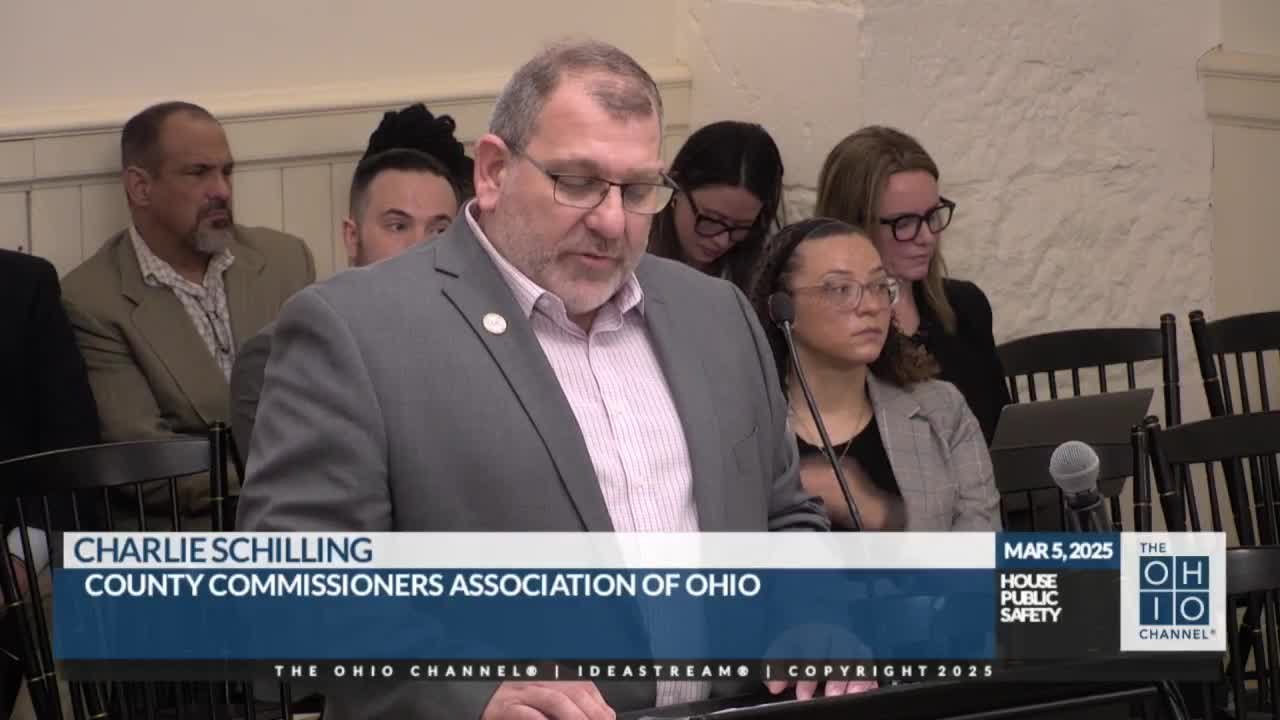
Charlie Schilling, a Washington County commissioner testifying for the County Commissioners Association of Ohio (CCAO), urged the House Public Safety Committee to consider raising the monthly Next Generation 911 access fee from 40 cents to $1 to reduce reliance on local property‑tax levies.
What the commissioners said: Schilling said Washington County was the first in the state to connect to the NextGen 911 system and that counties face higher recurring costs (IT, staffing and oversight). He told the committee that a $1 fee spread across cellphone users would be a more equitable way to fund 911 operations and could allow counties to roll back or avoid property tax levies. "One of the goals of this policy would be to distribute the cost of 911 across all citizens who are able to access 911 via their cell phone instead of relying on property tax owners," he said, and he urged support for proposed amendment HC0401.
Opposition and fiscal audit context: Committee members flagged language in a recent state auditor performance audit indicating that, under the audits assumptions, maintaining the fee at 40 cents would produce positive fund balances through 2032. Representative Hall cited the audit, noting it found the 40¢ fee produced surpluses in some scenarios. Members asked whether counties would simply accumulate surpluses or whether the distribution formula should be changed instead of raising the fee. Schilling said he wanted a net zero outcome for his county and argued that a $1 fee would allow Washington County to fund three public‑safety answering points (PSAPs) and the additional personnel and IT costs.
Distribution and equity questions: Representatives asked for data showing which counties currently levy property taxes for 911 services and how much those levies raise; Schilling agreed to provide county levy lists and rates through his association. Some members supported the concept of a statewide pool that would distribute revenues and reduce property‑tax burdens in smaller counties; others said more analysis was needed.
Comparisons to other states: Schilling cited neighboring states that are charging higher surcharges — Pennsylvania, West Virginia and Texas — and called $1 "reasonable" in that context. Committee members responded that each state's model is different and emphasized the need to analyze distribution formulas and carryover surpluses before raising the fee statewide.
What happens next: Schilling said CCAO can provide county levy and rate data; the committee asked staff and stakeholders for additional fiscal modeling to compare raising the fee versus changing how the current funds are distributed to counties.