Get Full Government Meeting Transcripts, Videos, & Alerts Forever!
Get email alerts on the Victim Services topic
No spam. Unsubscribe anytime.
Victim advocates urge $5 million state line to backfill federal VOCA shortfall
Summary
The Ohio Victim Witness Association told the committee federal Victims of Crime Act (VOCA) funds have dropped sharply and asked for a $5 million annual state line item to sustain victim advocates and meet Marcy's Law implementation needs.
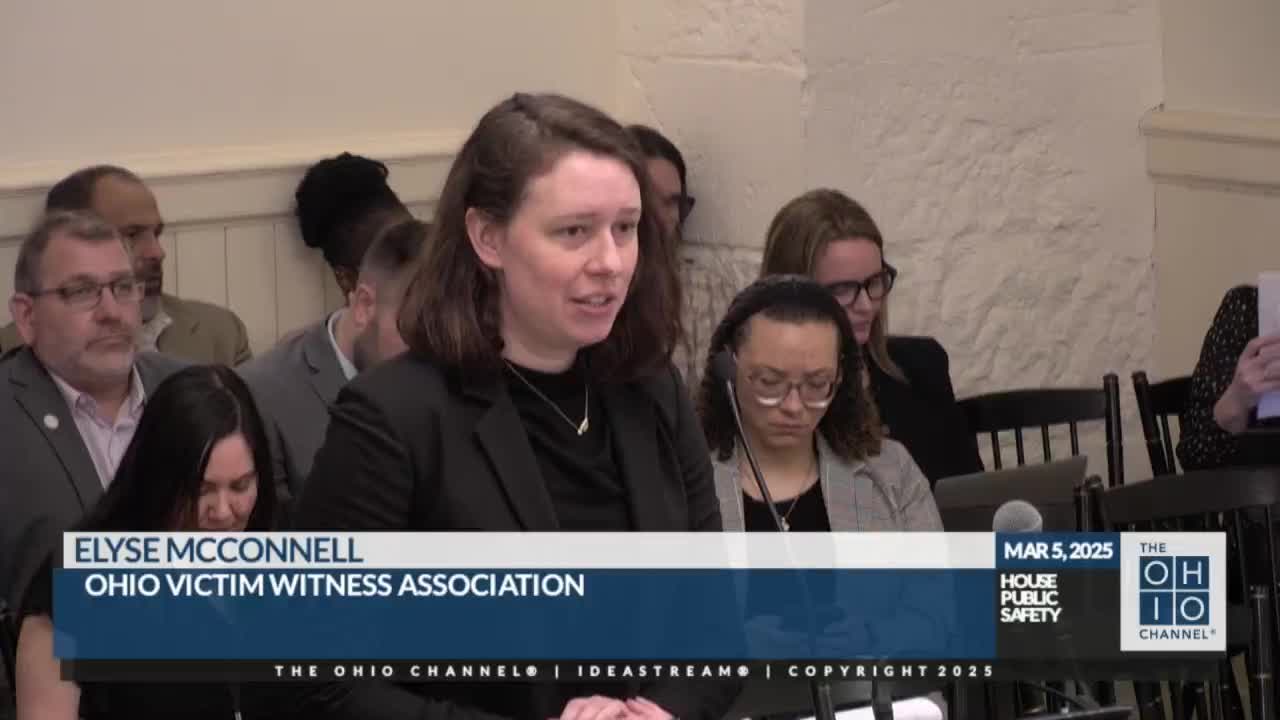
Elise McConnell, executive director of the Ohio Victim Witness Association (OVWA), told the House Public Safety Committee that Ohio victim advocates have experienced a steep funding decline due to reduced federal Victims of Crime Act (VOCA) receipts and asked the legislature to create a $5 million annual state line item to stabilize direct victim services.
Decline in VOCA revenues: McConnell said Ohio received about $117 million from the Crime Victims Fund in 2018 but received approximately $26.5 million in 2024, a decline she described as "almost 77%." She said the shortfall has forced victim services organizations to reduce staff, curtail programs or close entirely, and made it harder to comply with legal obligations under recent expansions such as Marcy's Law.
What OVWA proposes: McConnell asked for a new state appropriation of $5,000,000 each fiscal year to be administered through the attorney general's office to fund direct victim services and to ensure victims can access advocates and statutory rights. She said the proposed fund would prioritize counties with no full‑time victim advocate or only part‑time coverage and that the dollars would largely support staff salaries.
Why advocates say the funding is needed: McConnell told the committee that state‑level support would reduce coverage gaps, increase consistent service delivery, and enable compliance with statutory obligations to notify and assist victims. She said that many local programs currently rely almost entirely on VOCA funds (federal fines, fees and penalties) and remain vulnerable to federal funding fluctuations.
Committee response: Representatives asked clarifying questions about allocation, county equity and whether funds could be shared or regionalized; OVWA said the association is open to flexible delivery models (shared advocates or traveling advocates) but emphasized the immediate priority is to make full‑time advocacy available in counties currently without it.
Provenance: McConnells remarks and Q&A are in the public hearing transcript at the time she testified.