Get Full Government Meeting Transcripts, Videos, & Alerts Forever!
Get email alerts on the Bureau Of Workers Compensation Budget topic
No spam. Unsubscribe anytime.
Bureau of Workers' Compensation pushes modest budget, seeks statutory fixes on prosthetics and program consolidation
Summary
The Bureau of Workers' Compensation presented its 2026–27 budget and described proposals to authorize replacement prosthetic devices after closed claims, clarify board and program authorities, and continue investments in safety and data analytics.
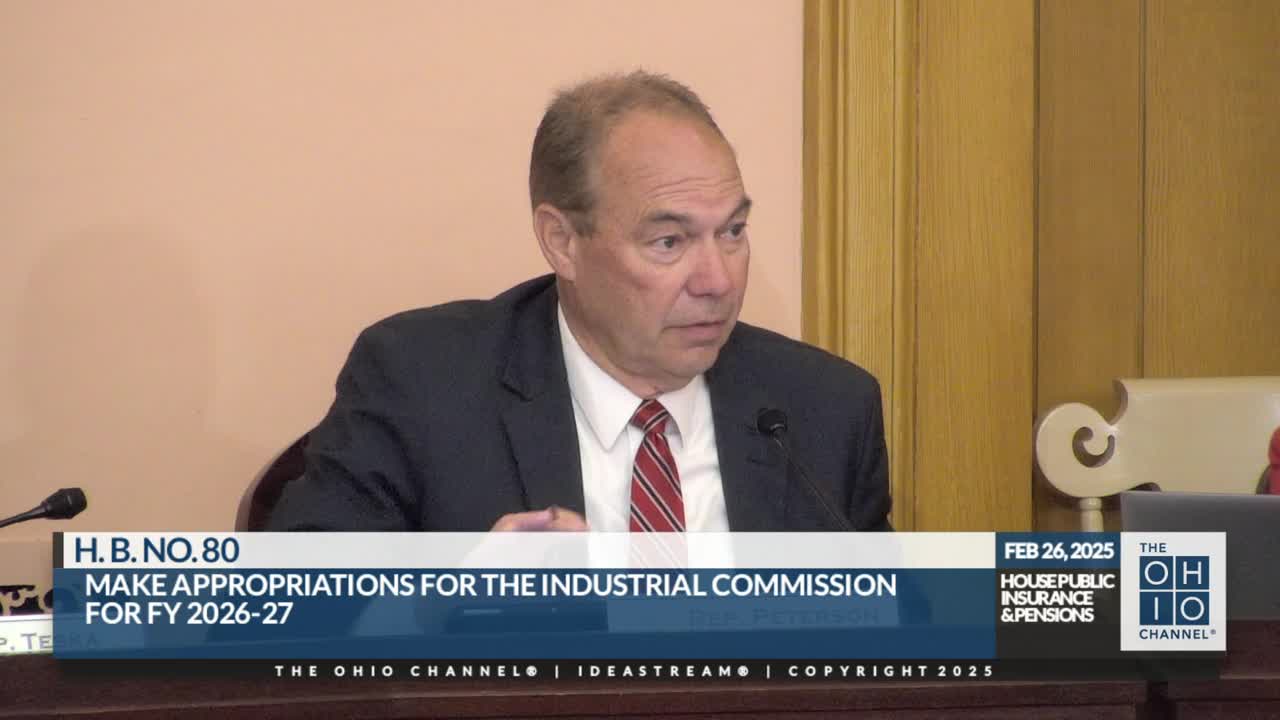
The Ohio Bureau of Workers' Compensation told the House Public Insurance and Pensions Committee its 2026–27 budget request would continue a focus on workplace safety, rate stability and customer service while seeking statute changes to clarify benefits and program authorities. "BWC is not funded from the General Revenue Fund. We are, for all essential purposes, an insurance company," Stephanie McLeod, director of the Ohio Bureau of Workers' Compensation, said at the bill's first hearing.
McLeod said BWC serves roughly 258,000 public and private employers with approximately 1,600 employees and reported assets of about $23.1 billion. The bureau described a budget that is modestly lower than the prior biennium overall and said it will continue investments in data analytics, robotic process automation and public health‑oriented grants. McLeod highlighted the Better You, Better Ohio (BYBO) wellness program and a firefighter cancer‑screening pilot, and listed grants to fire departments for extractor dryers, diesel exhaust control systems and turnout gear.
On policy changes, McLeod described proposed statutory language to allow BWC to pay for replacement or repair of prosthetic devices tied to workplace injuries after a claim has closed under the existing five‑year no‑payment rule. "Our proposed language provides explicit authority to pay for these prosthesis in the future," McLeod said. She also outlined proposals to clarify board duties, streamline subrogation claims with Medicare and Medicaid, simplify coverage for the Federal Prison Industries Enhancement Certification Program (FPIEP/PICEP), and remove an outdated statutory requirement to administer a safety museum.
Committee members questioned coverage for psychological injuries such as PTSD for first responders, the rising payments to managed care organizations (MCOs), and changes to board oversight requirements. McLeod said BWC already administers PTSD claims when accompanied by an accepted physical injury but noted that expanding coverage to mental‑only claims would be a policy decision for the General Assembly. On managed‑care spending, she described MCO work that goes beyond bill review — including medical management, return‑to‑work planning and dispute resolution — and said contracts and operational requirements have evolved since the program's earlier years.
McLeod said some eliminations in the proposed budget are intended to remove duplication rather than reduce compliance with federal Occupational Safety and Health Administration standards. The hearing included multiple requests from members for additional data; McLeod said BWC is continuing to invest in analytics to better explain long‑term trends such as falling claim counts.