Get Full Government Meeting Transcripts, Videos, & Alerts Forever!
Get email alerts on the Corrections Budget topic
No spam. Unsubscribe anytime.
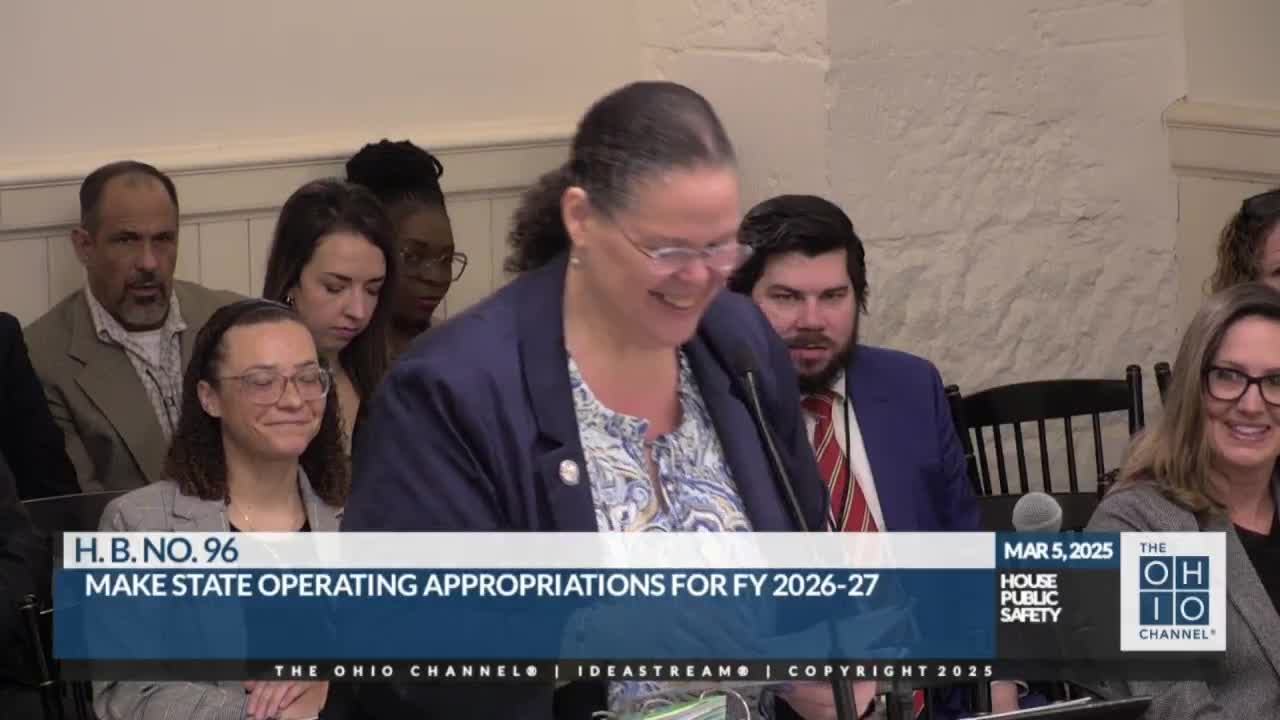
Ohio prison chief urges more staff, security tools and reentry funding in biennial budget
Summary
Director Chambers Smith told the House Public Safety Committee the Department of Rehabilitation and Correction(DRC) needs more officers, security equipment (including a taser pilot), and expanded reentry services to address a more violent prison population, rising costs and a projected population increase by July 2027.
Director Chambers Smith, head of the Ohio Department of Rehabilitation and Correction, told the House Public Safety Committee that the departmentis seeking additional staffing and security funding in the governors executive budget to address a more violent prison population and rising operational costs.
The departments FY26-27 executive request, Smith said, targets staffing and security: "78% of the additional GRF request that we've made is to go to staffing either raises that we're contractually obligated or increasing security staff." She also described a taser pilot and asked for statewide funding to deploy them if the pilot proves successful: "We will have 2 facilities piloting those this year and hope that we get the funding in the budget to take that statewide."
Why it matters: Smith said the system was built for less‑violent inmates and is now housing a much higher share of people convicted of violent crimes, which raises risks for staff and inmates and increases operational pressure. She told committee members the department expects the prison population to grow by about 1,000 people by July 2027 and that staffing accounts for roughly 72% of DRC's budget.
Key facts and figures cited by Smith: DRC's current in‑custody population is roughly 45,200; about 78% of new commitments now are for violent offenses; the statewide correctional vacancy rate fell from 7.9% to 7.3% in a month; roughly 3,200 staff are eligible to retire around the same period; and the department estimates 72% of its budget is tied to staffing and contract increases. Smith also said about 23% of people in prison meet the department's definition of mentally ill, 68% need substance abuse treatment and 27% tested below a sixth‑grade reading level on intake.
Safety measures and contraband controls: Smith described a multi‑pronged approach to drug and contraband reduction that she says has reduced detected drug use since 2021 and includes increased urine testing, wastewater testing, drug‑sniffing dogs, drone detection, body scanners, body‑worn cameras, a centralized mail processing pilot, restrictions on who may visit an incarcerated person, and a books‑ordering pilot. "We now have a pilot at 1 prison that's gonna go statewide soon, where we order their books for them, and they cannot any longer get books from the outside," she said. Smith said DRC is also pursuing a change to a Department of Health administrative regulation so staff and contractors can be scanned at entry (currently DRC is allowed to scan only incarcerated people).
Parole and monitoring: Smith highlighted investments in parole supervision tools and ankle monitoring, which she said helped reduce the average parole officer caseload from about 1:77 to 1:48 during the DeWine administration. She said funding in the executive budget would continue expansion of the ankle monitoring project.
Programming and reentry: Smith defended education, vocational training and medication‑assisted treatment (MAT) in prisons as means to reduce recidivism. She cited program outcomes the department tracks: college plus recovery programs decrease recidivism by 15.6%, general education plus recovery services decrease violence 16.7%, and GED attainment reduces recidivism in Ohio studies by about 20%. She said last year 3,000 people left DRC having completed at least one career‑tech, apprenticeship or advanced credential program and 1,600 people received a high‑school diploma or GED while incarcerated.
Committee questions focused on housing near facilities, accountability for repeated infractions, how the department will staff new or reopened beds, and the scope of drug trends. On community context and recruitment, Smith said many prisons are sited in rural areas and that many staff commute up to 90–120 minutes; she said housing shortages around some prisons complicate recruitment.
On accountability and discipline, Smith described the Facilities Rules Infraction Board process and said discipline can include security reclassification and segregation. On contraband trends, she said DRC is seeing shifts to novel delivery methods ("paper" doped with chemicals, covert shipments, drone drops) and that the agency is using new technology and policy changes to respond.
What the budget request would fund: increased correction officer pay and staffing, shift sergeants whose job is on‑the‑floor mentorship for new officers, expanded body scanners (subject to the Department of Health regulation change), continuation of the ankle monitor expansion, pilot funding for phone‑call transcription/search technology (a 90‑day pilot with Cuyahoga County to translate and search recorded calls), and investments in rehousing and specialized beds to treat serious mental illness.
Ending note: Smith told the committee she recognizes the need to balance safety and rehabilitation: "The department's responsible for incarceration, operating safe prisons for those who work in, live in, and visit them is paramount," she said. Committee members asked for additional follow‑up data after the hearing on vacancy trends, program participation rates and the math behind staffing requests.
Provenance: Testimony and Q&A appear in committee transcript beginning with Smith's opening remarks and continuing through members' exchanges on staffing, contraband and programming.