Get Full Government Meeting Transcripts, Videos, & Alerts Forever!
Get email alerts on the Workers Compensation Safety Grants topic
No spam. Unsubscribe anytime.
Ohio Chamber asks committee to add $7 million to BWC safety grants
Summary
At a committee hearing, the Ohio Chamber of Commerce urged the House Public Insurance and Pension Committee to amend House Bill 81 to add $7 million from the state insurance fund to Bureau of Workers' Compensation safety grants to meet employer demand and avoid application pauses.
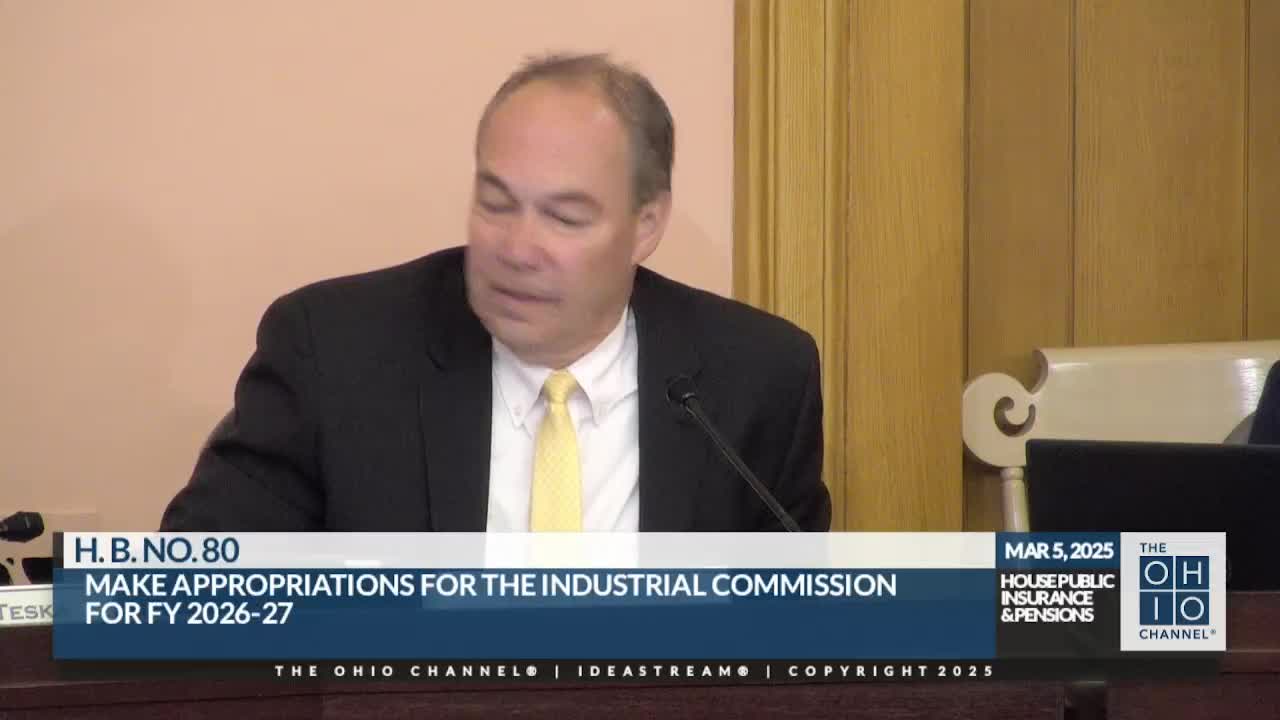
Kevin Shimp, an associate attorney at Dickinson Wright testifying on behalf of the Ohio Chamber of Commerce, told the Ohio House Public Insurance and Pension Committee that the chamber wants House Bill 81 amended to provide an additional $7,000,000 for Bureau of Workers' Compensation (BWC) safety grant funding from the state insurance fund.
"These premium reductions . . . will save employers approximately $60,000,000 next fiscal year," Shimp said, and he added that the chamber requests the extra $7,000,000 so the BWC can meet employer demand without pausing applications. The chamber representative told the committee Ohio has "the fifth lowest workers' compensation premiums in the country," a point he used to argue that continued investment in safety grants helps employers and workers.
Shimp described how the primary safety intervention grant works: it provides three dollars from the BWC for every one dollar an employer contributes, up to $40,000 per award, and supports purchases of equipment intended to reduce or eliminate workplace injury or illness. He also listed other BWC grant lines that HB81 would fund, including body‑armor grants for law enforcement, grants for firefighter exposure to environmental hazards, and a school safety and security grant for K–12 schools. Under HB81 as discussed in the hearing, the safety grant appropriation is currently identified as $34,300,000 in each fiscal year.
Shimp told legislators demand for the grants has outpaced funding in the past. He said that when the safety grant line was previously set at $35,000,000, the BWC paused accepting applications until the Controlling Board approved additional funding. The chamber's requested $7,000,000 increase, Shimp said, would help avoid that scenario by matching observed employer demand.
Committee members pressed Shimp on related trends and program tracking. Representative Bridal asked whether a large historical return of surplus funds could create an endowment to cover employer premiums; Shimp said he had not previously heard that proposal and cautioned a free system might reduce incentives for employers to invest in safety. Several members asked why the number of claims has fallen; Shimp attributed the decline to structural shifts in Ohio’s economy toward industries with lower injury rates, and he noted that claimants' attorneys typically work on contingency.
Representative Brennan and Representative Teska asked about whether grant recipients’ results are tracked; Shimp said employers who receive safety grants must provide a report a year after funding to document outcomes. When asked why payouts have risen even as claim counts fell, Shimp pointed to rising medical costs and increases in the statewide average weekly wage, which affect temporary total disability benefit amounts.
No formal committee action on House Bill 81 was recorded during the hearing. The committee approved previously distributed minutes without objection earlier in the session and then moved on from the HB81 testimony without a vote. The committee did not set a subsequent action date for HB81 during the portion of the transcript provided.