Get Full Government Meeting Transcripts, Videos, & Alerts Forever!
Get email alerts on the Community Corrections Funding topic
No spam. Unsubscribe anytime.
Community corrections providers urge lawmakers to preserve funding in House Bill 96
Summary
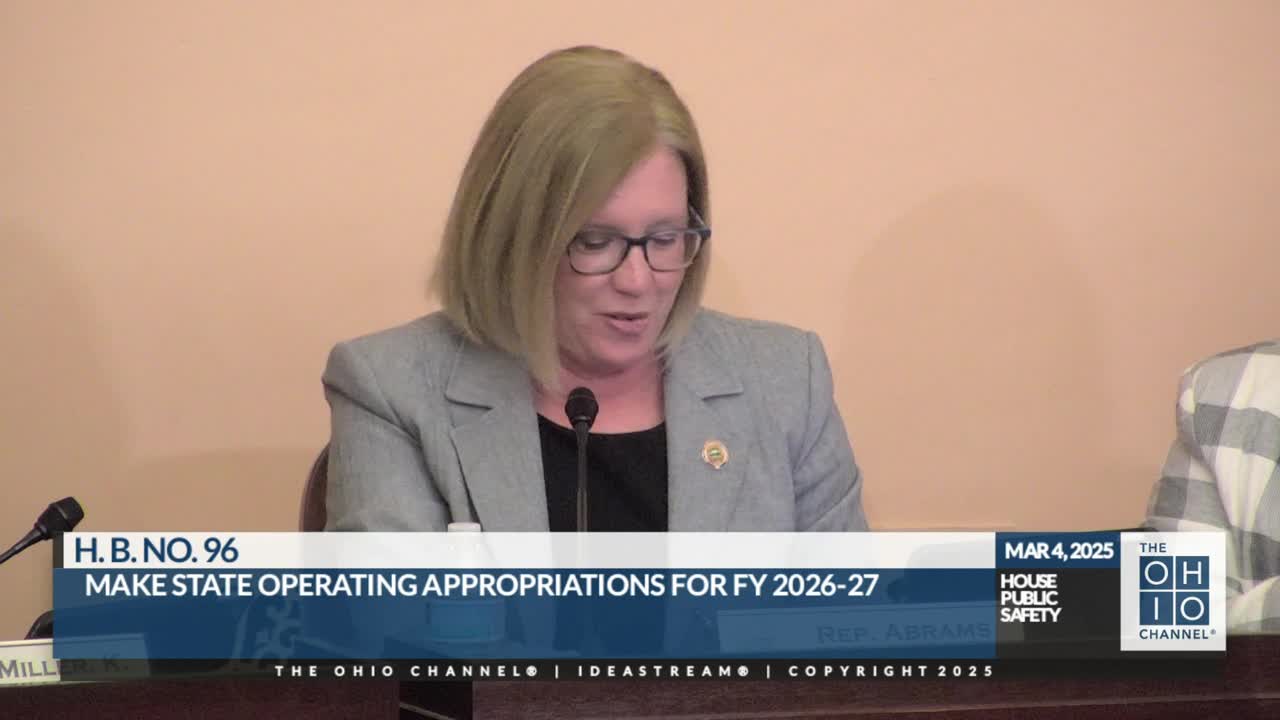
Leaders of nonprofit and publicly operated community corrections programs told the House Public Safety Committee they support increases included in the governor's introduced operating budget and asked lawmakers to maintain line items that fund residential treatment, psychotropic reimbursements and staff pay.
Leaders of Ohio community corrections programs told the House Public Safety Committee they support the increases proposed in House Bill 96 and asked lawmakers to preserve line items that fund residential community corrections and medication reimbursements.
Speakers from nonprofit and public community corrections groups testified that the governor's introduced budget includes funding increases they believe are necessary to retain staff and maintain treatment capacity. They asked the committee to keep proposed amounts for the Department of Rehabilitation and Corrections lines that support halfway houses and community based correctional facilities (CBCFs).
Testifying, Matt McClellan, executive director of Star Community Justice Center and trustee of Gorgias Inc., described the role of CBCFs in providing residential treatment and other services and said the sector needs the higher wages and reimbursements proposed in the budget. He told the committee the as-introduced budget contains a 4.4 percent increase for FY 2026 (listed in testimony as $4,358,400) and a 4 percent increase for FY 2027 (listed as $4,146,200) for the CBCF line and asked the House to maintain the line as introduced.
Dave Stilwagen, chief executive officer of the Ohio Community Corrections Association, said OCCA represents 38 nonprofit residential reentry facilities and that members are grateful for the proposed increases for halfway houses and CBCFs in HB 96. He emphasized that the Behavioral Health Drug Reimbursement Program (listed in testimony as GRF line MHA 336,442) expanded access to psychotropic drugs and medication assisted treatment but that demand outstrips reimbursement; he said the program’s reimbursement rate had covered only a fraction of actual expenditures.
Linda Janes, president of the Ohio Justice Alliance for Community Corrections and chief operating officer of Atlas, added that community corrections programs serve tens of thousands of people statewide and that the proposed increases to multiple line items (including lines referenced in testimony as 501405, 501501, 501407 and 501408) will help address staffing, inflationary costs and program effectiveness. She cited past research and state evaluations posted by the Ohio Department of Rehabilitation and Correction on recidivism reductions for program completers.
Committee members pressed witnesses for measurable outcomes. Witnesses said some programs track pre- and post-test assessments and phase advancement; one provider gave a program success rate in testimony of about 70.1 percent for halfway-house completers. Witnesses also said they could follow up with more precise data (for example, counts of additional offenders that could be served by expanded psychotropic reimbursement funding or bed occupancy numbers by facility).
The witnesses recommended that the committee maintain the governor’s as-introduced funding levels for CBCF and halfway-house lines and consider expanding reimbursement capacity for psychotropic medications and medication assisted treatment in detention and residential settings.
If lawmakers alter the proposed amounts, the speakers warned, agencies could face further staff turnover, reduced access to medications and treatment, and pressure on local communities and jails to absorb people who cannot be served in CBCFs.