Get Full Government Meeting Transcripts, Videos, & Alerts Forever!
Get email alerts on the Historic Preservation Reorg topic
No spam. Unsubscribe anytime.
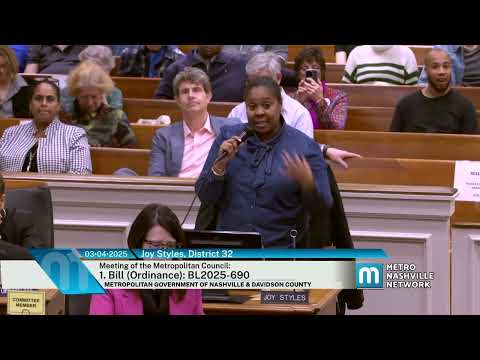
Council approves historic-commission restructuring on second reading after heated debate; public hearing set for March 18
Summary
Councilmember Benedict's substitute ordinance to reorganize historic-zoning staff and create a historic zoning administrator passed second reading with two floor amendments; an amendment that would have kept demolition documentation with the Metro Historical Commission failed. The council set a public hearing for March 18.
A substitute ordinance to reorganize historic-preservation staff and create a new historic zoning administrator cleared a contentious second reading on March 4, with councilmembers divided about whether the change shifts authority away from the Metropolitan Historic Commission.
The substitute (sponsor: Councilmember Benedict) removes the original bill's earlier approach and instead creates a new, codified historic zoning administrator position within the Planning Department, sets a July 1 staffing transition date and states that affected historic-zoning staff will retain civil-service status. Supporters said the move improves interdepartmental coordination; opponents said the change risks diluting an independent preservation voice.
Why it matters: The ordinance alters how historic zoning staff are organized inside city government and adds a new administrator post whose duties will include zoning-related reviews and coordination with the planning department. Preservation advocates and some commissioners urged caution; many community members asked for more time to review the change.
Committee actions and amendments - Planning & Zoning: The planning committee recommended the substitute and later recommended the substitute as amended (record and roll-call tallies were reported in committee).
- GovOps: The Government Operations committee also recommended the substitute and approved several floor amendments recommended by the sponsor.
- Amendment 3 (moved and explained by Councilmember Gadd) clarified staffing qualifications and preserved a formal role for historic preservation staff in document collection and review; that amendment passed on the floor.
- Amendment 1 (moved by Councilmember Cash) restored certain preamble/recital language to explain the ordinance's purpose; Council adopted the amendment on the floor.
- Amendment 2 (moved by Councilmember Su'arez) would have kept the demolition-documentation and initial preservation-review steps with the Metro Historical Commission rather than moving that step under the new administrator. That amendment failed on a recorded vote (15 yes, 20 no).
Public hearing and next steps - Councilmember Benedict moved and the body approved a public hearing on the substitute for March 18.
- The council then approved the substitute on second reading with Amendment 1 and Amendment 3 added. Because the measure passed second reading, it will return for third and final reading at a later date. Sponsor and administration statements said they will draft a memorandum of understanding (MOU) describing collaboration between the new historic zoning administrator and the Metro Historical Commission staff; planning staff said they will work with the administration to fund the new position as part of the upcoming budget cycle.
What council members and officials said - Sponsor: "This substitute bill completely eliminates the first bill. ... The substitute's section creating the historic zoning administrator codifies a role that will work at the pleasure of the planning department," Councilmember Benedict said, describing the hire-and-staffing cleanup and a four-month transition.
- "If we want to be able to control this process, we should act now," Councilmember Coopin said in floor remarks in favor of moving the substitute forward; he and others emphasized the request to avoid a state preemption attempt.
- Opponents and some preservation groups asked for more public input. "We must ensure that [preservation] work continues for the benefit of Nashville and all our residents," Historic Nashville Inc. said in public comment and asked for a March 18 public hearing.
Budget and staffing - Administration officials told the council that the new historic zoning administrator position would be implemented in coordination with the FY2026 budget; the July 1 transition date is intended to match budget timing so that new positions and reporting lines will be included in the planning department budget if the council approves the ordinance.
Why some councilmembers wanted a deferral - Several councilmembers urged a deferral to allow more public input and time for community outreach; proponents of immediate action argued that potential state-level changes make delaying risky and that moving the staff now preserves local control and streamlines operations.
What to watch for - Draft MOU describing the collaboration between the new historic zoning administrator and the Metro Historical Commission staff (sponsor and planning staff said they will draft language). - Third (final) reading date, which will include a public hearing record from March 18.
Sources: Metro Council meeting transcript, March 4, 2025; Planning Director Lucy Kemp, Metro Historic Commission executive director (statements at committee and during hearing); public comments from Historic Nashville Inc. and the Preservation Society of Nashville.