Get Full Government Meeting Transcripts, Videos, & Alerts Forever!
Get email alerts on the Public Safety Surveillance topic
No spam. Unsubscribe anytime.
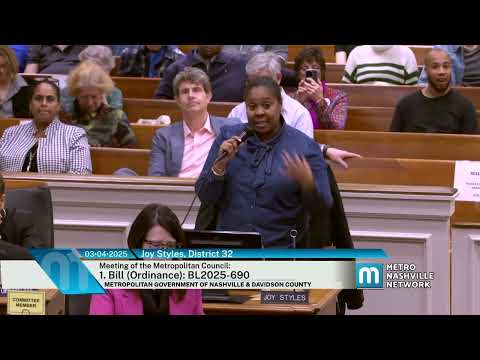
Council advances community safety network ordinance after hours of debate, adds privacy guardrails for apartment cameras
Summary
The Metropolitan Council on March 4 advanced an ordinance amending the Metropolitan Code of Laws to govern a proposed community safety network and police access to donor cameras, approving the measure on second reading after adding privacy-focused guardrails for cameras on multifamily properties.
The Metropolitan Council on March 4 advanced an ordinance amending the Metropolitan Code of Laws to create rules for a citywide community safety network and to govern police access to cameras donated by private operators. The bill (BL2025-690) passed its second reading with the version on the floor after the adoption of four amendments.
The measure drew more than three hours of debate focused on where police may access live camera feeds and how to protect residents' privacy, particularly in multi-family housing. Sponsors and critics debated whether cameras in apartment complexes should provide live footage to Metro Nashville Police Department (MNPD) or only recorded video after an incident.
Why it matters: The ordinance sets local rules for what proponents call an investigative and incident-response tool and what opponents call expanded surveillance. Amendments adopted at the meeting narrow live access for MNPD on multifamily properties, add recordkeeping and preservation requirements when police use camera footage, and create a standing set of procedural safeguards the council said are intended to reduce the risk of overbroad monitoring.
Key changes and votes - Amendment 2 (moved by Councilmember Huffman) narrowed MNPD's live-access authority on donor cameras installed on multifamily residential properties to three specifically enumerated public areas: parking lots, parking garages and outdoor common areas; areas where people have a reasonable expectation of privacy remain excluded. Special Counsel Darby explained the change as defining the limited areas where MNPD could obtain donor-camera access on multifamily property. The council adopted that amendment (recorded machine tally reported during the meeting: 23 yes, 13 no, 1 abstention).
- Amendment 1 (moved by Councilmember Toombs) prohibits MNPD access to live video feeds on properties that are solely residential; recorded footage from qualifying common areas can still be accessed under other provisions. That amendment was adopted and placed on the bill before the final vote.
- Amendment 5 (moved by Councilmember Prepti) requires MNPD to preserve footage where officers observe potential unlawful force or violations of department policy and to refer that footage promptly both to the district attorney general's office and to MNPD's internal office of professional accountability. The council adopted amendment 5 by voice vote.
- Final tally: The ordinance as amended (with amendments A, 1, 2 and 5 on the bill) passed its second reading by a vote of 28 in favor, 8 opposed and 1 abstention. The bill will return for a third and final reading on a later agenda.
What council members said - "We're trying to protect the rights, the privacy rights of the individuals that do live in apartments while also respecting that an apartment complex is, in fact, a business," Councilmember Huffman said during debate on Amendment 2, arguing the change balanced privacy and investigative needs.
- "The amendment prevents live access to live footage of apartment complexes," Councilmember Toombs said when she introduced Amendment 1, describing it as a privacy safeguard intended to prevent 24/7 live monitoring.
- From the administration, Dave Rosenberg of the mayor's office said the amended language would allow MNPD to access recordings more quickly than the current property-by-property process: "With this amendment, they would not have to go through the process that they do now. They would still be able to access it quicker."
- Supporters of Amendment 5 argued video is a critical investigative tool. "Video evidence can be very important in determining exactly what happened and who did what," Councilmember Nash said in support of requiring preservation and referral for potential use-of-force incidents.
How access will work (as explained in the meeting) - The council debated technical and legal limits on MNPD access. Special Counsel Darby explained the ordinance language retains a baseline exclusion for any area where a person has a reasonable expectation of privacy, and Amendment 2 specifically limits access on multifamily residential properties to parking lots, garages and outdoor common areas.
- Council members repeatedly emphasized that the systems are not intended as 24/7 continuous live monitoring by MNPD. Councilmember Huffman noted that access requires a call for service and that auditing procedures were part of the package to track when feeds are requested.
Next steps and implementation questions - The ordinance passed second reading and will return for final (third) reading and a vote on the council's future agenda. Council members asked for additional technical implementation details from the administration in the weeks ahead, including how recorded footage will be stored and accessed and how audits of requests will be handled.
- Administration officials said they would provide follow-up on how recordings will be accessed (for example, whether the footage will be retrievable via a cloud service versus by contacting property operators) and confirm funding and operational details for any systems used to support the program.
Context - The measure tracks the city's previous pilot programs and national debates over so-called public-private camera networks. Proponents argue the networks help solve and investigate serious crimes; opponents and privacy advocates say the systems risk broad surveillance of residents and disproportionately affect low-income and minority communities. Several public commenters and council members urged caution and additional guardrails at the meeting.
What to watch for - Administration follow-up on access, audit and data-retention procedures and the third-reading vote date. Implementation details about the chain-of-custody and auditing systems adopted in Amendment 5 will be among the next items public safety and council staff field questions on.
Sources: Metro Council meeting transcript, March 4, 2025; statements on the record from Councilmembers Huffman, Toombs, Prepti, Nash and others; comments from Dave Rosenberg, mayor's office; Special Counsel Darby (counsel briefing).