Get Full Government Meeting Transcripts, Videos, & Alerts Forever!
Get email alerts on the Immigration School Enrollment topic
No spam. Unsubscribe anytime.
Senate committee advances bill letting local districts verify immigration status, allow tuition for undocumented students
Summary
After hours of testimony and debate, the Senate Education Committee approved an amendment to Senate Bill 836 that would let local school districts require documentation of legal presence and — at their option — charge tuition to students who cannot prove lawful status. The measure passed the committee 5–4 and now moves to the Finance Committee.
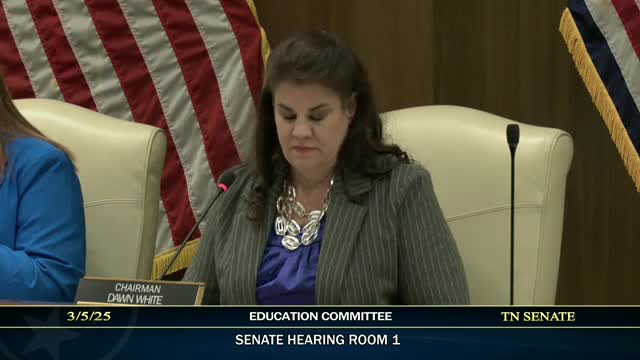
Senate Education Committee members on March 5 approved Senate Bill 836 as amended, a measure that would allow local education agencies to verify a student’s immigration status at enrollment and — if a district chooses — charge tuition for students who cannot document lawful presence.
The bill’s sponsor, Senator Watson, told the committee the amendment (drafting code 4412) makes the requirement permissive for local school districts and creates an appeal to the State Department of Education for families who assert lawful presence.
"The amendment changes the state's public school enrollment policies by requiring all public schools, including public charter schools, to verify a student's legal status before enrollment," Senator Watson said in committee. "If a student cannot provide such documentation, local school districts and public charter schools have the option ... to charge tuition."
Why it matters: Supporters framed the bill as a fiscal and administrative response to rising education costs tied to English-language learner services; opponents said the measure would deny or chill access to K–12 education for children and expose the state and districts to legal and financial risk.
Public testimony included several speakers who opposed the bill. Ruby Aguilar, introduced herself as a public-school educator at a diverse Tennessee school and said the measure "seeks to deny Tennessee's children access to education based on their immigration status." She cited Plyler v. Doe and appealed to the committee to reject the bill.
"Every child has the right to a public education," Aguilar said. "Denying a child the right to attend school based on where they come from is not only unfair, it is untennessean."
Daisy Perez, who testified as a former Tennessee public-school student, said she built a career in immigration law because she had access to schooling regardless of status and warned the bill would create high legal costs and damage the future workforce. Philip Lovell, of the national nonprofit All4Ed, told the committee the legislation would impose heavy bureaucratic burdens on districts tasked with verifying status and risked undermining long-term economic growth.
Committee debate focused on legal risk, administrative burden, and whether the bill conflicts with the U.S. Supreme Court decision in Plyler v. Doe (457 U.S. 202 (1982)). Senator Watson argued Plyler was a narrow 5–4 decision whose legal posture could be revisited and said the bill simply gives districts an option rather than a statewide mandate.
Committee action and outcome: The committee adopted amendment drafting code 4412 and approved the bill with a recorded roll-call vote of 5 ayes and 4 noes. The committee clerk recorded the ayes as Senators Crow, Hensley, Lowe, Powers and Chairman White; the no votes were recorded for Senators Ackbery, Hale, Pote and Roberts. The bill moves to the Senate Finance Committee.
What remains unclear: The bill text permits local tuition charges "not to exceed the total average per pupil funding amount for the LEA" but leaves multiple implementation details to the Department of Education rules and to local boards. Committee members repeatedly asked whether districts could implement the proposed verification systems in time, and whether truancy rules or federal preemption questions might follow — the department indicated those matters would require rulemaking and further review.
For now, the committee’s vote sends SB 836 to Finance for possible inclusion in budget deliberations and further legal review.