Get Full Government Meeting Transcripts, Videos, & Alerts Forever!
Get email alerts on the Open Government Remote Meetings topic
No spam. Unsubscribe anytime.
Committee adopts permissive remote‑participation rules with limits; open‑government group raises accessibility and agenda concerns
Summary
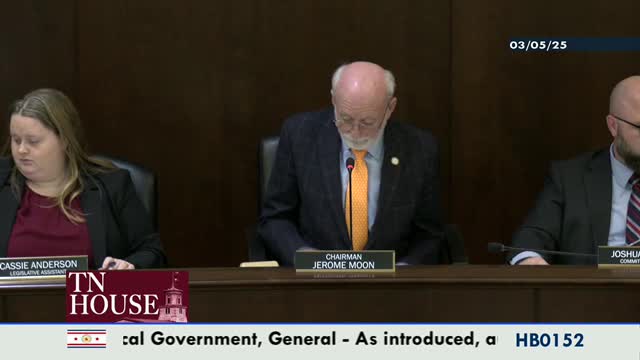
Vice Chairman Wright presented House Bill 152 on March 5, 2025; the Cities & Counties Subcommittee approved the amended bill on a 4-3 vote.
The Cities & Counties Subcommittee approved House Bill 152, as amended, on March 5, 2025 by a 4-3 recorded vote. The bill, presented by Vice Chairman Wright, would allow local legislative bodies to permit member participation via electronic means in specified circumstances and sets procedural conditions for public access and notice.
Vice Chairman Wright described the bill as a permissive measure enabling remote participation for members dealing with "a family or medical emergency," military service, or inability to attend due to inclement weather. He said the bill places strict limits: a member may participate remotely no more than twice per year; no more than 20% of the membership may be remote at one meeting; the legislative body must provide real‑time audio or video access to the public; a clear audio or video recording must be made available as soon as practical and no later than two business days after the meeting; and the legislative body must adopt a policy under the bill's guidelines by a two‑thirds vote.
The committee adopted Amendment 4344, which Vice Chairman Wright said "puts on the correct sunshine date." The amendment was adopted without recorded objection.
Deborah Fisher, executive director of the Tennessee Coalition for Open Government, testified in opposition. She voiced several concerns: that hybrid meetings can make it hard for the public to identify who is speaking or to hear remote participants; that "family emergency" is a broad exception that could be abused (she gave the hypothetical of a member stepping away for a child activity); and that the bill weakens an existing statutory agenda requirement by replacing a mandatory agenda with language that "strongly urges" providing an agenda for meetings using remote participation. Fisher urged stricter safeguards to preserve public access and audibility.
The clerk reported 4 ayes and 3 nos; the chair declared the ayes prevail and the bill moved to the next available State and Local Government calendar.