Get Full Government Meeting Transcripts, Videos, & Alerts Forever!
Get email alerts on the Historic Preservation topic
No spam. Unsubscribe anytime.
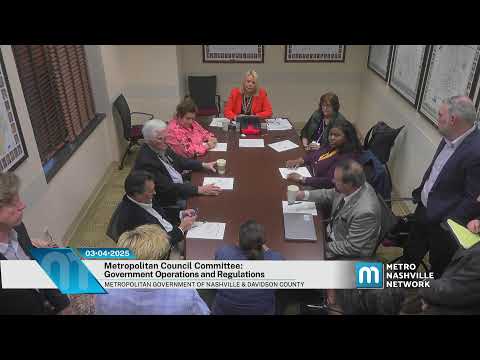
Committee approves substitute ordinance to reorganize historic‑zoning staff; public preservation group urges more public comment
Summary
A Government Operations & Regulations committee on a substitute ordinance to reorganize staffing for historic‑zoning functions and to codify a historic zoning administrator, passing the substitute as amended after public comment and several amendments.
A Government Operations & Regulations committee on a substitute ordinance to reorganize staffing for historic‑zoning functions and to codify a historic zoning administrator, passing the substitute as amended after public comment and several amendments.
The substitute ordinance, as presented by Council Member Benedict, would not change existing historic or conservation overlays but would move current Metro Historic Commission staff into the Department of Planning, preserve civil‑service status for affected employees and create a codified historic zoning administrator position that mirrors qualification requirements for the historic commission director. Council Member Benedict said, “It changes no historic or conservation overlays. They all remain as they are today. It retains all current staff. It moves them from 1 department to another.”
Why it matters: sponsors and supporters said the change would clarify code language, create an explicitly authorized historic zoning administrator and align demolition and zoning review processes under planning. Opponents and some administration officials warned of legal risk and urged a cooperative memorandum of understanding (MOU) between departments. The committee also heard that separate state legislation could limit or reassign local historic/zoning authority, which compressed the timetable for local action.
Public comment and advocacy David Grider, executive director of the Preservation Society of Nashville, told the committee the substitute “represents a significant step in the right direction from the original legislation.” Grider said his organization had met with Mayor O’Connell, Planning Director Lucy Kemp, Metro Historic Commission leaders, council members, neighborhood advocates and downtown business owners and recommended the committee approve the substitute and advance it to full council where the Preservation Society expects to ask for additional public comment or a deferral.
Structure and process changes Under the substitute language presented, the change would take effect on July 1 to align with the fiscal year and would explicitly allow the historic zoning administrator position to be codified with qualifications similar to the Metro Historic Commission executive director. The ordinance text also specifies that employees moving to Planning would retain civil‑service status, which currently exists for staff performing historic‑zoning functions but not for all Planning Department staff.
Demolition review Committee members asked staff and the Metro Historical Commission to clarify the demolition permit process. Tim Walker, executive director of the Metro Historical Commission, said the existing code provides a 90‑day review period for National Register‑eligible or National Register‑listed structures but does not prohibit demolition. “It is just a 90 day hold. It does not permit prevent demolition of the structure. Just a time for us to have a conversation with the applicant and see if there are alternatives,” Walker said. Sponsors said placing the historic zoning administrator within planning would better align demolition review with zoning review and codes processes.
State legislation and timing An administration representative, Rosenberg, told the committee that if the substitute is not passed locally, at least one of the related state bills could be put on notice with an amendment the next day and scheduled for a House subcommittee the following week. Rosenberg said, “If it isn't passed tonight, that at least 1 of the bills will be put on notice with its amendment tomorrow with the intent of it being heard in subcommittee in the house next week.” Another administration speaker characterized the state action as two related bills: one that could strip local historic/zoning authority and another that would place historic functions under planning for the state’s large cities.
Amendments, votes and next steps The committee considered and voted on a series of amendments to the substitute ordinance (Amendments 1–3) and then voted to move the substitute as amended. A motion to hold a public hearing on the ordinance on March 18 was announced by the chair as a next step to allow broader public input; the chair said she would move for that public hearing when the bill reaches the floor.
Other business Earlier in the session the committee moved a separate resolution, RS 20251058; the committee took the motion and advanced the resolution on a voice vote.
The committee record shows the substitute ordinance advanced from committee as amended and will be scheduled for floor consideration and a public hearing; the transcript records continued discussion about securing an interdepartmental MOU to define coordination between the Metro Historical Commission and Planning if the staffing reorganization proceeds.
Ending: The committee adjourned after approving the substitute ordinance as amended and noting the intent to seek further public input at the council level.