Get Full Government Meeting Transcripts, Videos, & Alerts Forever!
Get email alerts on the Public Safety topic
No spam. Unsubscribe anytime.
Bill would let PSC raise wireless 911 cap to $1; counties and PSAPs seek parity, industry warns of regressive impact
Summary
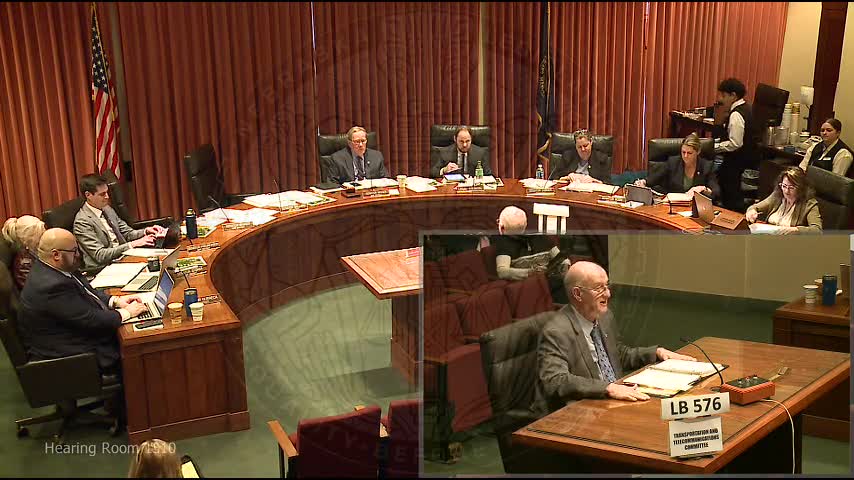
Senator Myron Dorn told the Transportation and Telecommunications Committee LB576 would equalize wireless 911 surcharge caps statewide and permit the Public Service Commission to set a wireless surcharge up to $1 per line to support PSAP operations.
Senator Myron Dorn introduced LB576, a proposal to make wireless 911 surcharges uniform across Nebraska and to allow the Public Service Commission to set a wireless surcharge up to $1 per month. Dorn told the committee the intent is to preserve operational support for the state's 67 public safety answering points (PSAPs) as landline usage declines and call patterns shift.
County officials and PSAP representatives said the bill would provide more reliable revenue for dispatch centers that face rising technology and staffing costs. John Cannon, executive director of the Nebraska Association of County Officials, described regions with very low local populations but seasonal call surges (for example at reservoirs and recreation areas) and said many small PSAPs rely on property taxes when 911 surcharges are insufficient. Sheriff Jeremy McCoy and other dispatch representatives described rising annual maintenance and software costs and steep wage pressures for dispatch personnel; McCoy said his center's annual budget is over $500,000 and 911 fees cover only a portion of that cost.
Public Service Commission testimony explained the commission currently sets the wireless surcharge by order; most counties are at the 70¢ cap while Douglas County is statutorily limited to 50¢. The commission representative said LB576 would permit parity and allow the PSC to raise the surcharge as needed, but any increase would be subject to the commission's annual review and hearing.
Opponents included the wireless industry trade association CTIA, which argued Nebraska residents already pay among the highest wireless taxes and fees nationally and that flat monthly surcharges are regressive. CTIA urged the state to consider targeted appropriations or other budget remedies rather than raising a flat per‑line fee. The fiscal note cited in testimony estimated a $1.2 million increase to the fund if wireless surcharges were raised on existing lines to parity at the statutory cap.
Emergency services and volunteer firefighter associations urged the committee to advance the bill to give the PSC flexibility to fund PSAP operational needs and to reduce reliance on local property taxes for emergency communications.
Committee members asked about current landline revenue declines, the size of expected new revenue, and the PSC's process for setting rates. The sponsor said the bill raises a statutory cap but does not itself change rates; the PSC would continue to set the exact monthly surcharge by order after an annual review.