Get Full Government Meeting Transcripts, Videos, & Alerts Forever!
Get email alerts on the Alcohol Regulation topic
No spam. Unsubscribe anytime.
Nebraska Legislature advances bill expanding self‑distribution for craft brewers and distillers
Summary
Lawmakers approved a committee compromise to raise craft distillers' self‑distribution limit to 3,500 gallons and expand off‑site retail locations to eight; a floor amendment to cut the increase failed and the bill advanced to enrollment and review.
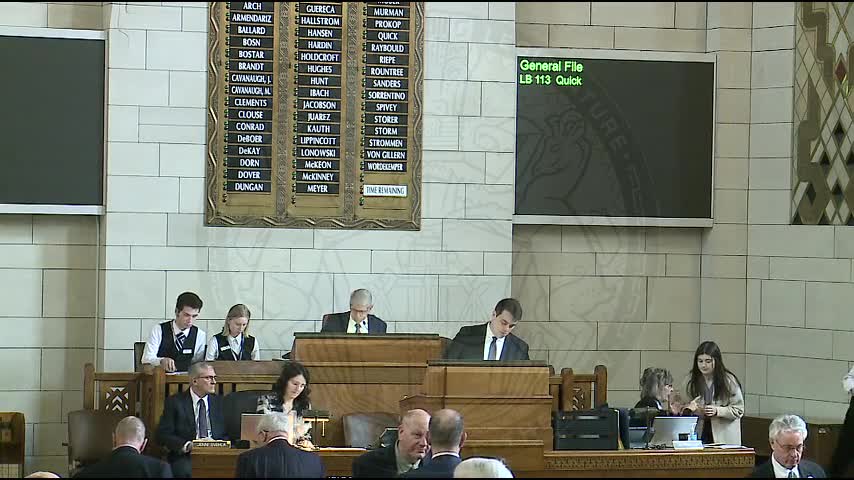
Senators on the Nebraska Legislature advanced LB113 on a bipartisan vote after adopting a committee amendment that raises limits on in‑state craft distiller and brewer self‑distribution and increases the number of off‑site retail locations allowed.
The committee amendment, AM 02:32, increases the permitted self‑distribution cap for craft distillers to 3,500 gallons and raises the allowed number of retail/tasting locations from five to eight. The General Affairs Committee amendment was adopted on the floor by a recorded vote of 36 ayes and 3 nays, and the bill later advanced to enrollment and review on a 36‑aye, 5‑nay vote.
Supporters said the changes are intended to help small Nebraska businesses expand market access. Senator Curt Quick, sponsor of LB113, described the bill as “an economic development bill for these local businesses” and said it would help small distilleries and breweries reach more customers in their home districts.
Senator John Kavanagh, who voted for the committee amendment despite reservations, said the existing 500‑gallon cap was too low to make self‑distribution economically viable. “One of the reasons folks haven't started the self‑distribution is because it's not economically viable for them to do it at 500 gallons,” he said. Kavanagh said he supported increasing the cap but wanted further conversation on the precise threshold.
Opponents urged caution about rapid expansion. Senator Carol Raybould said she opposed AM 02:32 and proposed a floor amendment that would have limited self‑distribution to 1,000 gallons and increased locations to six. Raybould argued the larger increase could advantage a few already successful operators and risk legal or market consequences. “There are only two operators exceeding that limit,” she said, referring to production figures distributed to senators.
Senator Holcroft, who spoke for the General Affairs Committee, described AM 02:32 as a compromise designed to preserve the three‑tier regulatory structure while allowing small producers greater flexibility. Holcroft noted Nebraska wineries already self‑distribute at higher volumes and said the amendment allows limited direct sales while keeping larger volumes in the distributor tier.
Senator Raybould’s floor amendment, FA 27, was defeated on final reconsideration by a vote of 10 ayes and 33 nays. Raybould had moved FA27 as a narrower compromise after the committee amendment passed; she withdrew closing remarks and later waived closing when the body voted.
Votes at a glance: - Adoption of AM 02:32 (committee amendment, limits set to 3,500 gallons and 8 locations): adopted, 36 ayes, 3 nays. - FA 27 (Raybould floor amendment: 1,000‑gallon cap and 6 locations): not adopted, final tally 10 ayes, 33 nays. - Advancement of LB113 to enrollment and review (E&R) initial: advanced, 36 ayes, 5 nays.
The bill drew extended floor debate spanning business and legal concerns, including questions about whether higher self‑distribution limits could invite out‑of‑state competition or legal challenges under the dormant commerce clause and whether geographic restrictions on additional tasting rooms should be added. Senators raised the practical cost‑benefit issue for small producers who must decide whether hiring drivers and buying trucks is justified by small increases in allowed distribution.
Senators who spoke in support emphasized local economic development and using Nebraska‑grown inputs; opponents flagged competitive fairness and legal risk as reasons for a more conservative increase. Several senators suggested potential follow‑on amendments to constrain locations by geography or to require divestiture above certain production thresholds.
With the committee amendment adopted and the bill advanced, senators indicated time remains to file or consider additional amendments before final passage. The bill now moves to enrollment and review as the Legislature continues consideration of alcohol and business regulation measures.