Get Full Government Meeting Transcripts, Videos, & Alerts Forever!
Get email alerts on the Tax Policy topic
No spam. Unsubscribe anytime.
Panel hears sweeping proposal to cut vehicle taxes, shift school revenue to counties; schools warn of funding gaps
Summary
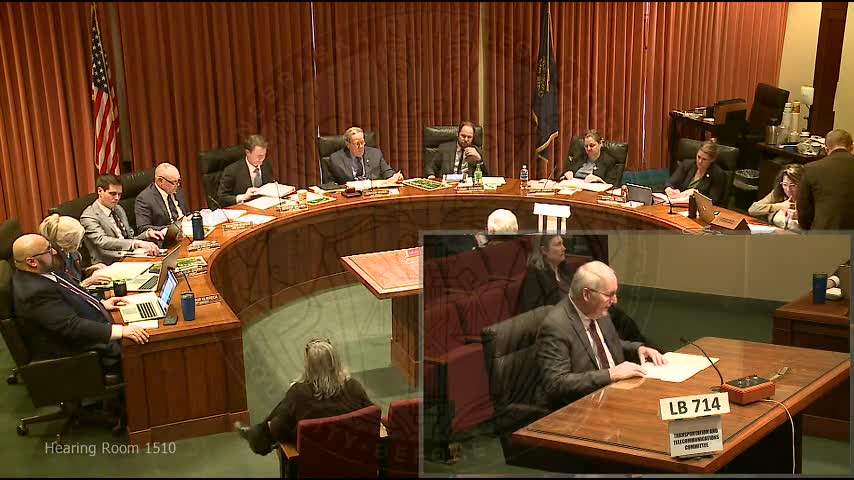
Senator Rob Clements told the Transportation and Telecommunications Committee LB714 aims to restructure how Nebraska collects and distributes motor vehicle taxes and fees with the goals of reducing vehicle owners' taxes and increasing county share of revenue.
Senator Rob Clements told the Transportation and Telecommunications Committee LB714 aims to restructure how Nebraska collects and distributes motor vehicle taxes and fees with two goals: lower motor vehicle tax burdens on vehicle owners and shift a larger share of revenue to counties.
Clements said the bill would change the yearly fraction multipliers used to calculate the motor vehicle personal property tax so the tax drops faster over a vehicle's life, which the DMV estimated would produce roughly 18%–20% savings for owners and about $70 million less collected statewide annually under current rates. He also said LB714 would raise the county share of distributed motor vehicle revenue from about 22% to 40%, producing roughly $37,000,000 to counties statewide, while lowering the school share from about 60% to about 37%—a reduction of roughly $101,000,000 in the motor vehicle revenue flow to schools.
Clements said the change in distribution is intended to provide a stable, more permanent revenue source counties could use to offset reductions tied to potential inheritance tax changes he plans to introduce separately. He described the proposal as part of a package to replace county revenue without relying on a recurring direct appropriation.
The hearing produced detailed fiscal and operational pushback from school districts and school finance representatives. Liz Standish, associate superintendent for business affairs for Lincoln Public Schools, and other school witnesses warned that any reduction in motor vehicle revenue for schools would have an immediate local impact because the TEOSA (Tax Equity and Educational Opportunities Support Act) state aid calculations use lagged data. Standish said the timing means equalized school districts would not receive backfill from state aid for about two years, producing an interim shortfall; Lincoln Public Schools estimated it could be short about $9,000,000 per year for two years under the bill's distribution change. Several witnesses from large and rural districts and associations said non‑equalized districts would face either property tax increases or program cuts.
Supporters included the Nebraska Association of County Officials, which testified that counties view the motor vehicle tax structure as a potential long‑term revenue source and welcomed an interim study on school funding impacts. Candace Meredith of NACO said counties collected $341,000,000 in motor vehicle taxes in 2024 and stressed the complexity of the current fee buckets and allocations.
Opponents included the Greater Nebraska Schools Association and multiple individual districts, which testified the proposal could shift up to tens of millions in funding away from schools and create significant short‑term budget pressure. Several witnesses requested an interim study and closer work with the Department of Education and stakeholders to design a replacement plan to hold schools harmless.
Clements acknowledged the fiscal complexity and told the committee he does not expect the bill to move this session without a clear plan to replace school aid shortfalls. He said he plans an interim study to examine replacement options and refine the proposal.