Get Full Government Meeting Transcripts, Videos, & Alerts Forever!
Get email alerts on the Military Department Budget topic
No spam. Unsubscribe anytime.
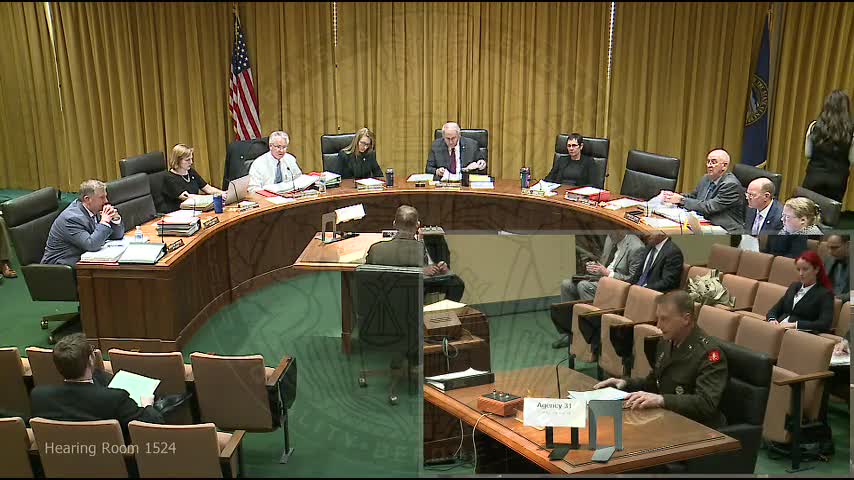
Adjutant General tells Appropriations committee governor’s budget meets Nebraska Military Department needs
Summary
Major General Craig Strong, the Adjutant General of the Nebraska National Guard and Director of the Nebraska Emergency Management Agency, told the Legislature’s Appropriations Committee that the governor’s biennium recommendation for the Nebraska Military Department “is sufficient and meets our needs.”
Major General Craig Strong, the Adjutant General of the Nebraska National Guard and Director of the Nebraska Emergency Management Agency, told the Legislature’s Appropriations Committee that the governor’s biennium recommendation for the Nebraska Military Department “is sufficient and meets our needs.” He said the department is made up of the Nebraska Army National Guard, the Nebraska Air National Guard and the Nebraska Emergency Management Agency (NEMA).
The department relies on federal funding for more than 90% of its budget, Strong said, with the remaining roughly 10% funded by the state to cover construction, salaries and other items not eligible for federal reimbursement. “Funding for NEMA is a mixture of federal grants and state contributions,” he said, adding that the blended funding gives the agency flexibility to respond to emergencies "before, during, and after" incidents.
The committee pressed Strong on personnel levels. Strong said the Air National Guard is near full strength — “about 100%, almost 99% strength” — while the Army National Guard is closer to 90% strength. He described recruiting progress year to date and said the force has experienced strong enlistment months recently: “We’ve enlisted approximately 150 soldiers…which is approximately 92% of our goal.” He also warned that an elevated retiree cohort is a near-term concern, noting roughly 22% of the force will be retirement-eligible in the next year.
Committee members asked about payroll, state active duty and interstate support. Strong said federal payrolls for Guard members are processed through federal systems, while state active duty pay (for events such as tornado response) is processed by the state; he reported no significant state payroll issues in 2024. He described mutual-aid mechanisms such as the Emergency Management Assistance Compact (EMAC) for interstate requests and noted that reimbursements may flow between states depending on the mission.
Strong also described outreach and recruiting incentives, telling the committee that tuition assistance — and removal of a prior cap on that program — is a major recruitment tool and that “we have a record number of individuals…utilizing the program for college tuition assistance.” He closed by thanking members for prior support and offering to answer follow-up questions; the committee received no agency opponents or additional testimony for Agency 31 that day.
Ending: The Appropriations Committee concluded testimony for Agency 31 after questions on staffing, state active duty procedures and recruiting incentives. No formal action or vote was taken at the hearing.