Get Full Government Meeting Transcripts, Videos, & Alerts Forever!
Get email alerts on the Auto Insurance Repairs topic
No spam. Unsubscribe anytime.
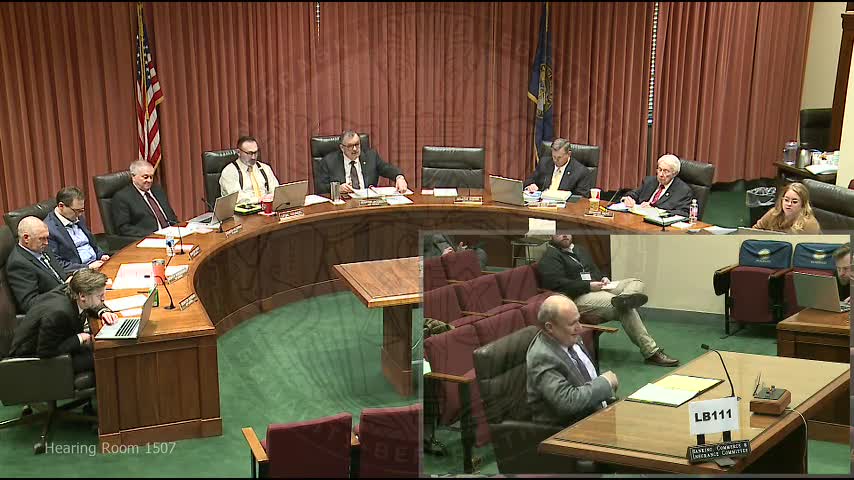
Nebraska committee hears bill to require OEM parts for vehicles 3 years old or newer
Summary
Senator Dan Quick, state senator for District 30-35 and the introducer of LB 111, told the Banking, Commerce and Insurance Committee the bill is meant to address consumer confusion and safety risks when insurers and repair estimators rely on aftermarket parts instead of original equipment manufacturer parts.
Senator Dan Quick, state senator for District 30-35 and the introducer of LB 111, told the Banking, Commerce and Insurance Committee the bill is meant to address consumer confusion and safety risks when insurers and repair estimators rely on aftermarket parts instead of original equipment manufacturer parts. "LB 111 is intended to address 2 specific issues for Nebraskans when they need a vehicle repaired after collision or some other insurable damage occurs to their vehicle," Quick said during the Jan. 1 committee hearing.
The bill would require insurers and shops to use OEM parts for vehicles 36 months (three years) old or newer, and would require insurers to disclose in writing when an estimate does not include OEM parts. Supporters argued the requirement would protect advanced safety systems and warranty coverage on newer cars; opponents said the change would reduce consumer choice and raise repair and insurance costs.
Why it matters: modern vehicles increasingly rely on sensors, cameras and other calibrated components that proponents say are engineered to OEM specifications. Several body shop owners and industry associations told the committee that aftermarket replacement parts sometimes fail to meet fit or calibration standards and can delay repairs or require rework that burdens vehicle owners. Opponents representing the aftermarket parts industry and insurers said similar or equivalent parts are widely available, help control repair costs, and that Nebraska already has Department of Insurance rules addressing fit, quality and performance.
Supporters' testimony
Ryan Clark, vice chairman of the Nebraska Auto Body Association and vice president of Eustis Body Shop, said that, under current practice, insurers often reimburse for "like, kind, and quality" (LKQ) aftermarket parts rather than OEM parts and that consumers frequently do not know the difference. Clark said newer vehicles have sensors and systems such as blind‑spot monitors and adaptive cruise control that can require OEM parts and specialized calibration: "If a vehicle's in an accident, these sensors are can be damaged and need replaced," he told the committee, adding that aftermarket parts sometimes fail calibration tests after installation.
Dylan Lapp, co‑owner and manager of Twin Rivers Body Shop in North Platte and treasurer of the Nebraska Auto Body Association, described a July 2022 case involving a special‑ordered 2022 Ford Expedition that had fewer than 10,000 miles when damaged. Lapp said aftermarket parts were not available for that vehicle and that the shop had to document vendor statements showing parts were unavailable before the insurer approved OEM parts.
Blair McDonald, representing the Alliance for Automotive Innovation (the trade association for vehicle manufacturers and suppliers), called LB 111 "a common sense, pro‑consumer, pro‑safety piece of legislation," saying the bill would ensure vehicles are returned to their pre‑loss condition while still under most manufacturers' warranties. McDonald said the bill allows non‑OEM parts when they are "equal in fit, quality, and performance" to the OEM part and would require clear consumer notice when non‑OEM parts are used.
Sarah Stallahn, manager of Bumper to Bumper Body and Paint in Scottsbluff, also supported the bill and cited complex driver‑assist systems and the need for proper calibration. She referenced a National Highway Traffic Safety Administration probe into certain driver assist systems and said that demonstrates the safety stakes for proper repairs and parts.
Opposition testimony
Representatives of the aftermarket parts industry and insurers urged the committee to reject LB 111 or to preserve consumer choice. Todd Moore of the Auto Care Association said the aftermarket industry supports affordable repair options and said there is no clear body of research that aftermarket parts are categorically inferior. "This type of legislation ... is really a government mandated monopoly, for OEM parts," Kevin Fisk of LKQ Corporation told the committee, arguing alternative parts generally sell for 25%–50% less than comparable OEM parts and that restricting them would raise costs for consumers.
Korby Gilbertson, speaking for the American Property Casualty Insurance Association, said Nebraska already enforces aftermarket‑parts standards through a Department of Insurance rule (cited in testimony as chapter 45) that requires parts be "like kind and quality" in fit, quality and performance and imposes civil penalties for violations. Gilbertson noted existing civil penalty amounts in the regulation and questioned adding a new criminal penalty; several committee members asked whether the bill's proposed class 1 misdemeanor penalty (section 8 as drafted) could be converted to a civil enforcement mechanism.
Robert Bell, executive director of the Nebraska Insurance Federation, said insurers pay for the majority of collision repairs and that insurer policies and market options already allow consumers to acquire coverage endorsements that pay for OEM parts. Bell referenced the federal Magnuson‑Moss Warranty Act (1975) to note that vehicle warranties cannot be voided simply for using non‑OEM parts.
Committee questions and bill status
Committee members pressed proponents and opponents on several points: how to define equivalency between aftermarket and OEM parts; whether the bill should require only certain safety‑critical components be OEM instead of all parts; the potential premium effects for policyholders; and existing state regulation. Some committee members asked proponents whether civil penalties would be acceptable in place of the class 1 misdemeanor referenced in the bill; proponents indicated they were open to that change.
Senator Quick, the bill's introducer, closed by saying he considered the measure a consumer protection bill and that he would follow up with insurers (he said he would contact State Farm) and was willing to work on clarifying language, including civil enforcement and limiting OEM requirements to particular parts if needed.
Documents and letters filed
Committee staff reported receiving two proponent letters and five opponent letters and no neutral letters or ADA testimony related to LB 111. Several witnesses referenced rules and resources they said were relevant, including Nebraska Department of Insurance aftermarket parts regulation (chapter 45), federal Magnuson‑Moss Warranty Act (1975), and a National Highway Traffic Safety Administration investigation into certain driver‑assist systems.
What the committee did
The committee held the public hearing on LB 111 and took testimony from multiple stakeholders; no vote or committee amendment was recorded on the bill at the hearing. The introducer remained for closing and indicated a willingness to negotiate statutory language.
Ending note
LB 111 will move forward only if the committee chooses to schedule further action; at the close of the hearing senators said they expected more technical questions and possible draft changes to address enforcement and scope before any final committee action.