Get Full Government Meeting Transcripts, Videos, & Alerts Forever!
Get email alerts on the Immigration Sanctuary Policies topic
No spam. Unsubscribe anytime.
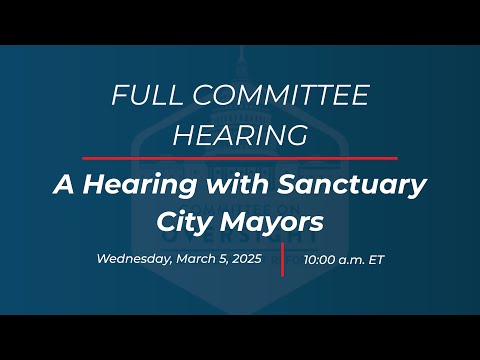
House Oversight questions mayors of New York, Chicago, Boston and Denver on sanctuary policies and enforcement
Summary
A House Committee on Oversight and Government Reform hearing on sanctuary‑city policies drew sharp exchanges on federal immigration enforcement, public‑safety trade‑offs and a Justice Department controversy that led several federal prosecutors to resign.
A House Committee on Oversight and Government Reform hearing on sanctuary-city policies drew sharp exchanges on federal immigration enforcement, public-safety trade-offs and a recent Justice Department controversy that led several federal prosecutors to resign.
The committee’s Republican majority pressed mayors of New York City, Chicago, Boston and Denver to explain local rules that limit cooperation with Immigration and Customs Enforcement (ICE). Committee leaders said those rules can keep criminal noncitizens from being handed to federal authorities; the mayors and a Cato Institute witness countered that well‑crafted local policies help preserve trust with immigrant communities and reduce crime.
Why it matters: Committee members argued that lack of cooperation with ICE detainers forces federal agents to make arrests in public and increases risks for officers and residents. Mayors said aggressive local involvement in federal immigration enforcement would chill reporting of crimes, strain city services and undermine public-safety work that they run every day.
House Republicans repeatedly asked whether the four cities qualify as “sanctuary” jurisdictions and pressed the mayors on whether they would honor ICE requests in custodial situations that involve a criminal warrant. Mayor Eric Adams of New York, Mayor Brandon Johnson of Chicago, Mayor Michelle Wu of Boston and Mayor Mike Johnston of Denver each said they and their departments cooperate with federal authorities on criminal warrants. The mayors argued, however, that state and local statutes and court precedent limit holding people beyond lawful release times in response to purely civil immigration detainers.
Mayor statements and city responses
Mayor Eric Adams (New York City) said public safety is his administration’s top priority and defended New York’s practice of working with federal task forces on criminal cases while maintaining local policies intended to preserve trust in immigrant communities. “Keeping New Yorkers safe is my top priority,” Adams said in his opening statement, adding the city continued to partner with federal agencies on criminal investigations.
Mayor Mike Johnston (Denver) described an 18‑month humanitarian response after thousands of buses arrived in Denver and said the city opened shelters, helped people gain work authorization and reduced the city’s migrant-support budget sharply as people moved into jobs and housing. Johnston said Denver received about 42,000 people over 18 months, opened eight shelters that housed roughly 5,000 people, and helped about 8,700 eligible individuals apply for work authorization.
Mayor Brandon Johnson (Chicago) credited Chicago’s long‑standing “welcoming city” policy with improving trust between police and residents and said the administration’s investments in detectives, violence prevention and youth employment had helped drive down violent crime.
Mayor Michelle Wu (Boston) said state law and the Boston Trust Act make immigration a federal responsibility while local policies focus police resources on preventing and solving violent crime. Wu said Boston’s homicide count reached historic lows last year and that community trust—encouraged by local rules—helps police solve crimes.
Federal witness and Justice Department controversy
David Bier, director of immigration studies at the Cato Institute, told the committee that mass deportation plans would harm public safety and the economy and urged Congress to pass comprehensive immigration reforms that expand legal pathways and adjudication resources.
The hearing also returned several times to the Justice Department’s recent decision to drop the federal prosecution of Mayor Adams, a move that prompted at least seven federal prosecutors to resign. Republican members repeatedly characterized the resignations and contemporaneous meetings between mayoral counsel and Justice Department officials as evidence of improper bargaining; Democratic members and the mayor denied any quid pro quo. Several resigned prosecutors submitted letters into the hearing record alleging they could not in conscience seek dismissal in the circumstances.
Enforcement specifics and examples
Members pressed the mayors on policies governing ICE detainers and jail access. Mayors said they routinely notify ICE of scheduled releases so federal agents can pick up people in custody; they also said local and state law and court rulings prevent municipalities from holding people beyond release dates on civil immigration requests. Denver said it had provided ICE with “notification of release” more than 1,200 times in recent years.
Committee members cited specific incidents, including a March release in Denver in which ICE agents arrested a person in a parking lot and were assaulted; lawmakers used that case to argue the city’s release procedures put federal officers at risk. Mayor Johnston said he had already contacted ICE and offered to review the procedures with federal partners.
What the mayors asked from Congress
The mayors repeatedly told the committee that Congress has primary authority over immigration law and urged lawmakers to pass bipartisan, comprehensive immigration reform and to increase adjudication capacity and work‑authorization pathways. They said federal action—not local policy—was the only durable solution to the large numbers of arrivals in recent years.
Committee actions and record submissions
Members on both sides of the aisle entered news articles, government reports and resignation letters into the hearing record. The panel did not adopt legislation or take formal votes during the hearing; members were permitted to submit additional written questions and documents for the record.
Outlook
The hearing made clear the political stakes in how the federal government, states and cities handle immigration: Republicans emphasized compliance with federal removal processes and threatened funding penalties for jurisdictions that do not comply; Democrats warned that federal enforcement inside sensitive locations would erode trust, reduce crime reporting and harm public safety. Several members urged passage of comprehensive federal legislation to reduce the burden on local governments and to provide predictable paths for work authorization and adjudication.
The committee recessed with members on both sides signaling they will continue to press the Justice Department for documents and to pursue additional oversight, and to press for legislative fixes to backlog and adjudication capacity at the federal level.