Get Full Government Meeting Transcripts, Videos, & Alerts Forever!
Get email alerts on the Conveyance Safety Elevator Code Clean Up topic
No spam. Unsubscribe anytime.
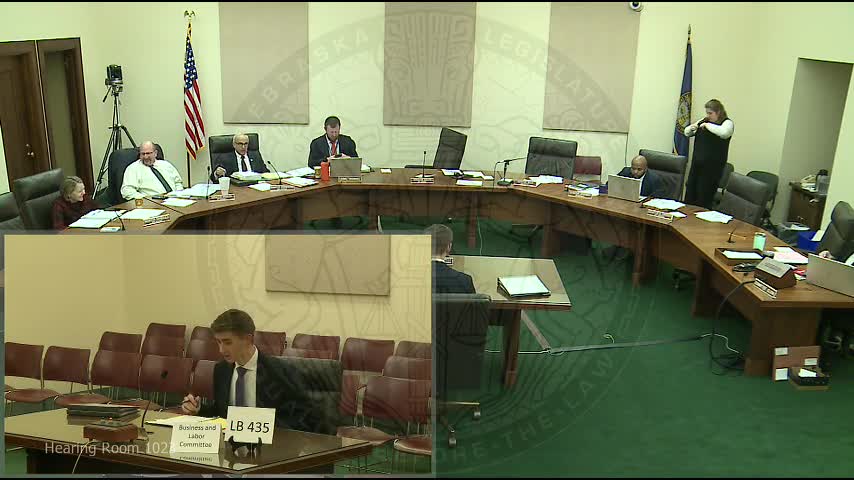
Committee hears cleanup bill for Conveyance Safety Act to align statutes with industry practice (LB435)
Summary
LB435, introduced on behalf of the State Fire Marshal, would modernize and clarify the Conveyance Safety Act by removing outdated dates, aligning inspection language to third‑party inspection companies, and requiring contractor contact information; the interim State Fire Marshal said changes do not reduce safety standards.
Kaden Robinson, legislative aide for Senator Werta Kempfer, introduced LB435 as a statutory housekeeping measure prepared by the State Fire Marshal—s Office to update outdated code references, clarify licensing forms, and align terminology with agency practice.
Doug Hohbein, interim State Fire Marshal, testified the bill removes obsolete implementation dates and adds year references for code exemptions, replaces references to "insurance company" inspections with third‑party inspection companies (reflecting current practice), clarifies the reporting line so the chief elevator inspector may report to a designee of the State Fire Marshal, and changes form requirements to separate elevator mechanic licensing from elevator contractor licensing. The bill also adds an "equivalency" pathway (or equivalency/variance via the offered amendment) to allow alternative compliance methods already used in other State Fire Marshal divisions and documented on existing equivalency forms.
Hohbein emphasized LB435 does not lower safety standards; the changes are intended to reduce confusion, use existing agency forms and retention policies, and provide a clear point of contact for mechanical contractors. No opposition or neutral testimony was offered at the hearing and senators did not raise substantive safety objections during questions.
The committee closed the hearing after technical questions and recorded one neutral comment for the record; no immediate committee action was taken.