Get Full Government Meeting Transcripts, Videos, & Alerts Forever!
Get email alerts on the Immigration Employment E Verify topic
No spam. Unsubscribe anytime.
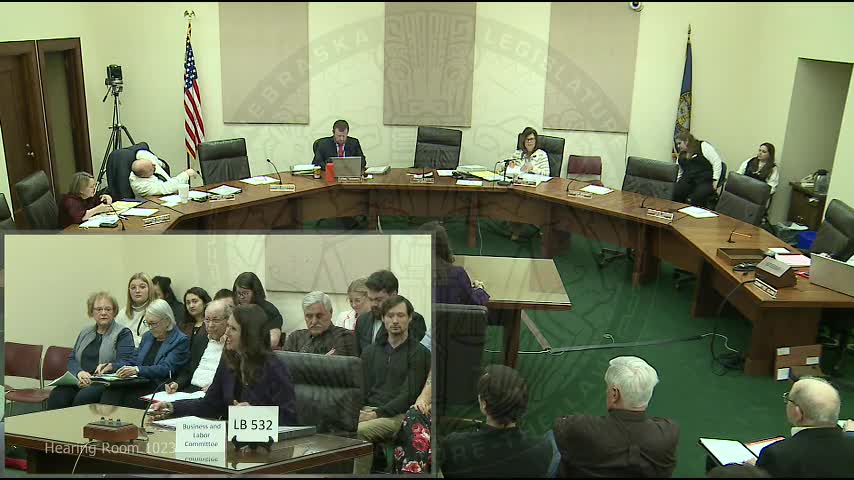
Nebraska committee hears wide-ranging debate on bill to require E‑Verify for all employers (LB532)
Summary
Senators and dozens of witnesses spent nearly four hours debating LB532, a bill to require Nebraska employers to use the federal E‑Verify system for new hires; supporters said the change would protect jobs and public coffers, while opponents warned of errors, discrimination and burdens on small and agricultural employers.
Senator Kathleen Kauth, the bill—s introducer, told the Business and Labor Committee that LB532 would require Nebraska employers to use E‑Verify when hiring new employees and that the committee would consider AM416 as its working amendment.
The bill—s sponsor said E‑Verify is "a win for everyone, businesses, workers, and even illegal immigrants," arguing the free, web-based system reduces the risk of hiring unauthorized workers and levels the playing field for law‑abiding employers. She told the committee the bill—s original fiscal note estimated about $260,000 in start‑up costs in year one and about $200,000 annually thereafter to support audits, and that penalties created in the amendment would be deposited into the Permanent School Permanent Education Fund.
Proponents who testified said mandatory E‑Verify would raise wages and reduce illegal hiring. Doug Kagan of Nebraska Taxpayers for Freedom said enforcement prompted shifts to legal hires in other states and cited academic and media studies that reported wage and employment shifts. Marilyn Asher, who described running a small remodeling business in Omaha for decades, and Susan Gum, a former small‑business bookkeeper, said employers paying workers "under the table" erode tax revenues and undercut law‑abiding firms. Jon Neeble of the Nebraska State Council of Electrical Workers urged accountability for employers who exploit labor, and suggested the committee consider ways to help workers who are found ineligible for work authorization.
Opponents raised multiple practical and civil‑rights concerns. Nick Grandgenne, staff attorney at Nebraska Appleseed, warned that LB532 as drafted extended liability beyond primary contractors and said E‑Verify is known to generate false flags that can initially identify authorized workers as unauthorized; he noted the federal process includes a chance for a worker to fix mismatches that must be preserved. Natasha Naseem of the Center for Immigrant and Refugee Advancement said long USCIS adjudication delays, a nontrivial rate of initially incorrect E‑Verify results, and low compliance in some other states mean a mandate would be "ineffective and burdensome." Dylan Severino of the ACLU of Nebraska testified that E‑Verify—s error rate and the system—s potential to chill hiring could produce illegal discrimination and harm workers who must navigate a bureaucratic dispute process.
Agricultural and food industry witnesses, including Chris Bosquette of the Nebraska State Dairy Association, said mandatory statewide E‑Verify would add regulatory burden to producers who already face seasonal and year‑round labor shortages and that federal guest‑worker reforms are the appropriate long‑term solution. Trade groups and chambers appearing in a neutral capacity urged caution about punitive license suspensions and asked for carve‑outs or phased approaches for sensitive licenses and small providers.
Committee members pressed the introducer and witnesses on enforcement and error mitigation. Senator Kauth said the fiscal note assumes audits of roughly 15% of businesses annually but that the Department of Labor could scale audits if manpower were limited. Several senators asked witnesses for data on E‑Verify false positive/negative rates and on the effect mandatory E‑Verify had in other states; opponents and neutral witnesses pointed to hundreds of thousands of initial nonmatches in recent federal reports and to state experiences showing uneven compliance.
The hearing produced extensive testimony but no final committee action on LB532. The committee recorded dozens of in‑person proponents and opponents for the written record and closed the public hearing after testimony and questions.