Get Full Government Meeting Transcripts, Videos, & Alerts Forever!
Get email alerts on the Transportation Regulation Pcn topic
No spam. Unsubscribe anytime.
Sen. Wendy DeBoer proposes shifting burden in licensing of common carriers to ease entry for new transportation providers
Summary
Senator Wendy DeBoer introduced LB227 to change the Public Service Commission’s public convenience and necessity process so incumbents must substantiate protests; supporters say it will reduce incumbents’ de facto veto, opponents warn it could harm non‑emergency medical transportation (NEMT) passengers and regulatory capacity.
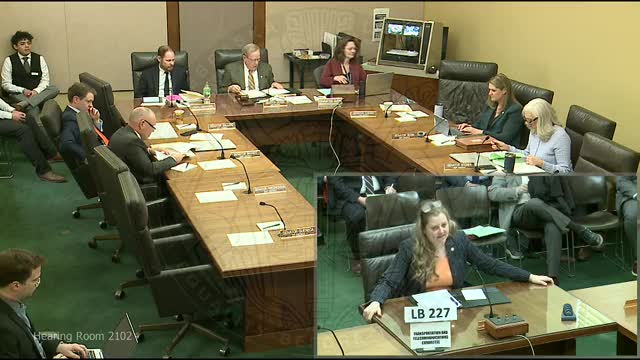
Senator Wendy DeBoer, D-Northwest Omaha, introduced LB227 to the Legislature’s Transportation and Telecommunications Committee, saying the bill would shift part of the burden of proof in Public Service Commission licensing hearings for common carriers.
"The free market should decide the market, not the regulators," DeBoer told the committee as she opened discussion on LB227, which keeps existing safety standards in place but would require protesting incumbent carriers to demonstrate how an applicant would ‘‘endanger or impair’’ current service rather than forcing new applicants to prove an unmet public need.
DeBoer said the current public convenience and necessity (PCN) process lets incumbents block entrants by asserting they can meet demand. She cited the Legislature’s 2021 changes that removed the PCN requirement for movers of goods as precedent for easing restrictions on market entry.
Dylan Kiefer Johnson, Transportation Director for the Nebraska Public Service Commission, testified in support and said LB227 aligns evidentiary burdens with which party is best positioned to know the market. He told the committee that under the bill an applicant would still have to show fitness and that the service would serve a useful public purpose; an incumbent protester would bear the burden to show the applicant’s service could be provided by existing carriers or would impair incumbents.
Alyssa Kern, managing director for Camelot and Triumph Transportation and a long‑time NEMT (non‑emergency medical transportation) provider, testified in opposition. Kern said the industry and passengers rely on a licensing screen that weeds out inadequately prepared companies and that an increase in unvetted providers could harm vulnerable riders who depend on reliably scheduled transport to medical appointments. She said Camelot has filed 24 protests in the last 24 months and that most applications were settled rather than litigated; one went to hearing and was denied after six hours of evidence.
Committee members questioned whether LB227 would leave the Public Service Commission with insufficient ability to police safety and financial responsibility and whether the change would generate more hearings rather than fewer. DeBoer and the PSC witness said safety, insurance and fitness requirements would remain unchanged and that protests could still be filed; the bill would simply require incumbents who protest to produce evidence of market harm.
The committee took testimony for and against LB227 and heard written opposition submitted online. No formal vote or amendment was recorded during the hearing.
The bill now awaits further committee action.