
Richfield High’s midweek “WIN Time” credited with improving grades, engagement and college prep
Get AI-powered insights, summaries, and transcripts
Sign Up Free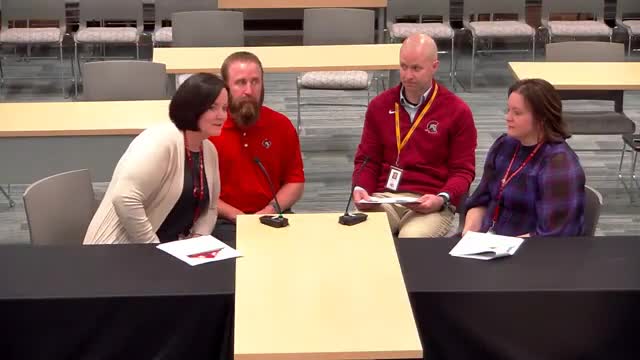
Summary
Richfield High School staff and students told the school board that a midweek flexible learning period called WIN Time has reduced fail rates, increased club participation and offered targeted academic and college-application support.
Richfield Public Schools principal Fine Collins and Ridgefield High School staff told the Richfield School Board on March 3 that a midweek flexible-learning period called WIN Time (also called WIN) has helped reduce failing grades, increase club participation and give students time for college and career planning.
WIN Time, held Wednesdays from about 1:05 to 2:10 p.m., provides individualized academic support, social-emotional learning, and enrichment activities, Collins said. “It really is a way to provide the opportunity,” she said.
The program is in its fourth year of iteration after adjustments made following the pandemic. Mr. Harris, the operations lead for the school’s BOLT team, said the program moved to the middle of the day after an action-research review of attendance and impact: “That allows us to have advisory where we can support kids signing up for where they need to go,” he said. Staff reported that moving WIN Time to the middle of the day improved participation and made it easier for adults to steer students to academic support or enrichment.
Administrators presented teacher-collected and standardized assessment data to illustrate results. In two WIN Time sessions last semester, staff logged 289 summative assessments completed during WIN Time and said 618 students made progress in a class during that short window. Administrators reported the school’s failing-rate indicators fell notably from the prior year: the number of students failing four or more classes decreased to 38 students, and those failing three or more dropped to 68% of an earlier higher figure (administrators described this as about a 50% reduction from last year).
Counseling staff said WIN Time is being used for college and financial-aid support. The district’s CCR (college and career readiness) coordinator and senior counselor run sessions for FAFSA, common-app work, scholarship essays and related tasks during WIN Time, providing seniors weekly help with applications.
Administrators and students stressed student choice and voice in shaping WIN offerings. A student who spoke during the presentation said WIN Time “helps me to catch up on late assignments” and gives “a quiet place to study and a nice break during the school day.” Another student said the midday timing is “perfect” and forces students to attend and use the time productively.
Staff also described WIN Time offerings that range from academic interventions (tier 2 reading and math supports) to enrichment clubs (plant club, pottery, K-pop, intramurals and inclusive cooking partnered with general education). Administrators noted that in AP Human Geography, 37 of 38 students who accessed WIN support passed the course in the first semester and that several students moved from high- to lower-risk categories on the FAST screening assessment.
Board members thanked the presenters and several indicated they had observed WIN Time in practice. When asked if teachers supported WIN Time, presenters said teacher feedback was “very supportive” and that seeing hundreds of summatives completed during WIN Time reinforced its value.
Administrators said attendance in particular WIN offerings ebbs and flows with the academic calendar (for instance, FAFSA and scholarship windows raise attendance). They said the CCR area takes weekly attendance and that participation increases when college and scholarship deadlines approach.
The board did not take action on WIN Time at the meeting; the presentation was informational. Presenters offered to provide follow-up data on weekly CCR attendance when requested.
Administrators closed by saying WIN Time’s goals are to improve individualized academic outcomes, increase student connection to school, and provide time for postsecondary planning and enrichment.