Get Full Government Meeting Transcripts, Videos, & Alerts Forever!
Get email alerts on the Workers Compensation Longshore topic
No spam. Unsubscribe anytime.
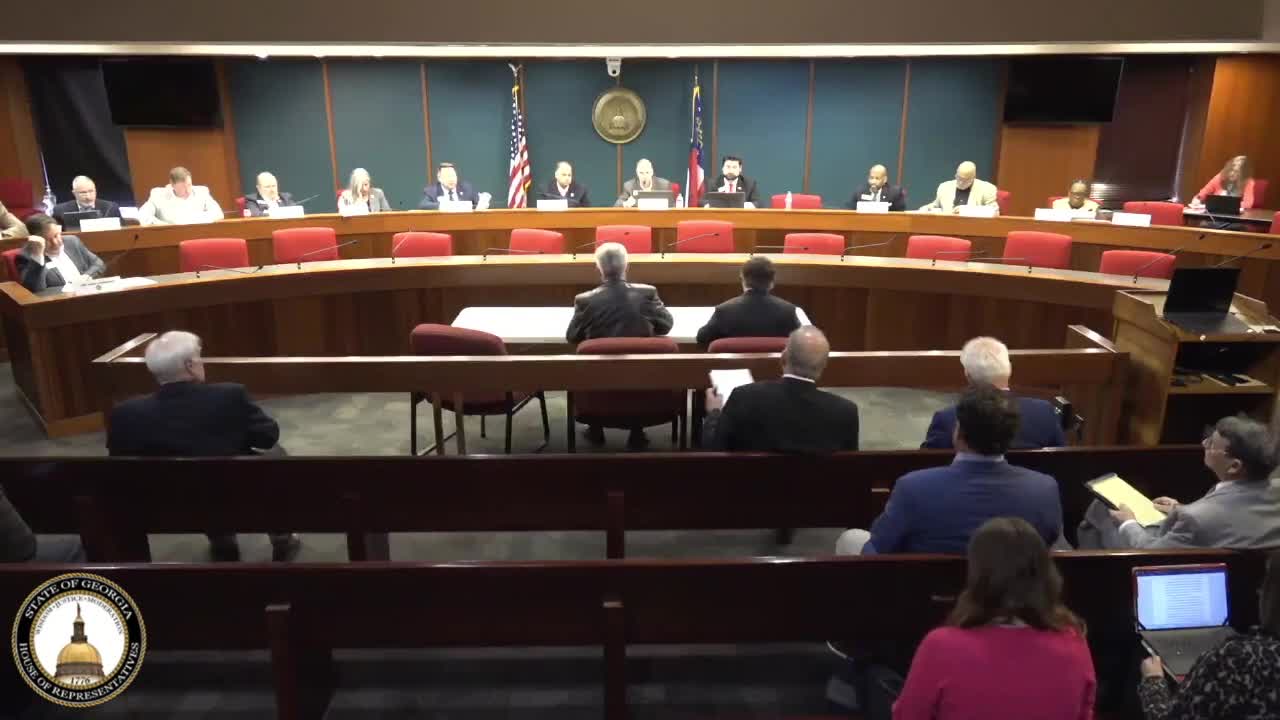
Committee tables longshoremen workers’ comp change after lengthy testimony on concurrent jurisdiction
Summary
A House committee heard detailed testimony about competing coverage under the federal Longshore Act and the Georgia state workers’ compensation law, then tabled action and sent the issue to its advisory council for study.
A House committee heard detailed testimony about competing coverage under the federal Longshore and Harbor Workers’ Compensation Act and the Georgia Workers’ Compensation Act and then tabled further action while sending the issue to the advisory council.
Brian McElreath, an attorney representing insurers and port employers, told the committee the federal Longshore Act delivers “vastly superior benefits,” including higher weekly payments and the ability for claimants to choose their treating doctor. McElreath said Longshore weekly benefits can be roughly $2,000 for high wage earners compared with about $800 a week under Georgia’s state act and that claimants typically receive an initial payment within 12–14 days in most accepted cases. He said the overlap of federal and state remedies produces inefficiencies and litigation “Frankenstein” problems when claimants pursue remedies under both systems.
Ralph Lorberbaum, a lawyer who represents injured workers, and other witnesses disagreed that concurrent jurisdiction systematically harms claimants, stressing that many injured workers rely on quicker state hearings and that benefits are not unlimited: lifetime benefits under Longshore require proof of permanent total disability, and medical coverage is limited to care related to the work injury. Bruce Carraway, another attorney with experience in both forums, described cases where lack of concurrent jurisdiction in other states produced coverage gaps that left injured workers without benefits.
Committee members asked about specifics, including whether benefit credits or offsets applied when claimants pursue both systems, how many claims follow state-first versus federal-first tracks, and the effect on port operations and competitiveness. Witnesses cited Gateway Terminal statistics: roughly 90% of claims are accepted and paid quickly, while about 10% are denied; Gateway employs about 3,700 people and the port complex is a major economic driver.
Committee leadership moved to table immediate action and directed the advisory council to examine jurisdictional options, credits for overlapping benefits, and measures to reduce administrative delay. The committee did not adopt any statutory changes at the hearing; advisory-council review and draft recommendations were requested before the next session.