Get Full Government Meeting Transcripts, Videos, & Alerts Forever!
Get email alerts on the Solar Decommissioning topic
No spam. Unsubscribe anytime.
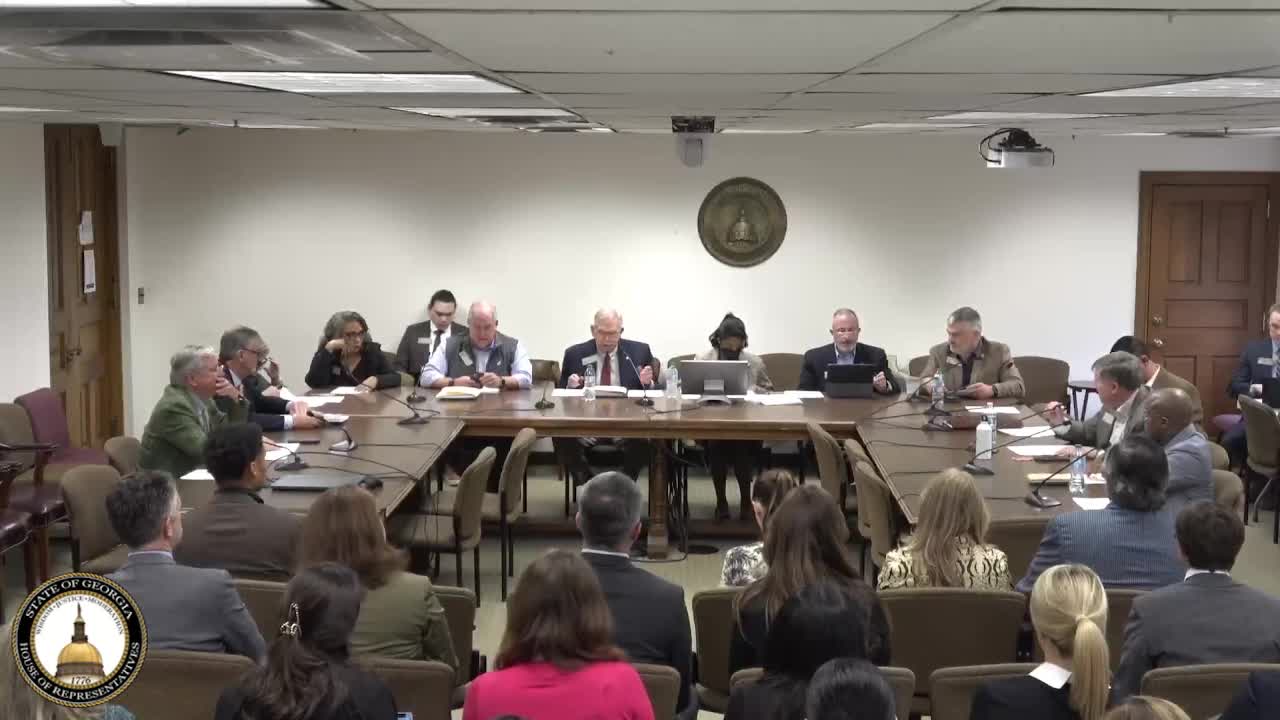
Panel approves requirement for financial assurance before utility-scale solar operates
Summary
The House Energy, Utilities and Telecommunications Subcommittee approved a committee substitute to House Bill 249 (LC 550584S) requiring operators to show environmental regulators proof of a financial instrument to cover decommissioning of utility-scale solar facilities before beginning operation.
The House Energy, Utilities and Telecommunications Subcommittee on Thursday approved a committee substitute to House Bill 249 (LC 550584S) requiring developers of solar facilities to provide evidence to the Georgia Environmental Protection Division that they have a financial instrument to cover decommissioning costs before the projects begin operation.
Supporters said the measure builds on prior legislation intended to ensure developers bear the cost of restoring land at the end of a solar facility's useful life. The presenting member said the bill is modeled on a provision in Representative Kelly's bill from last year and added that state agencies and stakeholders offered technical suggestions in recent weeks, including individuals at the Environmental Protection Division and the Public Service Commission.
Under the bill, EPD would receive documentation showing that an operator has the financial ability to decommission a facility; the presenter pointed to a provision near lines 167–168 of the bill text that spells out that requirement. Committee members were told the change imposes little additional work on either regulators or developers beyond providing proof that arrangements exist to restore sites to their prior condition.
There was no public testimony and no substantive questions that blocked the measure. The subcommittee moved to approve the committee substitute for House Bill 249 (LC 550584S) by voice vote; the chair announced the bill passed. The transcript does not record a roll-call tally or the names of the member(s) who moved or seconded the motion.
The bill leaves the subcommittee approved version ready for further processing in the House; the committee did not record additional amendments during this meeting.
Because the committee action was a voice vote, the record does not list individual member votes.