Get Full Government Meeting Transcripts, Videos, & Alerts Forever!
Get email alerts on the District Budget And Enrollment topic
No spam. Unsubscribe anytime.
Budget workshop shows recent decline in traditional FTE; staff outlines reductions and next steps
Summary
The district's first budget workshop reviewed preliminary October FTE, showing declines in traditional school enrollment and potential FY25‑26 revenue impacts. Staff outlined planned expense reductions, special‑education constraints and next steps for reconciling state counts and preparing the budget.
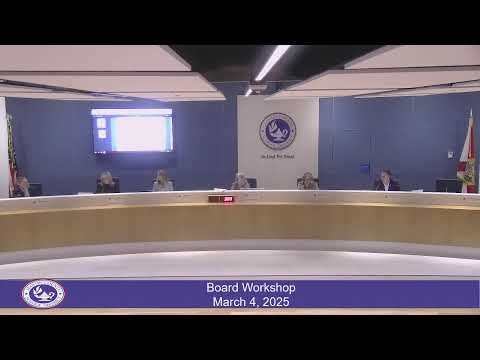
Carter Morrison led the district's first budget workshop, presenting preliminary state FTE counts and the district's projections for fiscal year 2025‑26. Morrison said the district received the state's third calculation late and that preliminary October figures show a decline in traditional (non‑charter) unweighted FTE compared with the district's projection.
Morrison presented school‑level trends: elementary schools showed modest gains overall, middle schools had documented declines (a loss of about 272.9 FTE across middle schools), and Jensen Beach High School continued to gain while Martin County High School showed a decline in the October snapshot. Charter and scholarship (voucher) counts were also discussed; the district treated scholarship/voucher counts as pass‑through funds and did not include them in operating revenue projections.
Using a combined state/local per‑student metric (presented as $9,541 per student for illustration), Morrison identified a potential revenue shortfall if projections were missed: the gap between the district's projection to the state and preliminary counts would translate to roughly $696,000 in lost revenue on the traditional side and additional charter/voucher differences; staff said the district had reserved contingency funds last year and had set aside roughly $1.3 million to offset projection risk.
Morrison also briefed trustees on other budget risks and considerations: the governor's recommended budget and legislative developments, possible changes to sovereign immunity caps under a pending House bill, inflationary cost pressures (for example, bus prices), and upcoming textbook adoptions for 2025‑26 that will affect materials spending. He noted federal grant roll‑forwards and the need to track grant balances; he also summarized federal special‑education maintenance‑of‑effort rules (CFR 300.2203) that constrain reductions in special‑education funding.
On next steps staff will finalize the October reconciliation once formal state certification is available, continue department budget submissions with requested reductions (staff said a 30% reduction target had been requested of departments with limited exceptions for special education), and return to the board with updated revenue projections and recommended reductions. Morrison said staff will publish reduction proposals and maintain transparency online.
Quotes used with permission: "We did not receive a third calculation until late yesterday afternoon," Morrison said, describing the timing of state data. Morrison said staff had set aside contingency funds so the district would not need ‘‘drastic cuts’’ in the immediate term but emphasized further reconciliation and targeted reductions are likely.