Get Full Government Meeting Transcripts, Videos, & Alerts Forever!
Get email alerts on the Land Use Rezoning topic
No spam. Unsubscribe anytime.
Commission tables rezoning request for Sebring Masonic Lodge at 1809 Home Avenue
Summary
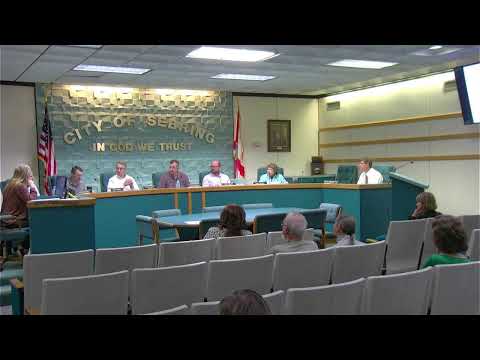
The City of Sebring Commission on first reading tabled two companion ordinances that would change the land use and zoning of a 1.38-acre parcel at 1809 Home Avenue from public/R-1 to commercial/C-1.
The City of Sebring Commission on first reading tabled two companion ordinances — 15-36 and 15-37 — that would change the future land use and zoning for a 1.38-acre parcel at 1809 Home Avenue, the site of the Sebring Masonic Lodge.
City planner Jennifer Cotto Salisbury of the Central Florida Regional Planning Council presented the item as a future land use map amendment and rezoning for the Masonic Lodge property. Salisbury said the site is about 1.4 acres, contains roughly 7,290 square feet of structure with parking, is presently designated with a public future land use and R-1 zoning, and that the proposed commercial land use would allow a C-1 zoning consistent with that commercial designation.
The change would permit a range of nonresidential uses and, under the comprehensive plan’s commercial future land use, a residential density up to 40 units per acre. Salisbury summarized staff analysis including water availability, the site’s current septic service and the need for central sewer if intensity increases, and that the parcel is outside environmentally sensitive areas.
Dana Bridal, agent for the applicants and representing Stonehenge Lane Development Consultants, told the commission the purchasers (identified in the presentation as David Lydell and Will Swain) requested a standard C-1 so they would have parity with commercial uses across the street where a Dollar General operates. Bridal said, “The reason that they are asking for a blanket C-1 is because they feel very strongly that they should be entitled to the same uses that are entitled just catty corner across the street.”
Several commissioners voiced concern that C-1 allows uses that could be incompatible with adjacent homes — commissioners named bars, liquor stores, automobile filling stations and dispensaries as examples of permitted uses that worry them. A council member asked whether a gas station would be permitted; Salisbury confirmed “automobile filling and parking stations” appear on the C-1 use list. One commissioner said they would prefer a planned development (PD) that could exclude specific uses; Bridal replied the applicants were not willing to consider a PD at this time and asked the council to vote on first reading so the applicants could decide before second reading. Bridal said, “My applicants are not willing to consider planned development at this time.”
After debate about timing, neighborhood impacts and prior planning-and-zoning review (the Planning & Zoning Committee had forwarded the request), the commission voted to table both ordinances to allow further discussion with the applicant rather than deny the application (a denial would have limited re-submittal under the zoning code). The commission’s tabling motions for Ordinance 15-36 (future land use change) and Ordinance 15-37 (rezoning to C-1) were approved by roll call. The record shows Commissioner Ray was absent; Commissioners Mendel, Stewart and Bishop voted in favor of tabling. No final land-use or zoning change was adopted.
Why it matters: the land-use designation and zoning change would alter what may be built on a site near existing single-family homes and potentially allow higher-density residential or a variety of commercial uses. Council members said the neighborhood context and specific permitted C-1 uses motivated their decision to pause action and seek further options from the applicant.
Next steps: because the applicants indicated they will not accept a PD without further conversation, staff and the applicants may confer before second reading. The commission may reintroduce the matter, but under the city zoning code a denial would have restricted re-submission for a period; tabling preserves the council’s ability to act again sooner.