
Senate committee hears $12 million request for ‘green ammonia’ research at University of Minnesota
Get AI-powered insights, summaries, and transcripts
Sign Up Free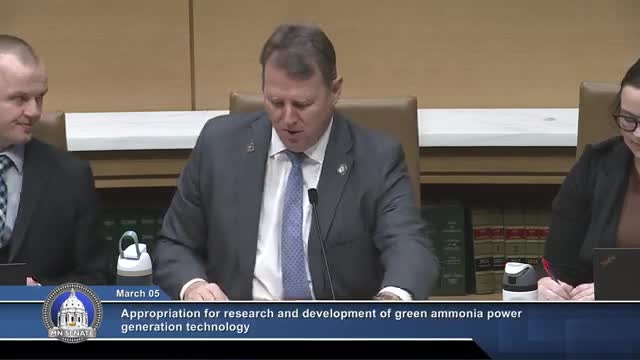
Summary
Sen. Mark Putnam on Wednesday told the Minnesota Senate Energy, Utilities, Environment, and Climate Committee that Senate File 2017 would appropriate $12,000,000 from the Renewable Development Account to the University of Minnesota to support development of “green ammonia.”
Sen. Mark Putnam on Wednesday told the Minnesota Senate Energy, Utilities, Environment, and Climate Committee that Senate File 2017 would appropriate $12,000,000 from the Renewable Development Account to the University of Minnesota to support development of “green ammonia.”
“The resources will be used to speed this research and development of the commercialization of green ammonia,” Putnam said, adding the funding would support “prototype development, performance evaluation, emissions measurement and pilot programs with real world applications.”
The request, Putnam said, is intended to help Minnesota remain a leader at the intersection of agriculture, technology and energy. The committee’s chair signaled the intention to lay the bill over for possible inclusion.
University testifiers described the technology and its near-term aims. Mike Reese, director of operations and renewable hydrogen–ammonia research lead at the University of Minnesota West Central Research and Outreach Center in Morris, told the committee ammonia can act as a hydrogen carrier and is substantially cheaper to store and transport than hydrogen itself. “It actually is more hydrogen dense than hydrogen itself,” Reese said, adding ammonia storage in Minnesota could be repurposed to provide dispatchable power when needed.
Professor Will Northrop, director of the Thomas E. Murphy Engine Research Laboratory at the University of Minnesota, described demonstration work on engines and burners. “We’ve demonstrated low emissions diesel–ammonia dual fuel engine” and other reciprocating engine technologies, Northrop said, while noting remaining technical challenges including material compatibility, fuel handling, and control of unburned ammonia and nitrogen-oxide emissions.
Testimony cited prior and existing projects: the university built an early wind-to-ammonia pilot plant in 2013 and is part of an 18-times-larger pilot plant funded by the U.S. Department of Energy that includes industry partners such as Shell, GE Research and IHI Corporation. Reese said those projects anchor Minnesota’s status as a research leader.
Committee members asked about safety, emissions and costs. Senators raised the need for data on fuel handling, NOx control, and how green ammonia might compare cost-wise with diesel, propane and natural gas. Reese and Northrop said safety expertise exists because anhydrous ammonia is widely handled in the Midwest for fertilizer, and that ongoing work aims to reduce NOx and unburned ammonia through combustion controls and after‑treatment.
The committee did not take a final vote on the measure; the chair said the bill would be laid over for possible inclusion.
The University of Minnesota and its West Central Research and Outreach Center in Morris are identified in testimony as principal recipients and implementers of the proposed appropriation.