Get Full Government Meeting Transcripts, Videos, & Alerts Forever!
Get email alerts on the Instructional Practice Vertical Whiteboards topic
No spam. Unsubscribe anytime.
Forbes Elementary teachers use vertical whiteboards to show student thinking and boost collaboration
Summary
Teachers and students at Forbes Elementary demonstrated the use of vertical nonpermanent surfaces (vertical whiteboards) as an instructional practice intended to increase engagement, make student thinking visible and support peer collaboration; a teacher-led grant and a near-universal book study helped spread the practice schoolwide.
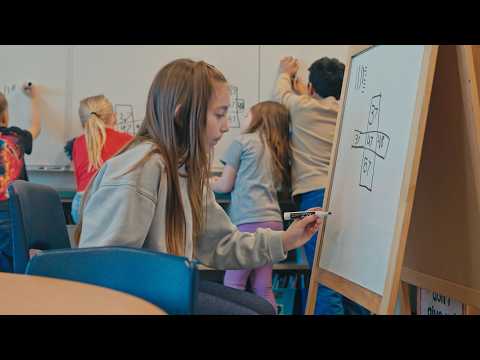
During a classroom demonstration at Forbes Elementary, teachers and students showed how vertical nonpermanent surfaces — commonly called vertical whiteboards — are being used to increase student engagement and make student thinking visible. Annette Kruger, introduced in the meeting as a first‑grade teacher at Ford Elementary, described the surfaces and how she uses them in lessons.
The demonstration centered on partners working at boards to solve problems while teachers observe and coach. "They're vertical nonpermanent surfaces is the technical name, and the main thing is that it gets students thinking," Kruger said, describing how the setup encourages active participation. River, a fifth‑grade student at Forbes Elementary, told visitors the boards let classmates borrow ideas: "Not really because she told us that, we can look on other people's work to help us understand it." Florence Pay, a professional learning communities coach at Forbes Elementary, said the practice began with the math team and spread through a voluntary book study: "I would say we were over 90% of our faculty, and it was optional."
Teachers described specific classroom mechanics that support collaboration and formative instruction. One student explained that partners take distinct roles: one holds the marker and writes while the other gives direction and talk through the solution; partners can swap marker responsibilities if someone is stuck. Students said teachers leave work on the board so peers can refer back and learn from others' approaches. Staff said the technique has been used in math and language arts, including summarizing text and citing evidence.
Staff attributed the schoolwide access to sets of boards to a math grant written by Annette Kruger; the transcript did not specify the grant amount or funding source. Pay said the math team introduced the practice to the school a few years ago and that Kruger led a book study based on the book Building Thinking Classrooms in Mathematics to help teachers adopt the method. The school said each classroom has access to a set of boards and that there are relatively inexpensive entry points for other schools interested in trying the practice.
The demonstration emphasized the instructional purpose: teachers use the visible student work to coach thinking in real time rather than only assessing finished answers. Staff framed the approach as a shift toward facilitation — allowing teachers to observe thinking, prompt students and guide discussion rather than solely delivering answers.
School staff did not propose an immediate formal policy change during the visit; they described ongoing implementation steps such as acquiring additional boards and coaching teachers through voluntary study groups. The grant that paid for current boards and the cost of expanding the practice were not specified.