Get Full Government Meeting Transcripts, Videos, & Alerts Forever!
Palm Coast council approves new utility rate path to fund water and wastewater overhaul
Summary
The Palm Coast City Council on March 4 approved a multiyear utility rate plan (scenario 3) to fund a $415 million five‑year capital improvement program for water and wastewater infrastructure, including a required expansion of Wastewater Treatment Plant 1 tied to an FDEP consent order. The measure passed 3–1; Vice Mayor Pontieri voted no.
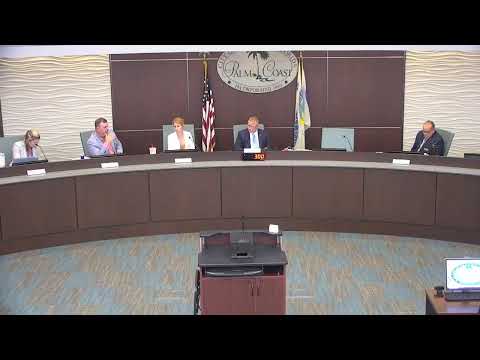
Palm Coast — The City Council voted 3–1 on March 4 to begin a multiyear rate increase and financing plan designed to fund a five‑year capital improvement program (CIP) for the city’s water and wastewater systems.
The ordinance, described in presentation materials as the recommended “scenario 3,” calls for phased rate adjustments in 2025–2027 followed by an annual index tied to a water‑and‑sewer CPI (not less than 4%) beginning in fiscal 2029. City consultants and staff told the council the plan finances about $614 million in projects over five years, roughly $415 million of which would be funded through two bond issues and the remainder through impact fees, grants, loans and reserves.
The rate path approved by the council is intended to pay for a set of projects officials said are needed to address long‑deferred repair and replacement (R&R), reduce inflow and infiltration (I&I) and add capacity — including a major expansion of Wastewater Treatment Plant 1 required by a Florida Department of Environmental Protection (FDEP) consent order.
Why it matters
Council members and city staff said the work is driven both by aging infrastructure placed during rapid growth and by regulatory obligations. Director of stormwater engineering Carl Cody told the council that the system includes 67 production wells, more than 830 miles of water main and about 700 miles of sewer main and that “the utility infrastructure is extensive and requires ongoing maintenance, repair and replacement.” Cody said the Plant 1 expansion and conversion to advanced wastewater treatment (AWT) are necessary to meet capacity needs and regulatory requirements.
Already have an account? Log in
Subscribe to keep reading
Unlock the rest of this article — and every article on Citizen Portal.
- Unlimited articles
- AI-powered breakdowns of topics, speakers, decisions, and budgets
- Instant alerts when your location has a new meeting
- Follow topics and more locations
- 1,000 AI Insights / month, plus AI Chat