Get Full Government Meeting Transcripts, Videos, & Alerts Forever!
Get email alerts on the Utilities topic
No spam. Unsubscribe anytime.
Palm Coast council approves new utility rate path to fund water and wastewater overhaul
Summary
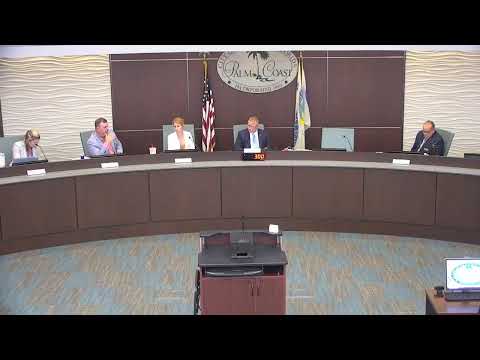
The Palm Coast City Council on March 4 approved a multiyear utility rate plan (scenario 3) to fund a $415 million five‑year capital improvement program for water and wastewater infrastructure, including a required expansion of Wastewater Treatment Plant 1 tied to an FDEP consent order. The measure passed 3–1; Vice Mayor Pontieri voted no.
Palm Coast — The City Council voted 3–1 on March 4 to begin a multiyear rate increase and financing plan designed to fund a five‑year capital improvement program (CIP) for the city’s water and wastewater systems.
The ordinance, described in presentation materials as the recommended “scenario 3,” calls for phased rate adjustments in 2025–2027 followed by an annual index tied to a water‑and‑sewer CPI (not less than 4%) beginning in fiscal 2029. City consultants and staff told the council the plan finances about $614 million in projects over five years, roughly $415 million of which would be funded through two bond issues and the remainder through impact fees, grants, loans and reserves.
The rate path approved by the council is intended to pay for a set of projects officials said are needed to address long‑deferred repair and replacement (R&R), reduce inflow and infiltration (I&I) and add capacity — including a major expansion of Wastewater Treatment Plant 1 required by a Florida Department of Environmental Protection (FDEP) consent order.
Why it matters
Council members and city staff said the work is driven both by aging infrastructure placed during rapid growth and by regulatory obligations. Director of stormwater engineering Carl Cody told the council that the system includes 67 production wells, more than 830 miles of water main and about 700 miles of sewer main and that “the utility infrastructure is extensive and requires ongoing maintenance, repair and replacement.” Cody said the Plant 1 expansion and conversion to advanced wastewater treatment (AWT) are necessary to meet capacity needs and regulatory requirements.
Consultant Murray Hamilton of Ruftalas Financial Consultants said the recommended financing balances long‑term cost with near‑term rate impact and that scenario 3 yields somewhat lower monthly bill impacts than the alternative. He summarized the recommended path as eight percent increases for four years and then an annual CPI adjustment (with a floor), and recommended issuing a first bond in late 2025 and a second in 2028, subject to feasibility work and potential grant offsets.
Details and debate
The council heard a detailed technical and financial presentation covering: water and wastewater plant capacities, a timeline for the Plant 2 expansion coming online soon, the planned 4‑million‑gallon expansion of Plant 1, well‑field additions (including brackish wells), PEP (pressure‑equalized) tank work in former ITT sections, force main projects on Old Kings Road, lift station upgrades, meter replacement and radio‑read upgrades, and a gravity sewer lining program to reduce I&I.
Staff and consultants described funding sources as impact fees, grants (including pursuit of hazard mitigation and federal appropriations), a state revolving fund (SRF) loan option for some projects, ARPA funding for specific sections, and two bond issues (the first estimated in staff comments at about $286 million, with the second to follow). Cody and Hamilton said impact fees have been exhausted for many of the near‑term projects, requiring debt to fill the gap.
Hamilton said the plan increases the city’s annual transfer to the renewal and replacement (R&R) fund and includes use of reserves to smooth rate impacts over the next few years. He also noted the plan assumes modest revenue growth (about 3% per year) and inflationary pressure on operating costs.
Public comment and council concerns
More than two dozen residents and stakeholders spoke; many described hardship for fixed‑income households and urged caution or alternative approaches. Builders and the Flagler Home Builders Association said they wanted fuller documentation of final connection and capacity fees before endorsing the proposal. Several commenters pressed the council to require developers to bear more of the immediate CIP cost and to seek additional state or federal grant funding.
Council members and staff noted a constraint: the city is subject to an FDEP consent order that requires specified improvements to wastewater operations, increasing urgency. Council members said they will continue to pursue grant and federal appropriation opportunities to reduce borrowing needs.
Votes at a glance
- Ordinance 2025, Utility Rate Amendment (adoption of recommended scenario 3, first reading / rate path approval to proceed with bond feasibility): Passed 3–1. Yes: Mayor Norris, Council member Gambarro, Council member Miller. No: Vice Mayor Pontieri. Mover/second: not specified in the record. (Staff and consultants will proceed with feasibility steps toward issuance of a 2025 bond and later 2028 bond.)
- Resolution re: Federal award for Hurricane Milton (dealt with separately on the agenda): discussed elsewhere on the agenda and adopted (see separate article).
What the council directed
Council approved the ordinance path and directed staff to proceed with the steps outlined by the city’s financial advisor and consultant: perform feasibility analyses, continue grant outreach, refine project costs, and prepare for a bond issuance in late 2025 if the feasibility work supports it. Staff said the city would continue to update council annually and planned a comprehensive 10‑year CIP to follow the five‑year plan.
Context and next steps
City staff said a full rate and fee study update will be performed no less often than every four to five years; miscellaneous service fees and connection charges will be reviewed annually to ensure cost recovery. Staff also said they are actively pursuing grants (including FEMA hazard mitigation and federal appropriations) and plan changes to debris‑management contracting to avoid the service delays residents experienced after Hurricane Milton.
Quotes
"The utility infrastructure is extensive and requires ongoing maintenance, repair and replacement," Director Carl Cody said during the presentation.
"Our strategy is to increase the annual transfer to the renewal and replacement fund to 15% of gross revenues and to finance deferred maintenance through a measured bond program," consultant Murray Hamilton said.
Ending
Council members acknowledged the ordinance will raise monthly bills for many households and promised continued outreach, documentation and pursuit of grant funding to reduce borrowing needs. Staff said the first‑reading action begins a multistep process that will include feasibility work, additional council briefings and a formal bond authorization process before borrowing occurs. Residents seeking details were directed to the city’s presentation packet and staff contacts for the utility department.