
Leavenworth hears state organics law, local composting plans as 2026 compliance date nears
Get AI-powered insights, summaries, and transcripts
Sign Up Free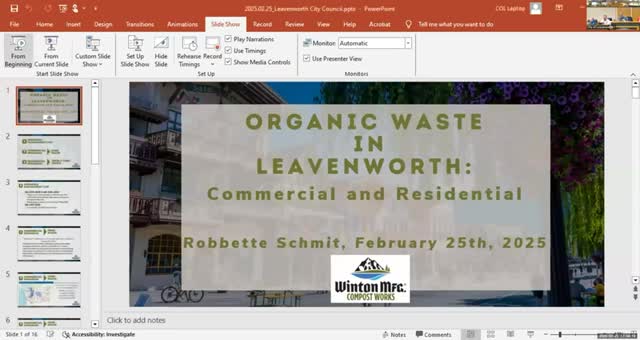
Summary
A company briefing and council discussion reviewed Washington’s organics management law, local business participation, residential options, and steps to expand composting while addressing enforcement, funding and bear-wise storage needs.
Josh, general manager of Making Compost Works, told the Leavenworth City Council and the public during a Feb. 25 study-session segment that Washington’s organics management law — which began moving through state process in 2022 and has subsequent updates — aims to divert large amounts of organic material from landfills.
“That overall goal is to reduce the amount of organic material in the landfill by 75%,” Josh said, and he summarized provisions that affect businesses and events, the state’s grant programs, and pending changes that add civil penalties and standardized bin colors.
With city and county officials in the room, Josh reviewed how the law phases in by generator size. He said that in the region already designated as a business organics management area, anyone producing more than four cubic yards of organics a week must sign up immediately; starting Jan. 1, 2026, generators producing the equivalent of a 96‑gallon container must be enrolled in a program. “What I perceive that fee is pretty much every restaurant in town by 2026 will need to start composting or have a management,” he said.
Josh presented local participation figures for Leavenworth’s commercial district: 44 restaurants (about 20% participating), hotels (18% participating), convenience/retail outlets (about 10%), and grocery/food resource partnerships. He said the Cascade School District has been composting for years and that some assisted‑living and healthcare facilities are already enrolled. Based on current participation, Josh estimated 25% of businesses are compliant; he said the state average commercial diversion rate is about 28% and that if Leavenworth matched that average the city could have diverted a larger share of organics in 2024.
“With that 28%, if that had been diverted in 2024, the city would have saved $72,000,” Josh said, citing his analysis of tipping‑fee savings and transfer station costs tied to commercial organics removed from the landfill stream.
On residential options, Josh and city staff described two paths: continue and expand the existing community drop‑off bucket program for food waste (a $5/month bucket program that currently serves about 81 households) and add a spring–fall curbside yard‑waste collection service (96‑gallon toters) for leaves and yard material. He said the recommended yard‑waste curbside fee would likely be similar to nearby communities’ elective services (approximately $13–$14 per month). Residents who subscribe to yard‑waste curbside would be offered community composting access for food waste rather than a year‑round curbside food collection, Josh said, noting seasonal collection and bear‑wise security concerns.
The presenter also described in‑town community composting receptacles being purchased with a USDA grant: polymer, lock‑access containers designed for cold climates and keyed access at drop sites to maintain the town’s bear‑wise practices. Josh said the grant will cover eight of those receptacles for public drop‑offs.
Council members and residents pressed staff on enforcement and jurisdiction. Josh said enforcement has been assigned to public agencies through the county solid‑waste management plan; the Department of Ecology and the county will play roles, and the county’s approach to enforcement is still being worked out locally. “Whoever holds that solid waste management plan is the one that has to direct those enforcements,” he said.
Council and staff discussed code changes and event permit language the Department of Ecology suggests for municipalities: requiring organic materials to be placed in designated containers, annual employee education for businesses, and including composting requirements in event permitting. Josh suggested adding language for events such as Oktoberfest into municipal codes or event contracts to align with state law and improve compliance.
The presentation closed with staff and Council discussing next steps: mapping existing participating businesses, expanding community drop‑off locations, adding curbside yard‑waste options, and using grant eligibility to fund rollout and outreach.
City staff and Josh emphasized the difference between the commercial phase already in force in parts of the county and broader residential requirements, and they flagged the county and Department of Ecology as the relevant enforcement and grant partners.
Looking ahead, staff said the council could consider code or contract language changes, coordinate with Chelan County on enforcement procedures, and use available state and federal grant programs to offset implementation costs.
Ending: The council did not make a legislative decision during the study session; the discussion produced options for staff to pursue and clarifications about timing, thresholds and available grant funding that the city will include in follow‑up briefings and future agenda items.