Get Full Government Meeting Transcripts, Videos, & Alerts Forever!
Get email alerts on the Solid Waste Ordinance topic
No spam. Unsubscribe anytime.
Brazos County holds public hearing on ordinance to prohibit landfills except on county-owned site
Summary
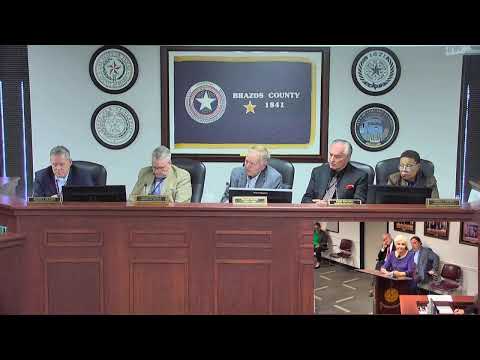
Brazos County Commissioners Court held a public hearing at 1:30 p.m. to consider an ordinance that would prohibit municipal solid waste disposal in much of the county while designating a county-owned tract on Kathy Fleming Road as the only area where disposal would not be prohibited.
Brazos County Commissioners Court held a public hearing at 1:30 p.m. to consider an ordinance that would prohibit municipal solid waste disposal in much of the county while designating a county-owned tract on Kathy Fleming Road as the only area where disposal would not be prohibited. County Judge said, "This is to designate a location for the for a landfill," explaining the step is required by state law.
The hearing, held pursuant to Texas Health and Safety Code §364.012, focused on the mechanics and local implications of formally designating an exception area rather than creating a countywide ban without such a designation. Eric McGee, outside counsel for the county, told the court that the Texas Commission on Environmental Quality (TCEQ) is the state agency that permits landfills and that Chapter 364.012 requires a county that seeks to prohibit solid waste disposal in most of its territory to first identify an area where disposal would not be prohibited.
Why it matters: designating a county-owned parcel would, the court said, give the county a measure of control and transparency by forcing prospective landfill operators to notify the commissioners court rather than allowing private parties to buy property and pursue permits without local notice. McGee described incidents in other counties where companies purchased or optioned privately owned land under confidentiality agreements, performed environmental testing, and only later filed TCEQ applications, leaving local residents and officials little advance notice.
Court and counsel details: McGee said the county does not have eminent domain authority to force a landfill on property and that any landfill proposal would still need to secure TCEQ approval and meet modern engineering requirements (liners, minimum clay/moisture specifications, floodplain limitations). He said Brazos County's situation is favorable because the likely exception area is county-owned land, a circumstance he described as "the best scenario that a county could have." McGee stated that he is aware of at least 50 Texas counties that have taken similar steps, though he said there is no centralized tracking database.
Public comments: Several residents spoke at the hearing. Carlyle Fraser asked whether a private buyer could lock up a large parcel and pursue testing before the county or neighbors knew; McGee confirmed private parties commonly use conditional contracts and confidentiality agreements while performing multi-year environmental and engineering studies before filing with TCEQ. Anne Lyons, who identified herself as a Milliken property owner, recounted historical dumping on and near Kathy Fleming Road, raised concerns about past leachate and possible groundwater contamination, and asked what protections Milliken residents would have beyond the present court. Gail Lyons asked how many other counties had adopted this approach; McGee repeated his estimate of at least 50. Another resident, identified by the court as Linda, told the court the old landfill sits above a salt dome she said reaches about 4,000 feet below the surface and warned of geologic complexity; the court acknowledged the concern.
Court response and next steps: The County Judge and commissioners emphasized that adopting the ordinance would not itself create a new landfill but would comply with state statute and preserve the court's opportunity to review any future landfill proposals. The judge said the required public-notice publications had been posted and that the ordinance will be placed on the commissioners court agenda next week; no formal vote was taken at the hearing. The judge stated he expected the ordinance to pass when the court takes formal action, but no vote or final adoption occurred during the hearing.
Technical and legal limits: Counsel and the judge made clear that even if the county designates an exception area, the TCEQ retains permitting authority and could approve or deny a landfill application based on state rules; designating a county-owned exception primarily changes the sequence and transparency of how proposals come to local officials. Counsel noted that historical TCEQ approvals and engineering work from earlier eras may not meet current standards, and he cautioned that, in rare cases, engineering solutions (for example, berms or floodplain work) have been used to qualify sites.
What was not decided: The court did not adopt the ordinance at this hearing. The hearing satisfied the statutory-public-hearing step; the court will take formal action at a future meeting (scheduled for next week at the time of the hearing).