Get Full Government Meeting Transcripts, Videos, & Alerts Forever!
Get email alerts on the Ethics Accountability Civil Rights topic
No spam. Unsubscribe anytime.
Residents and faith leaders demand action after council member posts swastika image; council debates resignation and accountability
Summary
Dozens of residents, students and faith leaders condemned recent remarks and a social‑media profile image posted by Council member Davion Williams and called on him to resign or to undertake substantive restorative engagement.
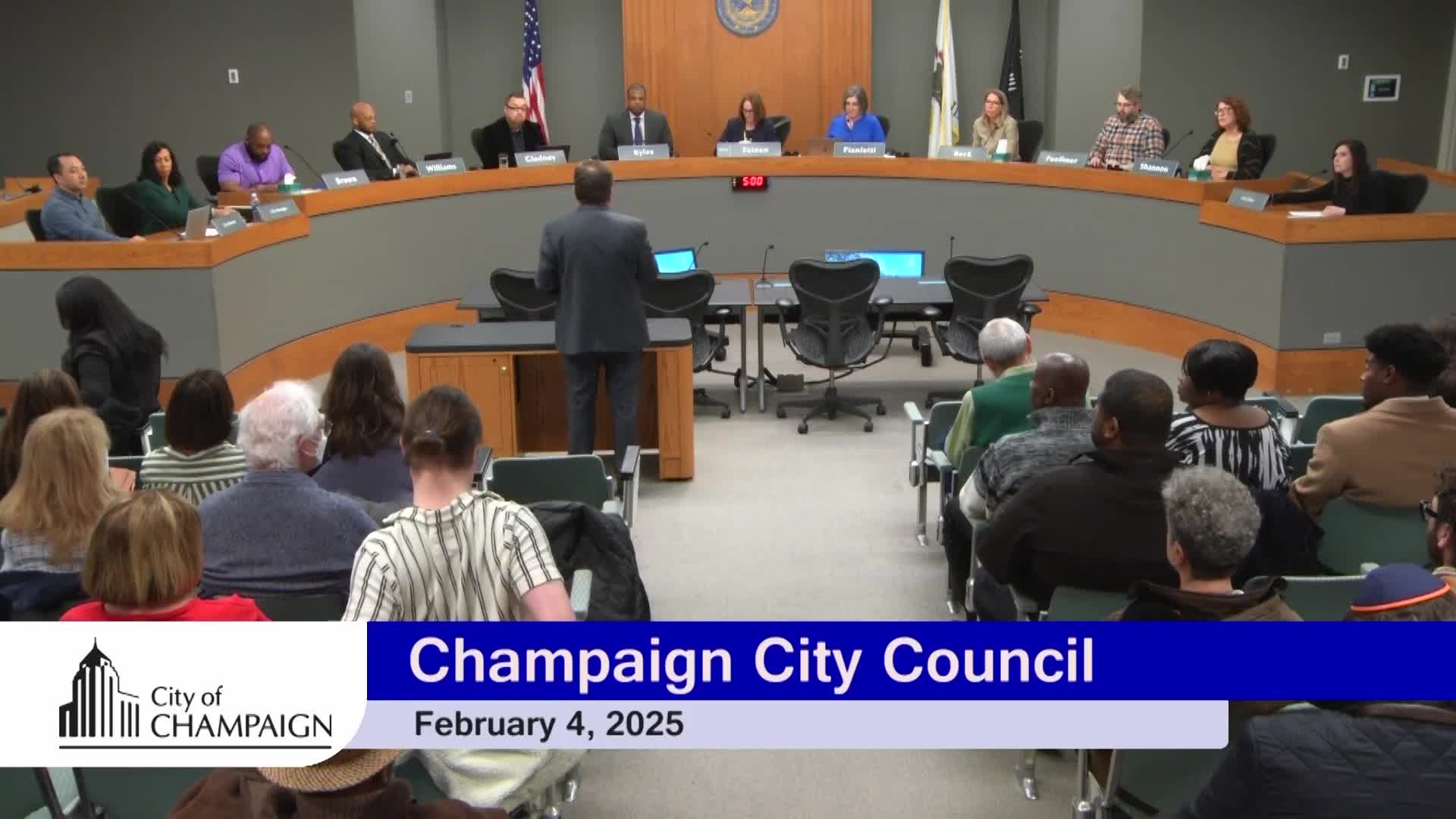
Hundreds of community members and more than two dozen speakers addressed the Champaign City Council on Feb. 4, 2025, raising sustained concerns about recent remarks and a social‑media profile image posted by Council member Davion Williams that many attendees and faith leaders described as antisemitic. Public comments included calls for Williams’ resignation, requests for meaningful engagement with Jewish and other impacted communities, and repeated appeals for the council to adopt a ceasefire resolution and socially responsible investing policies.
Rabbi Alan Cook of Sinai Temple opened public comment by saying he did not consider the council member’s written statement to be an apology and asked whether Williams was "the one who believes he did nothing wrong or the one who is truly contrite." Maayan Weinberg, executive director of the Champaign‑Urbana Jewish Federation, told the council that she and other Jewish leaders had repeatedly sought meetings with Williams and that those outreach efforts were not returned; she said she had “0 trust in council member Williams' ability to engage in this process in good faith.” Multiple speakers tied the posting of a swastika image (posted to Williams’ personal Facebook profile) to the timing of International Holocaust Remembrance Day and described the act as “calculated” and “disgusting.”
Speakers representing a range of perspectives urged different responses. Many Jewish community leaders and parishioners asked for Williams’ resignation; students and teachers described personal safety concerns after a spate of local incidents they linked to rising antisemitism; faith and community leaders urged dialogue and restorative steps. Pastor James Wright asked for “grace” and described personal knowledge of Williams’ community service. Several speakers and faith leaders said they had invited Williams to engage in dialogue previously and that attempts to follow up had not been completed.
Council member Davion Williams addressed the meeting and read an apology, saying he had underestimated “the profound and immense pain that symbol represents” and that he was “committed to listen and learn and to foster genuine understanding within our community.” Multiple council members responded during council comment. Council member Piafetti said she did not trust Williams to “make good decisions or have sound judgment” and urged resignation. Multiple other council members — including Beck, Reetz, Fulmer, Kyles, McGladden and Brown — publicly described their conversations with Williams, expressed anger or hurt, urged that Williams consider resignation to allow healing, or called for substantive restorative work that includes engagement with Jewish leaders.
Council members noted limitations on formal remedies: the body recorded that there is no mechanism under state law for recall or censure by the council itself. Several speakers and council members asked the council to consider next steps outside of removal — including formal restorative processes, direct engagement with Jewish institutions, or other accountability measures. The meeting concluded without a formal vote on discipline or removal; Williams said he has surrounded himself “with a group of individuals” to help him move forward and asked for patience while he works to rebuild trust.
Why this matters The comments at the Feb. 4 meeting reflect sustained community concern over antisemitism and local governance. Dozens of residents, faith leaders and students described both short‑term safety fears and longer‑term erosion of trust in elected leadership. The council’s public comments show deep division about whether the proper response is resignation, formal disciplinary action (which the council lacks authority to impose), or a restorative process led by the council and community organizations.
What’s next No formal disciplinary vote or resolution was recorded at the meeting. Council members and community leaders said they plan further outreach; Williams said he will work with advisers and with community leaders. Several speakers requested the council place a ceasefire resolution and responsible‑investment measures on a future agenda — items unrelated to the personnel matter but raised repeatedly during public comment.