Get Full Government Meeting Transcripts, Videos, & Alerts Forever!
Get email alerts on the Solid Waste Landfill Management topic
No spam. Unsubscribe anytime.
Collier County workshop weighs landfill expansion, reclamation and emerging technologies for long‑term waste disposal
Summary
County staff and consultants told commissioners that Collier’s integrated solid‑waste strategy has deferred immediate crisis but that policy choices are needed now: amend the ordinance to unify waste districts, align the landfill operating agreement to protect airspace, and study in‑county options including Immokalee reclamation, on‑site optimization and technology pilots.
County solid‑waste staff and consultants told commissioners at the March 4 workshop that Collier County must decide how to secure long‑term disposal capacity and outlined a menu of options that range from pursuing new technology pilots to reclaiming and expanding in‑county disposal sites.
Kerry Hudson, director of Solid and Hazardous Waste, and Daniel Deitch, a solid‑waste planning consultant with SCS Engineers, said the county’s current strategy — high recycling rates and integrated services — has bought time, but the county should set policy direction now to avoid a future disposal crisis.
“Long‑term disposal is an important matter and critically important to secure a best‑value approach before the county faces a crisis,” Deitch told commissioners. He presented three recommended policy actions: amend county ordinance 2005‑54 to create a single solid‑waste district; align the landfill operating agreement with the integrated solid‑waste management strategy (including performance standards such as in‑place waste compaction); and pursue preferred options to control long‑range disposal capacity.
Staff presented four categories of disposal options:
- Out‑of‑county disposal: staff said moving all waste out of county would require significant transfer infrastructure, create traffic impacts (roughly 50 tractor‑trailers per 1,000 tons per day), and cost roughly 35% more than in‑county disposal. The nearest private landfill is about a two‑and‑a‑half‑hour drive.
- New landfill: siting a new, modern landfill can be less costly to operate than some conversion technologies but takes a long time to permit and faces public opposition. Historically, the last new municipal landfill in Florida opened in 1998 (Sarasota County).
- Technology conversion (thermal or other conversion technologies): Deitch said the only proven large‑scale thermal conversion systems in the U.S. are mass‑burn and refuse‑derived fuel facilities; he cited Palm Beach County’s nearly $700 million mass‑burn plant as an example of a major capital investment. The county issued a request for expressions of interest to evaluate emerging approaches but concluded many newer technologies have not been demonstrated at commercial scale processing commingled municipal solid waste.
- Landfill reclamation and optimization of existing sites: staff described past reclamation work at the Collier County Landfill and noted Immokalee Landfill — an older, unlined 120‑acre site with about 20 acres used for disposal — as a potential redevelopment candidate. Reclaiming and reconfiguring Immokalee could reduce an environmental liability and create on‑site disposal capacity. Staff also outlined a potential “eastern optimization” contiguous to the Collier County Landfill that, in staff estimates, could provide very long‑term capacity (staff presented a conceptual estimate approaching centuries of capacity if developed at large scale) but would require land acquisition, LDC/PUD modifications and permit amendments and could cost hundreds of millions of dollars.
Deitch and staff said other near‑term steps would improve existing operations: set compaction performance standards in the landfill operating agreement to preserve airspace, secure more flexible long‑term disposal agreements with regional landfill operators (including for disaster debris), and move support operations to a designated Resource Recovery Business Park.
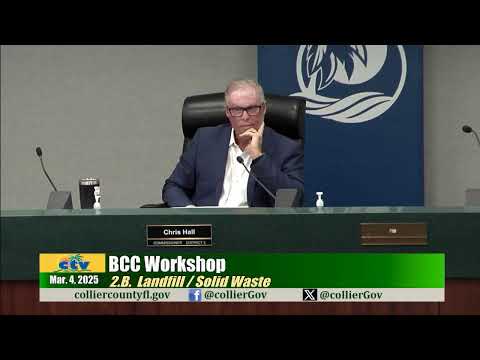
Commissioners asked questions about costs, scalability and pilot projects. Commissioner Hall asked whether the county could host a small‑scale pilot of an emerging technology and then scale up if successful; staff said the county has issued solicitations to identify potential partners and that a pilot could be accommodated in a business park area with contractual safeguards. Commissioner McDaniel and others asked for concrete analyses of how many additional years of capacity various options would provide; staff said annual capacity projections are part of the county’s existing annual landfill reports and that more detailed life‑of‑site estimates would be prepared if the board desires further study.
Several specific figures and tradeoffs were discussed during the workshop: staff said out‑of‑county disposal is roughly 35% more expensive than in‑county disposal; Palm Beach County built a mass‑burn waste‑to‑energy facility at nearly $700 million; staff described an eastern expansion scenario that consultants estimated could require significant capital (hundreds of millions) to realize long‑term capacity; and staff noted that reclaiming or reconfiguring Immokalee would require engineering, permitting and potentially land acquisition but could repurpose native soil and screened materials generated during reclamation.
The commissioners provided direction but did not adopt formal policy at the workshop. Staff were asked to return with more detailed feasibility analyses and to proceed with two near‑term tasks: drafting amendments to county ordinance 2005‑54 to create a single solid‑waste district and preparing recommended amendments to the landfill operating agreement (including compaction and other performance measures). Commissioners also asked staff to evaluate reclamation and redevelopment of the Immokalee site and to provide feasibility estimates and cost ranges for south/north on‑site expansions that would leverage land the county already owns.