Get Full Government Meeting Transcripts, Videos, & Alerts Forever!
Get email alerts on the Priority Based Budgeting topic
No spam. Unsubscribe anytime.
County briefed on ResourceX work; staff report about $37.3 million in implemented savings and new revenue
Summary
County staff and Tyler Technologies’ ResourceX reported implemented insights and ongoing opportunities from the priority‑based budgeting project, citing roughly $37.3 million in implemented savings/revenue, multiple grant awards and a program of next‑step work focused on process efficiencies and performance measurement.
Collier County officials and consultants from Tyler Technologies’ ResourceX gave the Board of County Commissioners a progress update on the county’s priority‑based budgeting (PBB) work, reporting roughly $37.3 million in implemented savings, grants and revenue changes to date and outlining a multi‑year plan to target program efficiencies and measure impact.
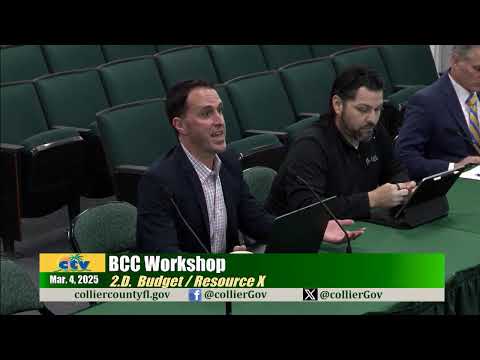
“Today we're gonna go through...we received the draft return on investment report in July of 2024,” Christopher Johnson, the county presenter, said as he opened the ResourceX update. Johnson summarized both completed items and projects in process across multiple departments.
What staff reported: Johnson and consultants listed implemented actions that staff said together total about $37.3 million in value. Examples presented to the board included: - Workforce prioritization pool: projected salary cost reduction of about $2.6 million in the pooled positions set aside for reallocation or reduction. - Public utilities grants: staff reported $10.5 million in grants received for septic‑to‑sewer conversions and related projects (three awards: $3,000,000; $4,500,000; $3,000,000) and additional grant applications totaling about $28.9 million in pursuit. - Fees and user charges: Financial planning and public utilities updated user fees, impact fees and implemented customer credit‑card processing fees; staff projected roughly $16.5 million in additional revenue from those changes. - Operational and procurement changes: rebidding landscape maintenance contracts, changing mulch color and contract structure, irrigation controller upgrades and conversion of about 70 miles of irrigation to reclaimed water were cited as contributors to savings and reallocation of roughly $1 million to date. - Pollution control and airport fee schedule changes: pollution control fee model projected $162,000 additional annual revenue; airport fee adjustments projected about $65,000 annually. - Grants and capital: a legislative appropriation funded an aquatic weed harvester (~$116,000) purchased with grant funds; the Bayshore Community Redevelopment Agency received a $1 million grant for land acquisition to expand stormwater capacity; growth management’s updated fee schedule (approved 06/25/2024) is projected to yield about $4.9 million in 2025. - Smaller operational savings: examples included a $19,000 annual savings by changing a bus data plan and contract efficiencies in other departments.
Consultant view and next steps: Chris Fabian of Tyler Technologies told the board that PBB data built last year is now being used to surface implementation options and that 2025 work will shift toward program efficiency — analyzing business processes, technology use, cross‑departmental collaboration and customer interaction points to find further savings. “This year we'll be tackling all programs with process efficiency,” Fabian said.
Fabian and Jesse Muniz (Tyler Technologies/ResourceX) outlined a phased approach: year one built the program data foundation; the current phase focuses on resource optimization and execution of high‑value insights; the next phase will analyze program efficiency (processes and technology); later years would pilot measuring program impact and outcomes.
Questions from commissioners: Commissioners asked for more explicit timelines on when projected savings and reallocations will appear in budgets and requested implementation schedules for in‑process opportunities such as stormwater funding options, advertising on county transit (CAT) and large road projects. Staff said timelines are included in the full presentation slides and that staff will return with more detailed implementation schedules; staff also noted legal and policy complications for some items (for example, CAT advertising requires further legal review because the county cannot regulate content).
Ending: Staff said they will present a policy for adoption at the next budget‑cycle meeting and will continue implementing the ResourceX recommendations, moving from funding‑model options to efficiency improvements and eventually to outcome measurements for selected pilot programs.