Get Full Government Meeting Transcripts, Videos, & Alerts Forever!
Get email alerts on the Water Quality Wellhead Protection topic
No spam. Unsubscribe anytime.
Council adopts West Metro multi-community wellhead protection plan Part 1
Summary
Bloomington joined seven neighboring communities in adopting Part 1 of a multi-community wellhead protection plan that redraws drinking-water supply management areas and vulnerabilities; staff will continue the pilot into Part 2 to identify management strategies and potential contaminant inventories.
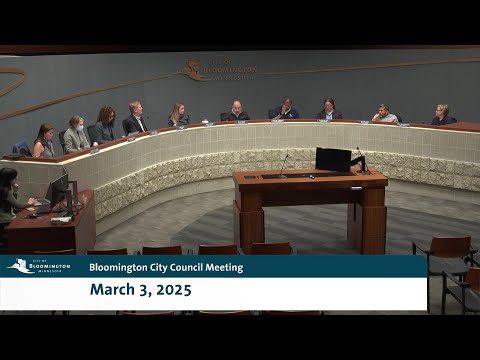
The Bloomington City Council unanimously adopted Part 1 of the West Metro Multi-Community Wellhead Protection Plan on March 3, joining seven other west-metro communities in a coordinated update of drinking-water supply delineations and vulnerability maps.
Scott Anderson, Bloomington’s utilities superintendent, told the council Part 1 is the technical "data element" of a wellhead protection plan — the delineation of wellhead protection areas, drinking-water supply management areas (DWSMAs), and vulnerability assessments. He said the revised maps reflect new hydrogeologic data and updated pumping patterns across adjacent cities and that the pilot project allowed municipalities and state agencies to work collaboratively rather than conducting separate, sequential reviews.
Anderson said Metropolitan Council and the Minnesota Department of Health jointly funded the pilot modeling that produced the updated vulnerability maps. The revised map for Bloomington shows small changes in vulnerability compared with the previous map; some nearby areas to the north increased in vulnerability when pumping from neighboring cities was incorporated into the models.
Council member D'Alessandro moved the resolution to adopt Part 1; Council member Moore seconded. After brief questions about timing and the next steps, the council voted 7-0 to adopt Part 1 and directed staff to continue with the multi community pilot for Part 2, which will focus on contaminant-source inventories, goals, objectives, and specific local management strategies.
Anderson said the Part 2 implementation effort is expected to take about a year, and staff will bring back draft management strategies and contingency plans for council consideration. He emphasized Bloomington’s existing contingency — a purchase agreement for finished water from Minneapolis that can be used if local supply is constrained — and said the city had not recorded problematic declines in its well levels at the time of the presentation.
Ending: With Part 1 adopted, Bloomington will participate in a unified West Metro approach to source-water protection and return to council as Part 2 develops site-specific inventory and management actions.