Get Full Government Meeting Transcripts, Videos, & Alerts Forever!
Get email alerts on the Procurement Bond Projects topic
No spam. Unsubscribe anytime.
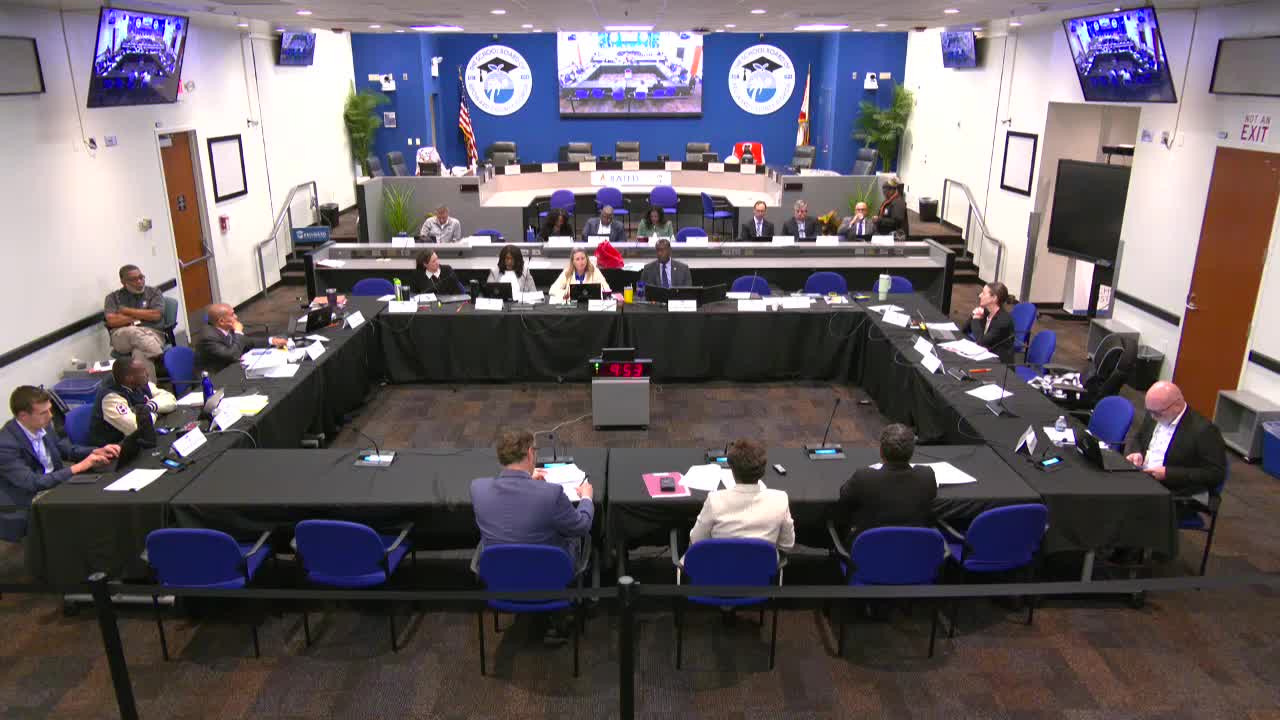
Broward school board members back six‑month AECOM extension, debate piggybacking with Jacobs
Summary
Board members in a workshop signaled support for extending AECOM’s contract for six months and launching a request for qualifications while voicing divided views on using a Duval County piggyback contract for Jacobs as project manager.
School Board of Broward County members signaled support in a workshop for extending the district’s contract with AECOM for six months and launching a request for qualifications to secure a new project manager, while expressing sharply divided views over piggybacking on a Duval County contract that would let Jacobs serve as a program manager.
The board’s discussion centered on how to staff and manage capital projects tied to the district bond program. "The hybrid approach with Jacobs and our staff from 2014 was a fiasco," Board Member Rupert said, citing the district’s earlier pre‑facility assessment and continuing delays in schools serving predominantly Black and brown students.
The endorsement for a six‑month AECOM extension came after staff explained the available lanes: a six‑month contract extension for AECOM to maintain continuity, use of a Duval County piggyback contract for staff augmentation, and an RFQ to procure one or more new program management organizations. "The most we can extend AECOM is 6 months," a staff member said, adding that the extension would carry the district to January 2026 and that an RFQ must be advertised during that period.
Board members framed the three options as complementary. "Extending the AECOM contract for 6 months and then pursuing the hybrid method, moving forward," Board Member Bowman said, describing a path that would pair short‑term continuity with a longer‑term procurement and internal capacity building. Several members said they favored running the RFQ and extending AECOM, while some supported adding staff augmentation if needed.
Concerns about using the Duval County contract focused on Jacobs specifically. Rupert and other members referenced past performance problems and a grand jury report tied to earlier work; those members said piggybacking to hire Jacobs again risked repeating prior problems. Other board members said piggybacking could provide flexibility and faster staffing but agreed the district should prioritize local service providers when possible.
Staff described how a Duval piggyback would work in practice: Duval renews its contract annually and the district could exercise that contract to add short‑term bodies while it hires permanent staff. Staff also said the piggyback could be used a la carte to add capacity quickly.
No formal vote was recorded at the workshop. Staff said that if the board reaches a consensus the administration would return with a contract amendment to extend AECOM for six months and continue work on the RFQ. "Between now and January, we have to put out a RFQ," the staff member said.
The discussion preserved a clear distinction between options being considered, direction for staff, and unresolved policy choices. Several members emphasized the need to solicit local vendors and to ensure any new contract did not replicate problems identified in prior oversight reports.
The board also discussed timing and implementation steps: the six‑month extension would maintain continuity while staff runs the RFQ; piggybacking via Duval is an available, optional short‑term tool; and final contract decisions would return to the board for approval.
Board members and staff agreed to return the agenda item with contract paperwork if the board’s informal consensus held. No formal motion or board vote on a final procurement path was recorded during the workshop.