Get Full Government Meeting Transcripts, Videos, & Alerts Forever!
Get email alerts on the Creative Placemaking topic
No spam. Unsubscribe anytime.
Bloomington adopts citywide creative placemaking plan; work plan approved with funding directive
Summary
The Bloomington City Council unanimously adopted a citywide Creative Placemaking Plan and approved a 2025 work plan that staff must pursue alongside alternative revenue and grant options. Council and presenters emphasized the plan is a framework; specific projects and costs will return for approval.
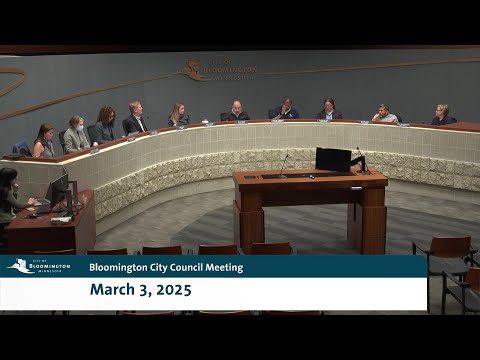
The Bloomington City Council unanimously adopted a citywide Creative Placemaking Plan on March 3 and approved the plan's 2025 work plan, directing staff to pursue alternative funding and grants before requesting new ongoing city funding.
The plan, presented by Alejandra Poinka, the city’s director of creative placemaking, and Teresa Sweetland, executive director of Forecast Public Art, lays out five goals — empowering artists, ensuring equity and inclusion, fostering connections, strengthening belonging and expanding creative placemaking citywide — and includes recommended activities, templates, sample policies and budget estimates. "Creative placemaking is powerful because it integrates arts, culture, and design to strengthen and connect communities," Sweetland told the council.
Council members praised the plan’s community engagement; presenters said more than 4,000 residents had been engaged through workshops, festivals and pop-up activities. The Creative Placemaking Commission had already given the plan a unanimous recommendation.
Council members repeatedly asked how costs would be handled. Presenter staff clarified the council was asked to approve the plan as a framework, not to authorize all listed projects or the full cost list. "We're not asking for approval of all of those activities," Poinka said, describing the project list as a "menu of options" staff would prioritize year to year.
Council member Carter said she supported the plan but sought clarity for residents reading the document: "We're not all of a sudden approving a $500,000 ask," she said, after staff explained the work plan is a vision and specific projects would return with funding requests. Council member Nelson urged staff to pursue outside funding before asking the city for ongoing resources: "I don't think we should be investing more money until we have that money," he said during debate.
Actions taken: the council (1) approved the Bloomington Citywide Creative Placemaking Plan and (2) approved the Creative Placemaking 2025 Work Plan with an amendment directing staff to pursue alternative revenue and grant opportunities. Both measures passed by roll call 7-0.
What happens next: staff and the Creative Placemaking Commission will prioritize activities from the plan into an annual work program and return to council with project-specific proposals and funding requests. Presenters said some 2025 items were already budgeted as part of the city's 2025 budget; other proposed activities will require separate approval and funding.
Community context and examples: presenters pointed to the South Loop creative placemaking efforts begun in 2016 as a local pilot and cited programs such as art box utility wraps (eight designs installed in 2024), pop-up events and partnerships with Parks & Recreation. The plan recommends exploring a percent-for-art policy, revised zoning/design guidelines and new staffing (for example, a public-art specialist or communications manager) as the program scales citywide.
Council and staff noted legal and fiscal limits: any changes that require city code changes, subsidies or developer requirements would follow standard ordinance and legal review and would return to council before implementation.
Ending: Council members encouraged ongoing community outreach and repeat reporting on funding pursuits and project priorities. The approved plan will guide creative placemaking decisions in Bloomington and serve as the basis for grant applications and partnership development over the next several years.