Get Full Government Meeting Transcripts, Videos, & Alerts Forever!
Get email alerts on the Education Budget topic
No spam. Unsubscribe anytime.
Brookline educators, union leaders and residents urge Select Board to shield schools from proposed cuts and privatization
Summary
During public comment at the Select Board meeting, teachers, union representatives and parents urged the town and school officials to avoid cuts to programming and to oppose possible privatization of custodial and cafeteria jobs the school committee is considering.
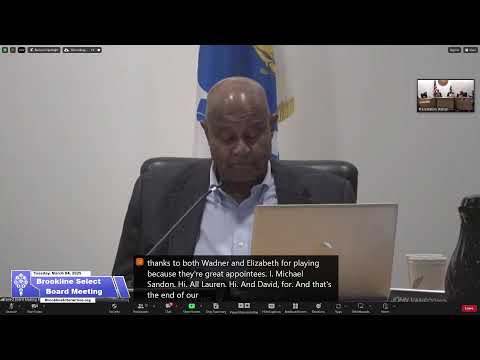
Residents, teachers and union representatives used the Select Board’s public-comment period on March 5 to urge town leaders to protect school programs, oppose privatization of school-support jobs and find alternatives to across-the-board cuts.
The speakers said proposed reductions would disproportionately harm students who rely on small classes, paraprofessionals, math and literacy specialists, counseling and special-education supports. They also said privatizing custodial and cafeteria positions would cost workers dearly and undercut continuity of service in schools.
“I ask as you make these grown-up town decisions that you keep at the forefront the question, what is in the best interest of the children?” said Daniel Lipton, a second-grade teacher and Brookline resident, who opened public comments by describing the effects of cuts on classroom music, small-group instruction and students’ day-to-day school experience.
Nut graf: The comments came as the town and schools face a multi‑million‑dollar budget shortfall. Speakers asked the Select Board to work with school leaders and unions to avoid layoffs and program reductions and to explore alternatives to outsourcing that would reduce services and pay for the district’s most diverse employees.
Jim Durkin, legislative director for AFSCME Council 93, told the board his union represents roughly 350 Brookline public‑sector workers and warned that privatization proposals before the School Committee could “result in a deep pay cut, the loss of their pension and, in all likelihood, the loss of quality health insurance” for those employees. “When it comes to health insurance, if history is any indicator, they will, under the best case scenario, be paying more out of pocket for reduced coverage,” Durkin said.
Kevin McKenzie, chair of the town’s Commission for Diversity, Equity, Inclusion and Community Relations, urged the Select Board to explore what authority the board has to intervene and “see if there's any possible way that you can intervene to protect these union jobs from privatization.”
Several classroom teachers and school leaders described how reductions would affect student supports. Rachel Keegan McGlynn, a school‑level special-education administrator, said Student Intervention Teams rely on a web of specialists — counselors, speech pathologists, math and literacy specialists — to keep struggling students in the classroom. “When we cut staff to the bone, we reduce our ability to bolster students at their moment of need,” she said, linking staff cuts to higher out‑of‑district special‑education costs.
Mark Goldner, a science teacher and Brookline Educators Union executive-board member, said cuts risk eroding professional development and curriculum coordinator roles, harming instruction across subjects and grades. “To imagine cutting special-education services even more seems unfathomable,” he said.
Other speakers gave personal examples. Maggie Canniff, a Lincoln School kindergarten teacher of 19 years, described her custodian as “my first friend at my school” and said the possibility that that worker could be fired is “heartbreaking.”
Board response and next steps: Town Administrator Michael Carey told the audience the town is arranging a deficit review audit; he said contract language with the auditing firm was nearly final and the review will take “around eight weeks” once started. Carey also said the town faces its own budgetary shortfall — “over half a million dollars” — and urged union leaders and town officials to meet to seek joint solutions.
No Select Board motions or votes on school cuts or privatization were taken at the March 5 meeting; speakers asked board members to coordinate with school officials and union leadership as the budget process continues.
Ending: Speakers emphasized that decisions this spring will shape classrooms and jobs next year, and urged an expedited schedule of town‑school collaboration. Several public-commenters said they were prepared to return to future meetings to press the point.