Get Full Government Meeting Transcripts, Videos, & Alerts Forever!
Get email alerts on the Criminal Justice topic
No spam. Unsubscribe anytime.
Pennington County State—s Attorney outlines caseloads, specialty courts and diversion in 2024 annual report
Summary
State's Attorney Laura Retzel presented the office's 2024 report March 4, citing roughly 8,000 criminal filings, expanded diversion, specialty courts, and a growing mental-health commitment workload; prosecutors urged continued support for staffing and community programs.
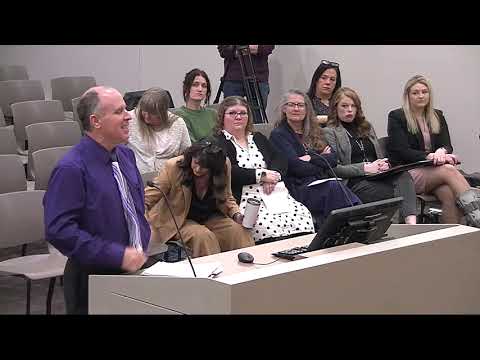
Laura Retzel, Pennington County State's Attorney, presented the office—s 2024 annual report to the Board of Commissioners on March 4, describing caseload statistics, specialty-court outcomes, victim services expansion and mental-health commitment costs.
Key figures: Retzel reported the office prosecuted about 8,000 criminal cases in 2024, down from 10,000 the prior year, and more than 6,000 misdemeanor cases. The felony division took 32 felony matters to jury trial in 2024; outcomes were 12 guilty verdicts, 8 not guilty verdicts, 8 mistrials and 4 hung juries.
Prosecution priorities and liaison work: Chief deputies described a focus on substance-use-related crimes and assaults on law enforcement. Senior Deputy Olivia Siglin explained the office—s law-enforcement liaison role, which assigns most assaults-on-officer cases to a single prosecutor to ensure consistent charging and improved coordination with police. Siglin said the role included pretrial training for officers and regular briefings: “I frequently attend shift briefings for the Pennington County Sheriff—s Office and Rapid City Police Department and speak with them about issues that they—re seeing,” she said.
Specialty courts and diversion: The office supports DUI court, drug court, veterans court and mental-health court. Director Kim Morshing said diversion programs achieve roughly an 85–86% successful completion rate and reduce recidivism; an internal review of 344 adult diversion cases in early 2024 found 17 reoffenders, many of which were low-level traffic cases.
Victim services and transparency: Retzel highlighted expansion of victim-assistance services and outreach, including a new public-information role and a justice-focused podcast. Director Tiffany Petro described a six-person victim services team that accompanies victims through the justice process.
Mental-health commitments and budget: The office budget is roughly $7.8 million, with nearly $1.85 million in operating costs and roughly $1 million in mental-commitment costs. Deputy civil staff reported about 1,237 mental-health hold filings in a recent year, while the number of final involuntary commitments was substantially lower; the office described efforts to prioritize outpatient and community services to reduce inpatient commitments.
Staffing and caseloads: Retzel said the office was near full staffing but that prosecutors manage high caseloads (felony prosecutors typically handle around 300 active felony files; misdemeanor attorneys carry very large active dockets). She and other deputies urged continued support for specialty courts and diversion as demand-management and public-safety tools.
No formal board action was required; commissioners thanked the staff for the presentation and asked for follow-up data on caseloads and cost implications for the county—s justice and jail system.