Get Full Government Meeting Transcripts, Videos, & Alerts Forever!
Get email alerts on the Rural Lending Tax Exemption topic
No spam. Unsubscribe anytime.
Banks back bill to exempt interest on rural farm, fishing and small‑town housing loans from corporate taxes; advocates warn of lost revenue
Summary
Bankers urged the Revenue Committee to pass House Bill 2,197, which would exclude interest income from certain rural loans from corporate income and commercial activity taxes; opponents said the break would erode the commercial activity tax base and questioned whether it would change lending behavior.
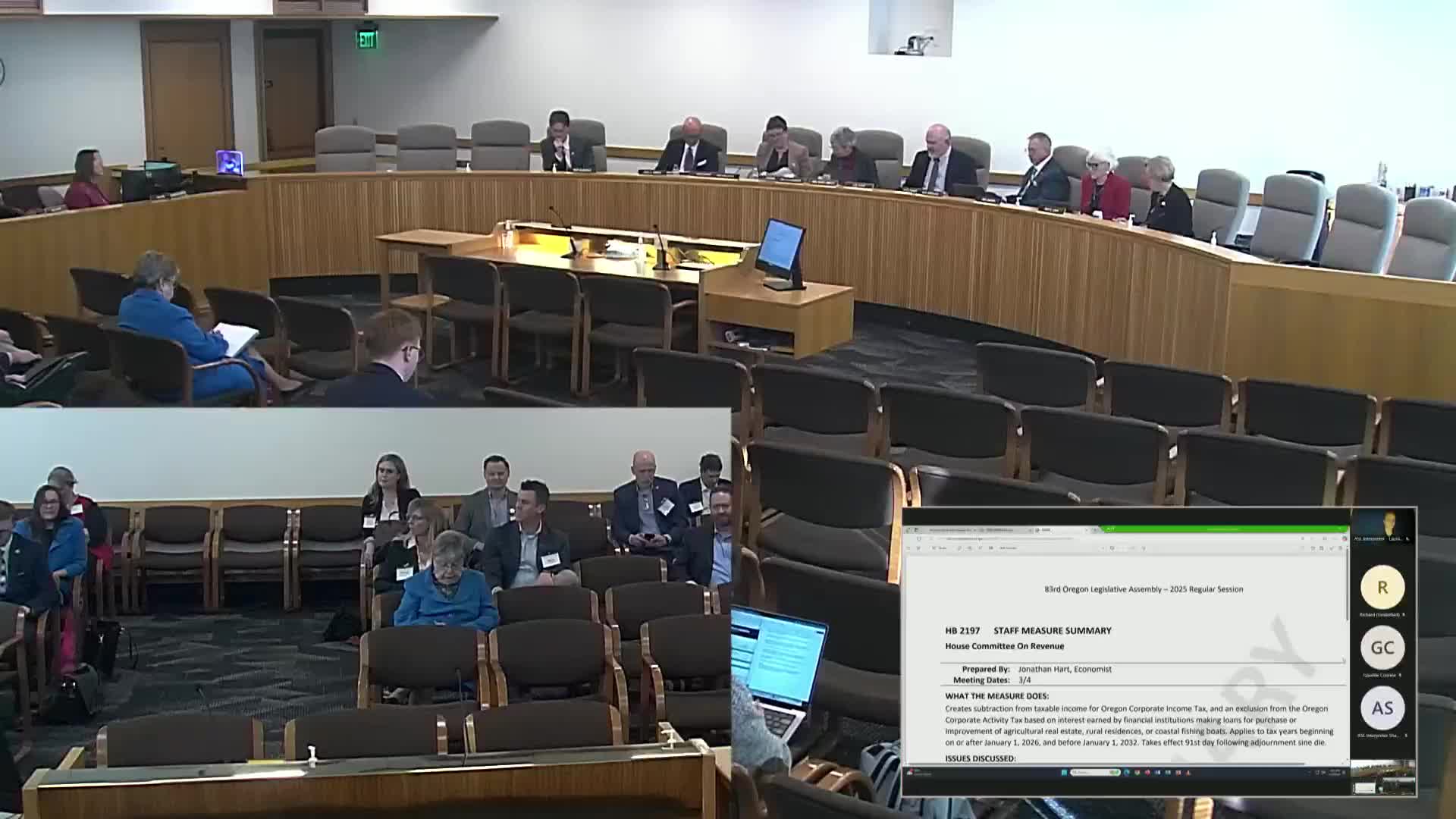
The House Committee on Revenue heard testimony March 4 on House Bill 2,197, a proposal to exempt from corporate income and excise tax, and from the commercial activity tax, interest income that financial institutions earn on loans for agricultural real estate, commercial fishing vessels, and rural residences in towns of 2,500 population or fewer.
Kevin Christiansen, government affairs director for the Oregon Bankers Association, said the measure—described by supporters as Oregon’s version of the Access to Credit for Rural Economy (ACRE) Act—would lower the cost of credit for farmers, ranchers, fishermen and rural homeowners without creating a new government program. “By lowering cost for rural borrowers, ACRE will bolster agricultural producers and rural communities,” Christiansen said.
Jeff Bailey, president and CEO of Bank of Eastern Oregon, and Lance Nunn, president and CEO of Oregon Coast Bank, described local impacts. Bailey said community banks provide a large share of farm lending in rural areas and that HB 2,197 would help them match pricing of lenders that already receive favorable tax treatment. “This bill will lower the cost of credit for farmers and ranchers, enhance competition for agricultural and rural housing credit, and helps sustain access to local credit decisions in rural Oregon,” Bailey said.
Lance Nunn said reduced tax on interest income would allow banks to offer more attractive financing, reduce barriers to entry for new producers and help preserve the diversity of smaller producers in agriculture and fishing. Nunn added agricultural statistics to frame the bill’s stakes: “Eighty percent of Oregon’s agricultural production is sold out of state,” he said, and agriculture accounts for a significant share of exports and jobs in Oregon.
Opponents argued the bill would remove revenue from the commercial activity tax (CAT) and that the financial sector has posted strong profits. Richard Swift of Taxpayers Oregon said there is no data showing a tax break for lenders would produce more loans; “Tax Fairness of Oregon opposes HB 2,197,” Swift said. Marcia Kelly noted financial institutions and insurance generated about $47 million in CAT in 2022 and cautioned that excluding interest from the CAT reduces funds that support services such as education. Kelly also suggested limiting loan size or otherwise adding sideboards for residential lending to rural properties.
Committee members asked clarifying questions about who benefits, how the bill interacts with federally favored lenders, and how it would affect competition between community banks and larger or tax‑favored entities. No committee vote was taken; the chair closed the public hearing.
Votes at this hearing: None (public hearing only).