Get Full Government Meeting Transcripts, Videos, & Alerts Forever!
Get email alerts on the Health Care topic
No spam. Unsubscribe anytime.
Senate committee hears bill to limit corporate control of medical practices; debate centers on MSOs, noncompetes and patient access
Summary
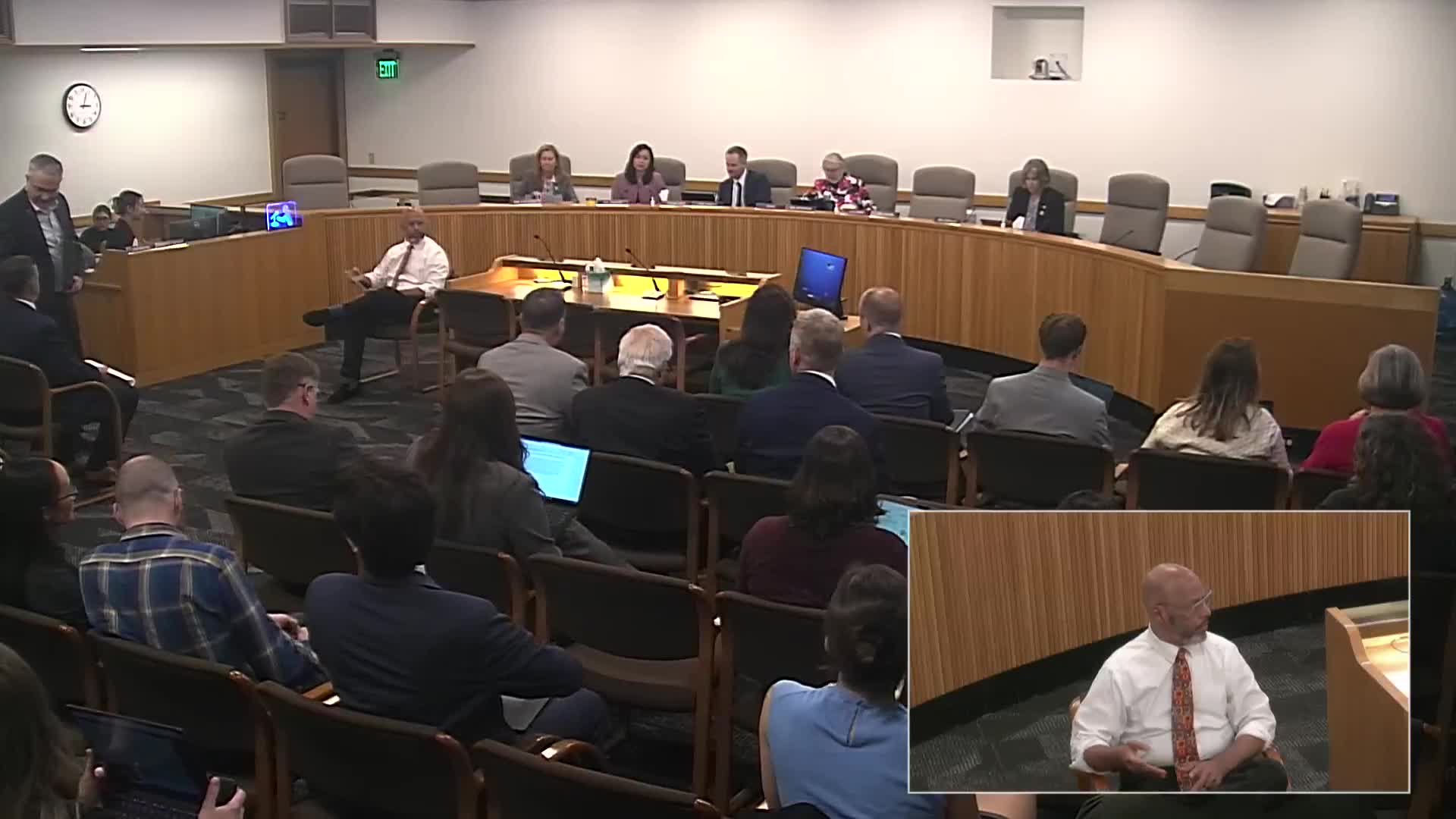
Senate Committee on Health Care Chair Patterson opened a public hearing March 4 on Senate Bill 951, a proposal that would tighten Oregon’s corporate practice of medicine rules by defining management service organizations (MSOs), restricting when nonlicensed entities can exercise control over medical practices, and limiting certain restrictive contracts between providers and other entities.
Senate Committee on Health Care Chair Patterson opened a public hearing March 4 on Senate Bill 951, a proposal that would tighten Oregon’s corporate practice of medicine rules by defining management service organizations (MSOs), restricting when nonlicensed entities can exercise control over medical practices, and limiting certain restrictive contracts between providers and other entities.
The measure, sponsored in the House by Representative Ben Bowman, was presented to the committee with three posted amendments (dash-2, dash-3 and dash-5). Under the introduced measure, the MSO provisions would take effect Jan. 1, 2029; the remainder of the bill would be effective on passage.
Supporters told the committee the bill is designed to preserve clinician control of medical decisions and protect patient care. "Medical decisions should be made by licensed providers who have an ethical duty to their patients and not by corporations or private equity firms who have a fiduciary duty to their shareholders," Representative Ben Bowman said. Bowman described MSOs as third-party vendors that can be used to exert de facto control when investors rely on contractual arrangements and so-called "captive" physicians.
Representative Cyrus Javedi, who identified himself as both a legislator and a health-care provider, said the bill does not ban corporate investment or MSOs but would prevent corporate entities from exerting clinical control. "This bill doesn't eliminate corporate involvement. ... It simply ensures that corporate entities cannot exert control over clinical decision making," Javedi said, citing examples he said led to clinic closures and longer patient travel for care.
What the bill would change
Key provisions presented by staff and sponsors define "management services organization," define "ownership and control," and narrow the circumstances in which a licensee who is an officer of a professional medical entity may also be an employee of or participate in an MSO. The bill would also void certain noncompete and nondisclosure provisions in agreements between health-care practitioners and a list of facilities; the dash-5 amendment, as reported to the committee, narrows enforcement language by removing an unfair trade practices designation and permitting a private civil remedy in limited nondisclosure or nondisparagement cases.
The dash-5 amendment also added specificity to the definition of control to include de facto control and allowed noncompete agreements during an employee's first three years in certain situations. The dash-3 amendment, offered by another member, would require Oregon Health Authority approval for transactions in which more than 500 members move between a coordinated care organization or dental care organization and would allow providers in such transactions to communicate with members without running afoul of nondisclosure or nondisparagement terms.
Supporters' testimony
Senator Lisa Reynolds, who also identified herself as a pediatrician and a clinician-owner of a practice, said patient care is harmed when business decisions, rather than clinicians, dictate clinical operations. "When we as physicians ... lose control over these operations, a lot of these priorities fly out the window, replaced by cost cutting, staff layoffs ... a focus on profits," Reynolds said.
Senator Kathleen Taylor and other legislators described local examples — including the purchase of longtime independent clinics by larger corporations — and said constituents had reported lost providers and reduced services after acquisitions. Representative Sarah Finger McDonald said her district's Corvallis Clinic lost nine primary care providers after a sale and that the clinic's lab was closed for six months, producing longer waits for routine services.
Many practicing clinicians and physician groups testified in favor. Dr. Alyssa Perakanik, who said she is vice president of the Association for Independent Medicine, testified that physicians increasingly feel "like ... cogs in the machine" under corporate ownership and that the bill is a modest step to protect clinical autonomy. Dr. Nicholas Jones, a family physician who said he left a purchased group to start his own practice, told the committee the measure could encourage physicians to stay and potentially recruit others to Oregon.
Opposition and concerns
Several witnesses warned of unintended consequences. Representative Ed Deal, speaking in opposition, said the bill would "place unfair and unnecessary restrictions on medical providers, threatening patient access to care, and discouraging capital investment in Oregon's healthcare sector." Deal argued the bill could make it harder to attract the capital needed to expand services, particularly in underserved and rural areas.
Healthcare attorneys and industry groups told the committee the draft contains ambiguities that need clarification. Peter Ricoy, a health-care attorney, listed multiple areas he said were unclear, including whether physicians may own interests in MSOs that serve their practices, how the "fair market value compensation" exception would apply, and whether the restrictions on transfers apply to forced transfers or other circumstances. "We need this committee's clarity on what you intend," Ricoy said.
Industry representatives said the bill as drafted could make it harder to recruit and retain senior physicians who expect ownership stakes, to acquire expensive equipment, or to form partnerships that sustain services in small communities. The Oregon Ambulatory Surgery Center Association and other groups asked for clearer cross-references to existing statute and for drafting fixes so common administrative delegations (billing, payer contracting, equipment acquisition) would remain feasible.
Other testimony addressed enforcement. The dash-5 amendment removed the unfair trade practice label that staff had described early in the hearing but preserved limited private civil enforcement for some nondisclosure/nondisparagement matters; several organizations, including the Oregon Liability Reform Coalition and the Oregon Medical Association, urged the committee to consider enforcement via the Attorney General or a regulatory agency rather than broad private damages.
Quantitative and technical clarifications from testimony
- The MSO provisions in the introduced bill were described as taking effect on Jan. 1, 2029; the remainder of the bill would be effective on passage. - The dash-5 amendment would allow noncompete agreements during the first three years of an employee's term in certain circumstances. - The dash-3 amendment would require Oregon Health Authority approval for transactions moving more than 500 members between a CCO or dental care organization and allow provider communications to members in those transactions. - Some witnesses cited local impacts: Representative Finger McDonald said nine primary care providers left the Corvallis Clinic after a takeover; she said no primary care providers in Corvallis were accepting new patients at the time she testified.
Committee process and next steps
Committee members and sponsors repeatedly said the bill had been shaped by a months-long work group that included stakeholders from multiple sectors. Sponsors urged the committee to use the short session time to refine the measure; opponents and several testifiers urged additional drafting fixes, clearer definitions, and attention to enforcement mechanisms.
No vote was taken during the hearing. Chair Patterson closed the public hearing after receiving extensive oral and written testimony and said deliberations on SB 951 would continue in committee.
Ending
The committee received dozens of oral witnesses and written submissions filed on OLIS. Committee members indicated they expect additional amendments and drafting work before any floor action; for now the hearing record remains open and the bill is under continued consideration.