Get Full Government Meeting Transcripts, Videos, & Alerts Forever!
Get email alerts on the Public Contracts Disclosure topic
No spam. Unsubscribe anytime.
Bill would require firms earning 20%+ from public contracts to disclose amounts on tax returns
Summary
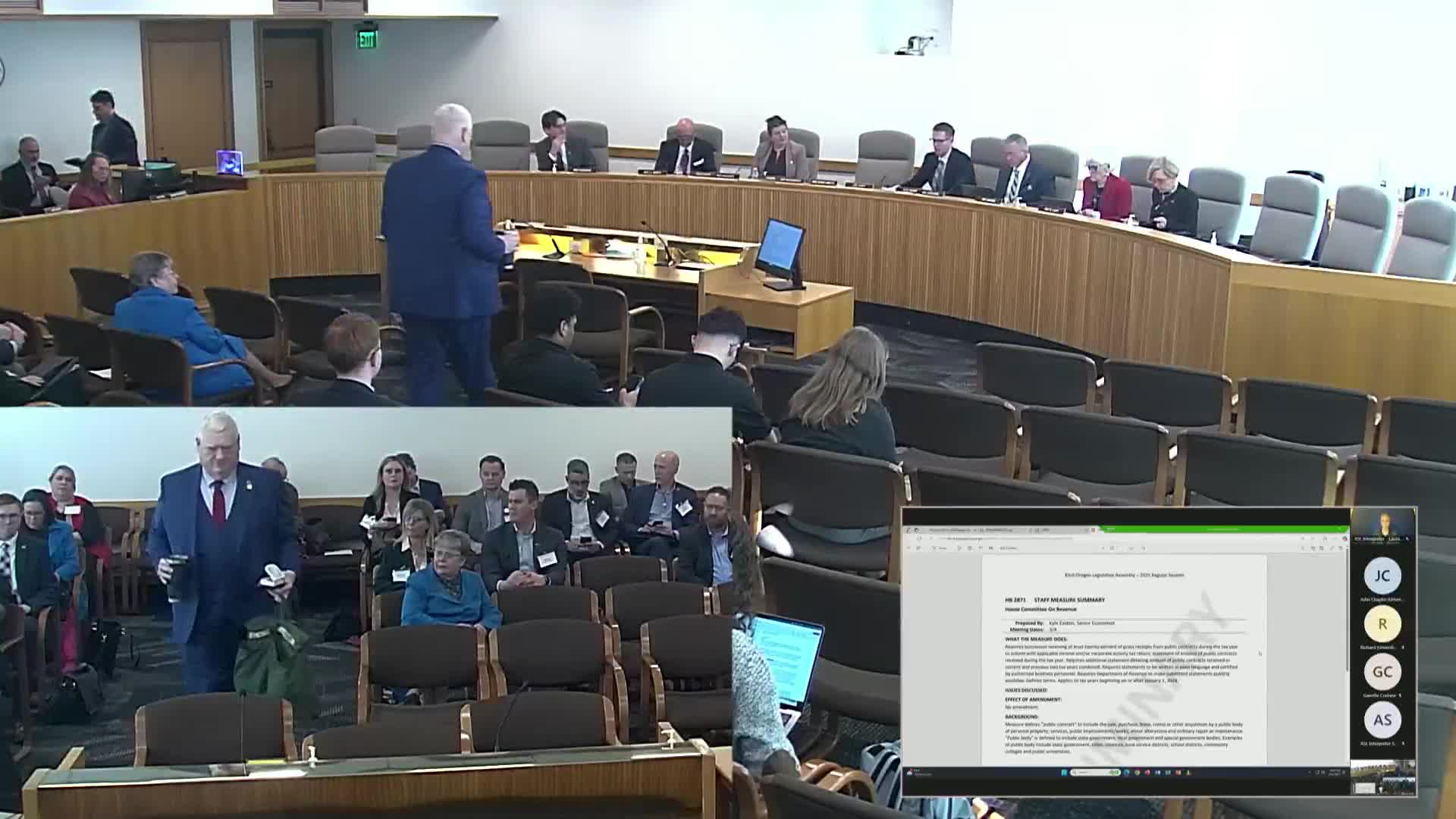
The House Committee on Revenue opened March 4 for public testimony on House Bill 2,871, which would require businesses receiving at least 20% of gross receipts from public contracts during a tax year to file a statement of those amounts with their tax returns.
The House Committee on Revenue opened March 4 for public testimony on House Bill 2,871, which would require businesses receiving at least 20% of gross receipts from public contracts during a tax year to file, with applicable income or corporate activity returns, a plain‑language statement of the amount of public contracts received that year and for the prior two years. The Department of Revenue would publish the submitted statements; the requirement would apply to tax years beginning Jan. 1, 2028.
Representative Paul Evans, who introduced the proposal, said the bill aims to clarify the boundary between private entities and entities substantially funded by public contracts and to increase transparency about which businesses act as public partners or agents. “The public should know if a private corporation receives so much or nearly all gross income from public funding,” Evans said, and described a tiered labeling approach in the bill (affiliate, public partner, public agent) based on percentage thresholds.
Business groups and contractors raised objections. Derek Singston of Oregon Business and Industry said the 20% threshold and accompanying look‑back create additional accounting and compliance burdens that could be especially difficult for small businesses and firms that rely on multi‑year public contracts. “House Bill 28 71 would impose unnecessary administrative requirements,” Singston said, warning it could shrink the pool of bidders for public contracts.
Kirsten Adams of Associated General Contractors and Marshall Koba of the American Council of Engineering Companies expressed similar concerns about paperwork, compliance costs, the new terminology the bill would create, and the potential for qualified firms to decline to pursue public work. “For smaller contractors the administrative burden … would likely make it so that they do not bid when they are getting close,” Adams said.
Representative Smith challenged the industry witnesses’ characterization of the proposal as burdensome, calling the requirement “a single sheet of paper” and urging a substantive argument against the disclosure requirement. Witnesses responded that while the form might be simple, the calculations needed to determine the applicable percentage for multi‑year contracts and different tax years could be complex for some firms.
The committee did not vote on HB 2,871 during the March 4 session. The public hearing record remained open for additional written testimony to be submitted within the usual posting window.
Votes at this hearing: None (public hearing only).