Get Full Government Meeting Transcripts, Videos, & Alerts Forever!
Get email alerts on the Rail topic
No spam. Unsubscribe anytime.
ODOT, railroads outline needs and funding options as passenger ridership grows
Summary
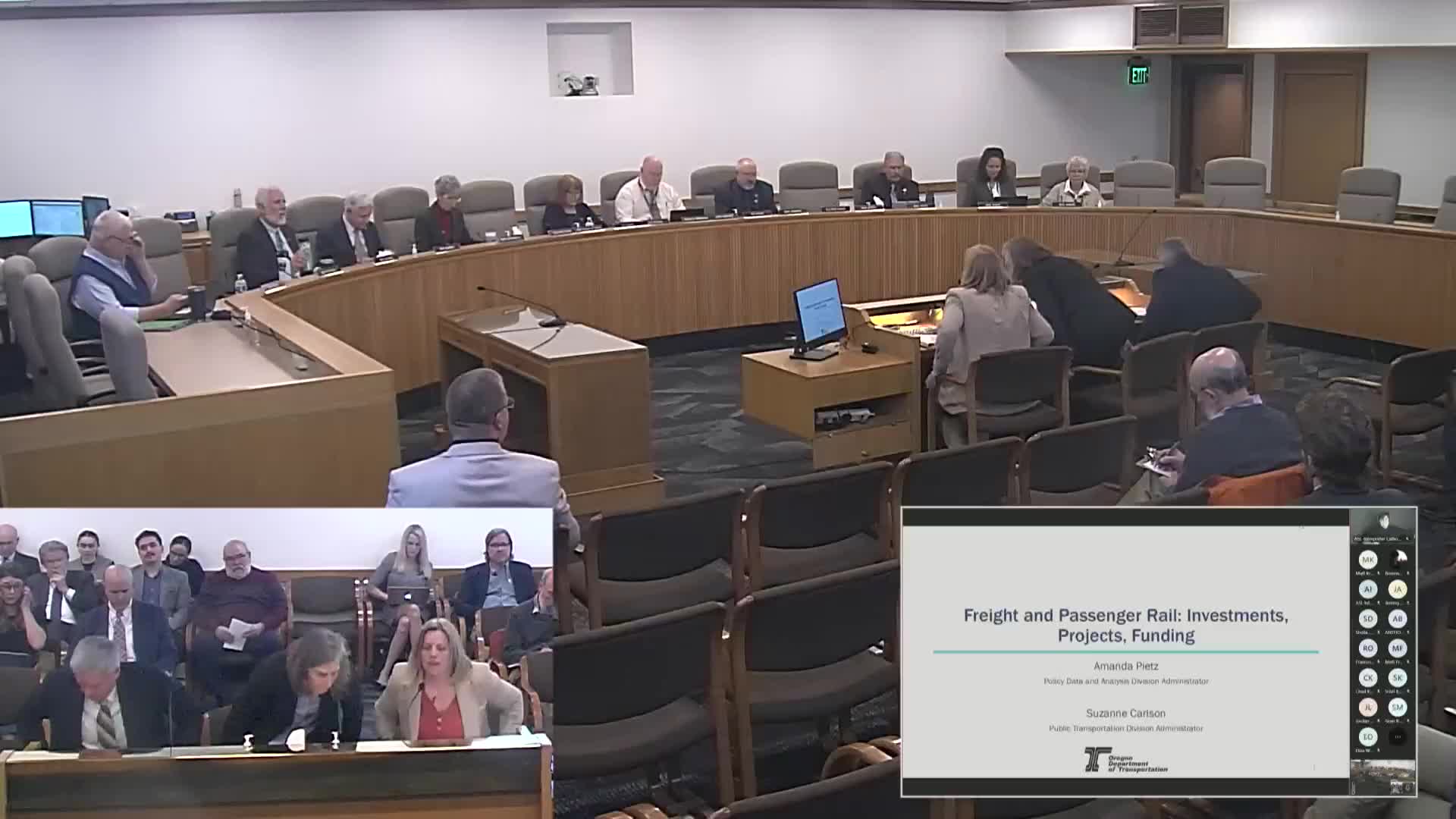
At a March 4 informational meeting, Oregon Department of Transportation staff and freight and passenger rail operators described a rail system largely owned by private companies, identified capital and safety priorities, summarized Connect Oregon funding, and urged more match and corridor planning to capture federal grants.
At an informational meeting of the Joint Committee on Transportation on March 4 in Salem, Oregon Department of Transportation officials, Amtrak and representatives of major and short-line railroads described the state rail system, recent ridership gains and a list of projects they say will be needed to expand passenger service and improve freight efficiency.
"ODOT does not own or operate any rail service in the state," Amanda Pietz, administrator for the Policy, Data and Analysis Division at the Oregon Department of Transportation, told the committee, adding that the agency owns about 55 miles of right-of-way under tracks but that most lines are privately owned and any work requires owner approval.
The distinction matters because much of Oregon’s rail network — including the lines used by Amtrak Cascades and most freight routes — is owned and operated by Class I and Class III companies. That structure shapes what public dollars can achieve and where state or local funding will be needed to leverage federal grants.
Pietz summarized the state’s dedicated rail funding. Connect Oregon, a competitive capital grants program, is the largest state source for rail improvements at roughly $45 million per biennium. Smaller amounts support crossings and state-supported passenger services; federal grants are critical but often require match or projects to be at a sufficient design level to be competitive.
"Connect Oregon . . . that's about 45,000,000 a biennium for that program," Pietz said, noting the program’s two-decade history and that the most recent competitive round, Connect Oregon 9, was approved by the Transportation Commission in August 2024.
Officials gave examples of Connect Oregon projects ranging from a roughly $400,000 spur that let a food producer receive rail shipments to multi-million-dollar investments to remove curvature and increase speeds. Pietz said the competitive rounds historically distribute a large share of grant dollars to rail projects; ODOT staff noted that roughly 44% of the competitive funds in recent rounds went to rail projects (about 32% if measured across the full program history when other modes were previously eligible).
Passenger rail officials described rising ridership and growing operating costs. "We're seeing record ridership on the Oregon portion" of the Amtrak Cascades corridor, Suzanne Carlson, division administrator for ODOT’s Public Transportation Division, told the committee. Carlson said state-supported corridors grew 27% in 2024 and that the Oregon segment recently showed a 32% increase over 2023; those gains have increased fare revenue but also raise ongoing operating and equipment costs.
Carlson said ODOT estimates current service will cost about $8.5 million more per year as new trainsets are introduced and as catch-up maintenance and inflation raise operating expenses. Amtrak representatives said new equipment is on order and that Amtrak will place eight new trainsets in revenue service next year, each with about 300 seats; Amtrak also described a major new Seattle maintenance facility under construction.
Freight operators described recent investment in Oregon track and yards and urged continued public–private coordination. "From 2019 to 2023, Union Pacific invested $430,000,000 on our Oregon infrastructure," a Union Pacific representative told the committee, citing work on switches, rail and bridge systems. Johan Hellman, BNSF executive director of public affairs for the Pacific Northwest, said BNSF has invested about $90 million in Oregon over the past five years.
Representatives of short-line railroads and ports said public grants remain essential for lines that serve local industries. Christine Everts of Portland & Western and the Central Oregon & Pacific described short lines’ role in the first- and last-mile of freight movements; Matt Friesen, director of external affairs for the Port of Coos Bay, described the port’s 34-mile short-line railroad, recent tie and bridge work and larger regional planning for a proposed intermodal project.
Panelists and legislators discussed federal programs and planning steps that the state is pursuing: ODOT is updating the Oregon State Rail Plan (required every four years) and has entered its passenger corridor into the Federal Railroad Administration’s Corridor Identification (Corridor ID) process to qualify for certain federal grants. ODOT and Union Pacific are running corridor modeling that officials said will inform project sequencing and identify siding and passing locations needed to improve both freight velocity and passenger reliability.
ODOT officials and railroad partners urged the committee to consider stable match and planning funds so projects can reach the design readiness levels that competitive federal programs commonly require. ODOT described a statewide rail needs inventory that lists hundreds of freight and passenger projects (track upgrades, grade crossing improvements, bridge rehabilitation and station work) that the agency said it will use to match grant opportunities.
The informational session closed with committee members asking follow-up questions about specific projects and siting options; ODOT said staff would follow up on items where more detail was requested.
ODOT staff said they expect to finalize the State Rail Plan in the fall and continue corridor modeling with federal partners and host railroads this year.