Get Full Government Meeting Transcripts, Videos, & Alerts Forever!
Get email alerts on the Unemployment Insurance Tax Credit topic
No spam. Unsubscribe anytime.
Committee hears bill to give some employers temporary tax credit for pandemic-era unemployment spikes
Summary
A public hearing on House Bill 2,271 reviewed a proposal to create a limited nonrefundable tax credit for employers whose unemployment insurance tax rates were frozen higher after COVID-era claims. Supporters described the bill as targeted relief; advocates urged caution about scale and eligibility.
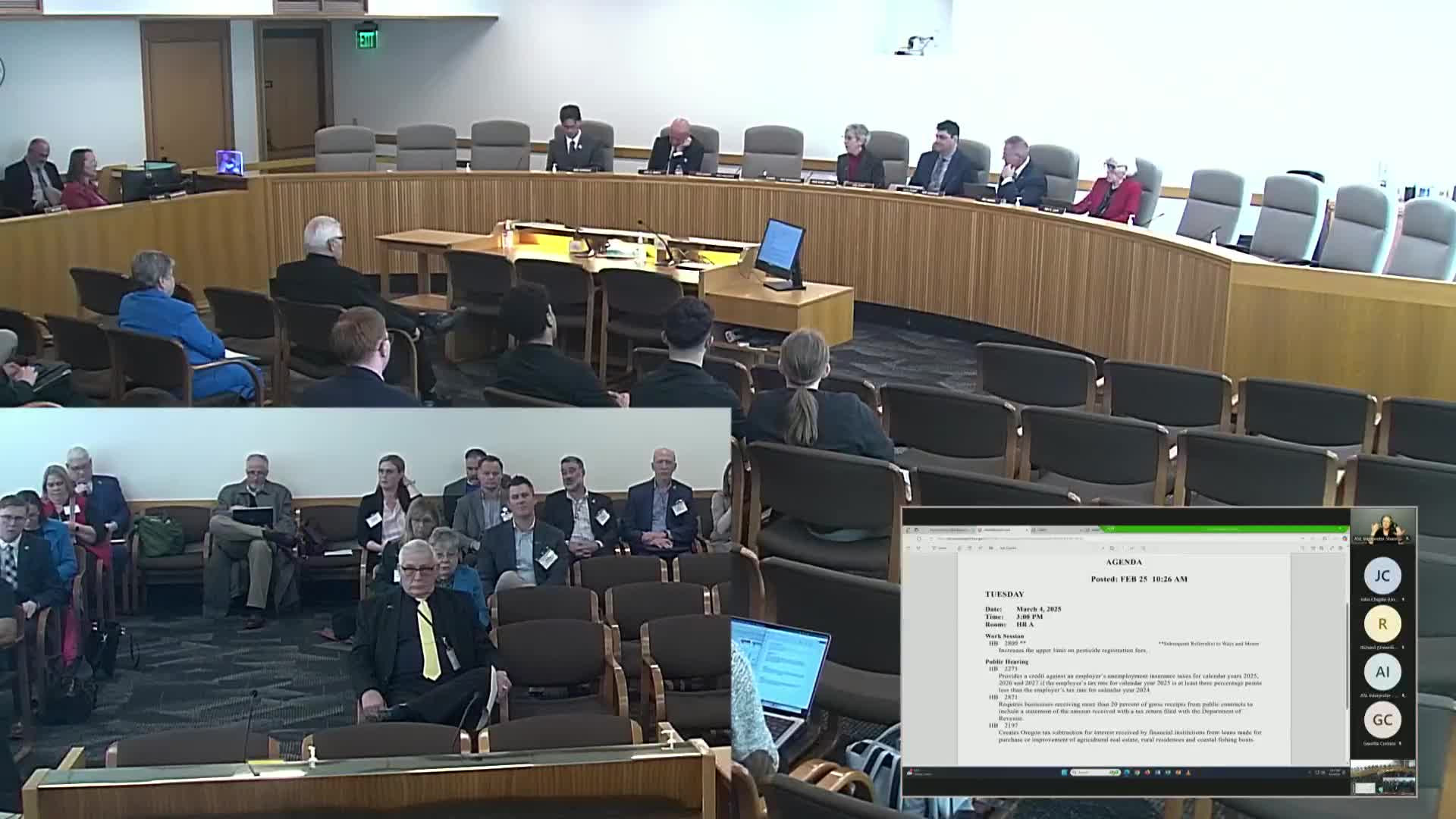
House Committee on Revenue Chair Nathanson opened a public hearing March 4 on House Bill 2,271, which would create a nonrefundable tax credit for employers to offset unemployment insurance payroll taxes in certain cases where employers’ experience ratings were held at pandemic-era levels.
The bill would pay, for tax year 2025, the lesser of $5,000 or an employer’s taxes due for 2025; for 2026 and 2027 the credit would be the lesser of that year’s taxes or the 2025 credit. The measure limits eligibility to employers whose 2025 tax rate is at least 2.5 percentage points lower than in 2024 (the committee noted a dash-1 amendment reduces the original 3-percentage-point threshold to 2.5), who had an experience-based tax rate determination for 2020, who filed wage reports and paid taxes for 2024 and 2025 on time, and who are complying with payment terms for outstanding unemployment insurance tax-related obligations as of Jan. 1, 2025.
Representative Boomer Wright, who presented the bill, said the proposal aims to help small employers who were “stuck” with higher rates because of COVID-era claims and a three-year experience-rating freeze enacted in 2021. “Two years ago I got a call from one of my constituents in Coos Bay,” Wright said, describing a small auto‑repair business whose rate “quadrupled” after a single claim and did not fall back under the freeze. Wright said the bill is a targeted way to provide “regress” for affected businesses.
John Chaplin, owner of Metric Motor Works in Coos Bay, testified in support and described his experience. “My rate quadrupled to 3.6% when I had a single claim in 2019,” Chaplin said. He said the change raised his monthly payments from roughly $200 to about $800 and that, across three years, he paid “somewhere north of $20,000 of excessive taxes.” Chaplin noted the bill’s $5,000 annual cap would not fully reimburse him but called the proposal reasonable.
Anthony Smith, Oregon state director of the National Federation of Independent Business, told the committee HB 2,271 addresses a known, unintended consequence of the experience‑rating freeze created by House Bill 3,389 in 2021. Smith said the freeze prevented some employers’ ratings from declining when they otherwise would have and described HB 2,271 as a narrowly tailored remedy that, according to Employment Department figures reviewed by NFIB, would not imperil the unemployment trust fund under either the 3-point or the 2.5-point threshold.
Marcia (Marsha) Kelly of the Oregon Women’s Rights Coalition urged caution and asked the committee to consider broader economic uncertainty, including potential federal layoffs and tariffs that could change how many employers are affected. She also asked for clearer data on how many employers might qualify under the bill.
The committee heard no formal motion or vote on HB 2,271 during the session; Chair Nathanson closed the public hearing for that measure and moved to the next agenda item.
Votes at this hearing: None (public hearing only).